
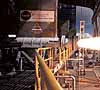
SpaceDev, the world’s first commercial space exploration company, has acquired exclusive rights to intellectual property including the three patents originally issued to American Rocket Company (Amroc) for their hybrid rocket motor technology.
In addition, SpaceDev has acquired exclusive possession of and access to a
large quantity of Amroc engineering documents, plans, designs, test
results, manufacturing data, and other materials related to the rocket
motors and Amroc launch vehicles.
“We believe this technology could be useful in a wide variety of
commercial launch vehicle applications,” said Jim Benson, president and
chairman of SpaceDev. “Hybrid rocket technology is relatively simple,
environmentally cleaner than most propulsion systems, non-explosive and
less expensive to manufacture. Furthermore, it is easily transported,
throttleable, restartable, and scalable.”
Benson noted that hybrid rocket technology has many potential markets,
some of which could be internally useful to SpaceDev and its subsidiaries
in the future, and some of which could become products for sale to
commercial and government customers.
Hybrid rocket motor products could include: small and large boosters for
use in sounding rocket applications, university class satellite launches
and LEO constellation launches; boosters for sale as main propulsion
systems for external customers; strap-ons for expendable and reusable
launch vehicles; smaller specialized motors for use in upper stages; and
for complete launch systems.
Integrated Space Systems (ISS), a wholly owned subsidiary of SpaceDev,
spent several months studying and analyzing original Amroc engineering and
test result documents. The documents were generated from years of Amroc
testing and improvements, and rocket motor test firings. ISS engineers
concluded that Amroc had done excellent engineering, and had brought the
technology close to commercial viability.
“Hybrid rockets combine a liquid oxidizer and solid fuel (therefore
hybrid) into a rocket motor,” said Phil Smith, Chief Operating Officer
of SpaceDev. “Because rocket motors or engines form a large part of the
total cost of any launch vehicle, controlling this fundamental underlying
technology could be key to developing low cost launch systems.”
In the agreement, SpaceDev is granted the exclusive world wide license
rights for the technology for a minimum of five years. If SpaceDev is
successful in developing a commercial market for the hybrid rocket
technology, it will have the rights to purchase the technology over the
next five years in exchange for discounted warrants for the purchase of
SpaceDev common stock. The warrants would be issued in relation to sales
of the rocket technology and the maximum dilution will not exceed three
million shares. If SpaceDev is not successful in developing a commercial
market for the technology, the company will return the technology and have
no further obligation for the issuance of additional warrants.
Mr. Benson added, “The agreement is extremely fair for both SpaceDev and
the owner of the technology as it allows for both to share in the success
of the technology as may be further developed and marketed by SpaceDev.”
SpaceDev, the world’s first commercial space exploration and development
company, intends to launch the first privately financed spacecraft to land
on another planetary body. SpaceDev is offering for sale rides for
scientific instruments to governments and companies to transport their
instruments and experiments through deep space to a near Earth asteroid.
SpaceDev intends to sell the data acquired by its instruments as
commercial products. Colorado-based SpaceDev has offices in San Diego, CA
and Washington, DC.
FYI
The foregoing press release includes numerous forward-looking statements
concerning the company’s business and future prospects and other similar
statements that do not concern matters of historical fact. The federal
securities laws provide a limited “safe harbor” for certain
forward-looking statements. Forward-looking statements in this press
release relating to product development, business prospects and
development of a commercial market for technological advances are based on
the company’s current expectations. The company’s current expectations
are subject to all of the uncertainties and risks customarily associated
with new business ventures including, but not limited to, market
conditions, successful product development and acceptance, competition and
overall economic conditions, as well as the risk of adverse regulatory
actions. The company’s actual results may differ materially from current
expectations. Readers are cautioned not to put undue reliance on
forward-looking statements. The company disclaims any intent or
obligation to update publicly these forward-looking statements, whether as
a result of new information, future events or for any other reason.
