
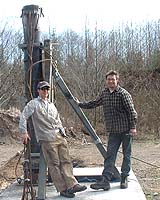
At their Forks, Washington facility, Space Transport Corporation (STC) successfully tested the 12-inch-diameter solid-propellant rocket engine for their Suborbital Tourism Vehicle (STV). The STV will be used in the $10 million X PRIZE competition.
The engine, developed by STC, tipped the scales at the expected 12,000 pounds of force during the 14-second static test event. The test proved the integrity of the solid propellant grain and the ability of the engine casing/insulation to withstand nominal operating conditions.
The divergent portion of the nozzle was fractured near the end of the engine burn. STC will make the appropriate nozzle improvement and proceed with STV flight plans.
After some trials to perfect the engine manufacturing procedure, STC is thrilled with this result and is enthusiastic about the next phase of the quest to develop the Suborbital Tourism Vehicle (STV), which is designed to take three passengers to 100 km (62 mile) altitude and return them safely to earth. The next step in development of this vehicle is an unmanned flight in May.
Space Transport Corporation develops launch vehicle technologies using a practical test-oriented approach. Three vehicles are under development by STC: a Three-Stage Rocket, a Suborbital Tourism Vehicle, and a Nano-Satellite Launch Vehicle (N-SOLV).
STC will contend for the X Prize with the Suborbital Tourism Vehicle. With the Three-Stage Rocket and N-SOLV, STC plans to offer launch services to universities, research groups, and private individuals.
Eric Meier and Phillip Storm are the driving force behind STC, a company with an initial goal of demonstrating low-cost missions to space. Storm and Meier are trained engineers, but also act as managers, technicians and receptionists at the two-employee company.
Though a few additional employees will be required in the future, STC will maintain focus on simplicity of design and business operations to control costs.
