
A Russian and US astronaut aboard the International Space Station (ISS) shifted their Soyuz space vessel to a new mooring Monday to free up docking space for the arrival of Brazil’s first man in space, the Russian Space Agency said.
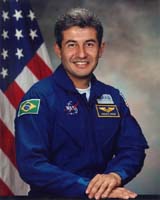
Marcos Pontes will arrive April 1 on a nine-day mission accompanied by Russian astronaut Pavel Vinogradov and US astronaut Jeffrey Williams, the last two to remain for the 13th long-term mission aboard the ISS.
The redocking manoeuvre was carried out by Russian Valery Tokarev and his American partner William MacArthur, who uncoupled the Soyuz TMA-7 from the space station, which is currently unmanned, and moved it 35 metres (yards) to the Zvezda module where the astronauts are berthed.
“The operation was carried out manually with considerable precision,” said a Russian Space Agency spokesman. “Thanks to the astronauts’ professionalism it took only 22 minutes instead of the planned 34 minutes,” he said.
Pontes, Williams and Vinogradov left the Star City space centre near Moscow on Saturday for the space launch base at Baikonur in the central Asian republic of Kazakhstan.
They were scheduled for lift-off on March 30 aboard a Russian-made Soyuz TMA-8 spacecraft. Docking with the ISS was set for two days later.
Pontes will return to earth on April 9 with the team of the previous mission Tokarev and MacArthur, who have been aboard the ISS since last October.
The first European to embark on a long (six-month) mission to the International Space Station (ISS) will be Germany’s Thomas Reiter, scheduled for arrival in May.
Until now, only Russian and American astronauts have undertaken long-term missions aboard the station.
Europeans have been on only 12-day sorties to replace equipment aboard the station.
Source: Agence France-Presse
