
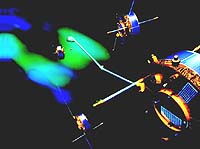
Two European satellites that will study the weather in space were put into orbit Sunday following a 24 hour delay, the European Space Agency (ESA) said.
A Soyuz rocket put the Cluster II satellites ‘Salsa’ and ‘Samba’ into orbit after launching from the Baikonur cosmodrome in Kazakhstan at 6:39 p.m. (1239 GMT), the ESA announced in Paris headquarters.
The original launch on Saturday was called off just 15 seconds before blastoff when experts found humidity in the rocket’s cable housing affecting an engine. The launch was carried out by the French-Russian company Starsem for the ESA.
A second launch scheduled for August 9 will place in orbit a second pair of satellites, called ‘Rumba’ and ‘Tango.’
The four satellites will carry out a two-year study on the complex interaction between the Sun and Earth, collecting data on geomagnetic storms caused by solar flares, which can knock out electronics on communications or weather satellites.
The 1.2 tonne satellites will transmit one gigabyte (two compact disks) of data per day from the end of December to help scientists more accurately forecast magnetic storms in space.
The Soyuz rocket launch would be the ninth carried out by Starsem, which was set up in 1996 to market Russian Soyuz rockets on the highly competitive world satellite launching market.
The original Cluster satellites were destroyed in 1996 when an Ariane rocket carrying them blew up just after launch. But the ESA decided to persevere with the troubled project, tipped as a groundbreaking mission.
According to ESA, for the first time four satellites will fly in close formation above the Earth’s poles, studying the magnetic field around our planet and its continual battle with the energetic particles of the solar wind.
The magnetosphere protects the Earth from electron, proton and ion particles fired from the Sun. But some reach the atmosphere causing electric storms that can affect communications networks and knock out satellites. They can also influence the climate over the long term.
The project aims to explore the magnetosphere and provide the first small-scale, three-dimensional “map” of near-Earth space. The project is one of the cornerstones of the ESA’s Horizons 2000 science programme.
Each satellite includes 11 instruments which will provide unique three dimensional images of the magnetosphere and its interactions with solar wind.
The satellites were manufactured by about 60 European institutes and industrial groups under the control of Dornier (DASA/DeutscheChrysler Aerospace), which last year became Astrium after its fusion with Matra Marconi Space (MMS).
Cluster Instrument Sites
