
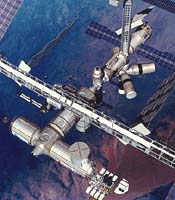
A Soyuz spacecraft carrying a three-man international crew docked at the International Space Station early Sunday, two days after its launch, Russia’s mission control said.
It said the docking operation was done on schedule at 0219 GMT and the crew — Russian cosmonaut Sergei Krikalev, John Phillips of the United States and Italian Roberto Vittori — afterwards opened the hatch and entered the space station.
The Soyuz TMA-6 blasted off Friday from the Russian space base at Baikonur in the former Soviet republic of Kazakhstan.
Krikalev, who is to be the commander of the new ISS team, and Phillips, the expedition’s flight engineer, are scheduled to remain at the space station for almost six months.
Vittori is to return to Kazakhstan on April 24 along with the current ISS crew, Russia’s Salizhan Sharipov and American Leroy Chiao, who arrived at the space station in October.
During his 10-day mission, Vittori is carry out experiments in the fields of human physiology, biology, technology and education.
Over the next six months, the crew are to receive the American space shuttle Discovery, which is due to blast off between May 15 and June 3 after a two-year break in operations that followed the disaster that killed seven astronauts on the shuttle Columbia on February 1, 2003.
Russia plans 10-year space program
Meanwhile, Russia’s space agency has presented to the country’s parliament an $11 billion space program covering the next 10 years, local media reported.
Anatoly Perminov, head of the Russian space agency, also known as Roskosmos, was quoted by the ITAR-TASS news agency as saying 305 billion rubles or $11 billion (U.S.) will be needed to implement the Federal Space Program for 2006-2015.
Martin Shakkum, chairman of the Duma’s committee for industry, construction and high technologies, said the committee recommended the government allocate no less than 24.4 billion rubles or $900 million for the program in next year’s federal budget, ITAR-TASS reported.
The space program will provide communications and satellite technology to monitor earthquakes, natural disasters, ice conditions and industrial accidents. Also included in the spending plan is Russia’s financial commitment to the International Space Station, he said.
The space program makes up about 1 percent of the Russian national budget.
