
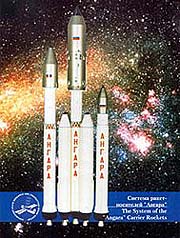
South Korea plans to build and test 10 launch vehicles derived from Russia’s Angara boosters, the Korean Aerospace Research Institute reported Tuesday.
According to Cho Hwan He, head of the launch vehicle development team at KARI, South Korea will develop rocket technology in three stages. Stage One will provide for construction of the KSLV-1 (Korea Space Launch Vehicle) booster, that will feature 80% commonality with the Angara developed by the Khrunichev State Space Research and Production Center.
The launch vehicle will be used to loft a satellite weighing up to 100 kg into low-Earth orbit (LEO).
According to He, up to 10 launch vehicles will be made, two of which will be used for launch tests, one for a micro-satellite launch, and the remained for “testing of their disposal on the ground,” he said.
Stage Two provides for developing the KSLV-2 booster by 2010, to boost a payload weighing up to one metric tonne, and by 2015 developing the KSLV-3 which will be capable of lifting a 1.5-tonne satellite onboard.
Longterm He says it is the the KSLV-3 that matters most to Korea. And that he believes 100-kg micro satellites are of little use and would be insufficient to ensure the competitiveness of the Korean space industry.
To orbit satellites in cooperation with Russia, South Korea has been building a space center, and a launching facility at Venarodo Island, in the sea between Korea and Japan.
South Korea has been operating a number of space programs since 1996. One recently announced program calls for greater cooperation with Russia, and will see the first South Korean cosmonaut trained by 2007 for a flight aboard the Soyuz spacecraft to the International Space Station.
