
New observations with space-borne instruments by Daniel Rosenfeld of the Hebrew University of Jerusalem showing aerosols over land can modify clouds, suppress precipitation and reflect light is a “huge leap forward” in understanding the interplay between pollutants, clouds and greenhouse warming, said University of Colorado Professor Owen B. Toon.
A professor in CU-Boulder’s Laboratory for Atmospheric and Space Physics, Toon authored a perspective article in the March 10 issue of Science magazine tied to a research paper by Rosenfeld in the same Science issue on his new findings.
Rosenfeld’s research shows that aerosol particulates from urban and industrial areas modify clouds over large land areas, suppress rain and snow and are responsible for reflecting significant of amounts of sunlight back to space.
Toon, who has studied similar modification of clouds over the ocean and their effects, said aerosol particulates in the atmosphere are reflecting sunlight back into space, directly cooling Earth.
The new findings by Rosenfeld are more evidence that aerosol-cloud processes may be diluting and perhaps even canceling out greenhouse warming, Toon said.
Unlike greenhouse gases — which stay in the atmosphere for long periods and are fairly evenly distributed — aerosols are more concentrated near their sources and variable in space and time, making it difficult to quantify their impacts.
“But their cooling effect may be as large as the warming effect creating by humans pumping greenhouse gases into the atmosphere during the last century,” said Toon, also a professor in CU-Boulder’s Program for Atmospheric and Ocean Sciences.
“Computer models could not explain the lack of warming that had been predicted because they were overlooking the opposing forces due to aerosol pollution,” Toon said.
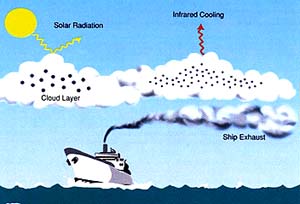
In the 1980s, long, bright lines in ocean clouds seen from the air were determined to be the tracks of ships, which were sending exhaust into the atmosphere, including low-lying cloud decks.
Because the particulates triggered new cloud formation and redistributed water in existing clouds, they became brighter and more reflective, Toon said.
In 1998, Rosenfeld detected similar “pollution tracks” over land areas of Earth for the first time. “We had known that aerosol particulates emitted by ships can trigger changes in clouds and even their formation over the ocean,” said Toon.
“What Rosenfeld has done in his latest paper is to use satellite data to demonstrate a clear, widespread influence of aerosol pollution on continental precipitation.”
