
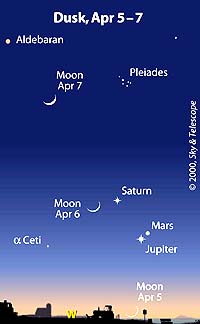
All five naked-eye planets – Mercury, Venus, Mars, Jupiter, and Saturn – plus the moon gather around the sun on May 5 in a relatively compact grouping. The same planets and the sun (but not the moon) form an even more compact grouping twelve days later on May 17.
Although unusual from a statistical standpoint, the planetary gatherings cannot be seen and will have no effect on the earth.
The planets are always in motion, and from time to time one passes another or several gather into a compact grouping. Because the sun is part of these particular groupings, the planets cannot be seen in May, and the main feature is the novelty of the event. The planets were last this close in February, 1962, and they will not be this close again until the year 2675.
Some sensationalist writers and talk-show guests claim that planetary groupings have an effect on the earth through tidal or “unknown” forces and that such groupings trigger disasters on earth.
The tidal forces are well understood and are negligible, and the earth has a history of surviving planetary alignments unscathed. Previous planetary groupings in 1962, 1982, and 1988 – all of which were accompanied by predictions of doom and gloom – had no effect whatsoever.
Planetary gatherings is the topic of the current planetarium show, “Cosmic Catastrophe.” The show evaluates the claim that planetary alignments cause disasters, shows how the planets move around the sky, looks at the alignments in May, and concludes with a preview of a future planetary alignment we will be able to see. “Cosmic Catastrophe” is presented daily except Mondays through May 21.

