
Last Friday (November 19) at 10:58 UTC, SMART-1 passed its second perilune and successfully completed its first orbit around the Moon. The first orbit started on 15 November at 17:47 UTC when SMART-1 passed its first perilune.
The next perilunae will occur with increasingly shorter intervals as the orbital period of the spacecraft continuously decreases. This is due to the thrust provided by the electric propulsion system, which is used to reduce the semi-major axis of the orbit.
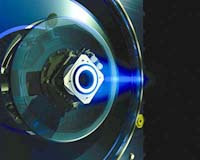
The first firing of the electric propulsion engine started on 15 November at 05:23 UTC and the engine has performed flawlessly since. It will remain on until 17:48 UTC today, providing a total thrust time of 108 hours.
Eclipse period
Another important event in the near future is a fairly long eclipse caused by the satellite crossing the Moon’s umbra for 1 hour and 50 minutes on 22 November starting at 08:52 UTC. The spacecraft has proved, during the transfer orbit, to be able to withstand even longer eclipses. However, since the batteries have not been discharged for that long since many months, the ESOC flight control team and the ESTEC and industry specialists will closely follow the event.
The final orbital elements are said by ESA to be extremely close to the calculated elements of the planned orbit. This accurate prediction is evidence of both the good performance of the electric propulsion engine (about 1% above nominal) and the accuracy of the trajectory calculation by the flight dynamics team.
