
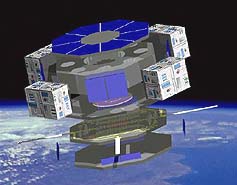
A critical moment for the smallest satellite pair ever launched will occur Sunday when they are released by a “mother” satellite over Menlo Park, Calif., and engineers from The Aerospace Corporation attempt to establish contact with them.
The tethered pair of “picosatellites,” designed by The Aerospace
Corporation under a project funded by the MEMS (microelectromechanical
systems) Technology Office of the Defense Advanced Research Projects
Agency (DARPA), were launched Wednesday from Vandenberg Air Force Base,
Calif., aboard a new Air Force booster for small satellites.
The tiny
DARPA/Aerospace Corp. satellites are the smallest such satellites with
active capabilities ever to be launched.
Each of the DARPA/Aerospace Corp. picosats is smaller than a deck of
cards and weighs less than one-half pound. These picosats are platforms
for validating MEMS and also will demonstrate how mass-produced
nanosatellites will operate in constellations in the future.
For satellites of this size, the DARPA/Aerospace Corp. picosats have
unprecedented features and capabilities. For example, in addition to
validating MEMS technology, they are able to communicate with each other
and a third picosatellite at the ground station, as well demonstrate the
principles of miniature satellites flying in a constellation. Another
distinctive feature is the use of patch antennas which allow for
omnidirectional signals between the picosats and limit the “envelope” of
space they occupy.
They were housed in the OPAL mother satellite built by Stanford
University students and taken aloft by a converted Air Force Minuteman
II ballistic missile. The historic mission thus combines proven missile
technology with pioneering satellite technology. The booster is formally
called the Orbital Suborbital Program Space Launch Vehicle. It combines
rocket motors from the Minuteman II and Pegasus XL launch vehicles.
Minotaur is the booster¿s informal name.
OPAL, which stands for Orbiting Picosat Automated Launcher, was one of
several small satellites aboard the OSP/Minotaur launch vehicle. OPAL
carries a total of six picosats, four built by students and amateur
space enthusiasts. OPAL is being tracked by the US Space Command’s Space
Surveillance Network based at Colorado Springs.
After the OPAL orbit is precisely determined and the satellite is over
the ground station operated by SRI International at Menlo Park,
engineers from The Aerospace Corporation will request that student
operators at Stanford¿s Space Systems Development Laboratory transmit a
command to eject the DARPA/Aerospace Corp. picosats.
Meanwhile A team of engineers from The Aerospace Corporation visited Stanford Thursday to assist students in troubleshooting procedures and set up for communicating with OPAL.
Team leader Steve Hast said that because OPAL
was in “a slightly different orbit than predicted,” release of the
picosats will be delayed. They originally planned for a release of the
DARPA/Aerospace Corp. picosats from OPAL Saturday evening with the
ejection of four student-built picosats to follow.
Because OPAL is a “tumbler,” that is, has no attitude control, it is
uncertain in which direction the DARPA/Aerospace Corp. picosats will be
ejected at the time of release either Sunday morning or evening. This is
where support provided by the Space Surveillance Network is crucial.
The network will track the DARPA/Aerospace Corp.
picosats with the help
of thin gold strands inserted in the tether that will keep the two
picosats close enough to communicate via a micropower radio. The gold
strands will help make the satellites locatable by radar.
The radios
were designed by Rockwell Science Center, Thousand Oaks, Calif., with
funding by DARPA and in collaboration with UCLA. They are based on
digital cordless telephone technology.
When the DARPA/Aerospace Corp. satellites are released from OPAL they
will begin transmitting a beacon signal that Aerospace engineers at the
Menlo Park ground station will attempt to pick up with a 50-meter dish.
Distinguished Engineer Ernest Y. Robinson of The Aerospace Corporation
said Space Surveillance Network tracking of these picosatellites is
important, “because they are a harbinger of emerging technology
associated with all kinds of fully functional miniature satellites
(which will present tracking challenges).”
Robinson said he was “elated” at the OSP/Minotaur launch Wednesday
because this increases the probability that a second launch of the
OSP/Minotaur booster carrying an Air Force MightySat 2.1 satellite and
planned for mid-June will go on schedule.
MightySat 2.1 will carry picosats designed by The Aerospace Corporation
that are similar to the ones aboard the OPAL satellite. But with the
more sophisticated MightySat 2.1 satellite built by the Air Force
Research Laboratory at Kirtland AFB, New Mexico, an important
demonstration of the capability of storing miniature satellites for
later release on command will be possible.
A key feature of the picosats and of planned mass-producible
nanosatellites is the use of MEMS for miniature integrated space systems.
The Aerospace Corporation and other organizations have already
experimented with MEMS in space. The corporation assembled a package of
30 MEMS devices¿such as microthrusters, gyros, and accelerometers¿for
flight on the shuttle Columbia (STS-93), which returned them from space
last July.
The Aerospace Corporation has been heavily involved in research into
miniature satellites for a number of years and formally advanced the
concept of nanosatellites at the 44th International Astronautical
Federation Congress in Graz, Austria, in 1993.
