
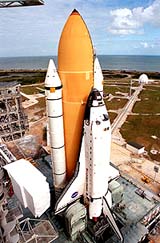
As the Space Shuttle lifts off to on a mission to activate the long-awaited International Space Station (ISS), the Space Frontier Foundation today calls for a re-examination of the idea of making space stations out of the External Tanks that are thrown away during Shuttle missions.
“As the Shuttle ascends to orbit today to work on a space station built to hold four or so people, it will throw away the equivalent of a small office building,” said Foundation President Rick N. Tumlinson.
“This will be the 99th of these giant structures to be wasted. Ironically, instead of there just being Mir and the infant ISS in space, there could have been 99 active space platforms by now. And it could have been done through recycling.”
The 10-story tall Space Shuttle External Tanks (ETs) are currently flown to over 95% of orbital velocity and then deliberately re-entered to burn up in the atmosphere, as NASA has no plan for their use.
However, the concept of taking the ETs all the way into orbit and using them in space has been around since the mid-1970s.
Interest in the scientific and technical community grew to the point where the National Commission on Space in 1986, Congress in 1987 and 1988, and President Reagan in 1988 directed NASA to make the ETs available to entrepreneurs in the late 1980s.
NASA signed Memoranda of Understanding in 1987, 1989, 1992 to provide ETs to the External Tanks Corporation (ETCO) of Boulder CO and Global Outpost Inc. of Las Cruces, NM.
“An ET-based platform was even proposed as a low-cost alternative to the current ISS in 1993,” said Foundation ET Applications Project Manager Alex Gimarc, author of one of the seminal studies on the subject for the Space Studies Institute (SSI).
“The ET offers unique opportunities for orbital applications, and after a few years of relative quiet, the concept is back as a low cost way to fly large commercial platforms in space. After all, isn’t the goal of NASA to encourage the use of space beyond its own airlocks?”
