
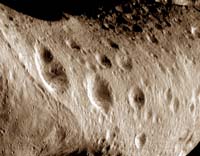
The true nature of Eros becomes a bit clearer — literally — as NEAR Shoemaker moves into a lower orbit this weekend.
Shortly after 9 p.m. (EST) on Saturday, April 1, the spacecraft will fire its thrusters for about 40 seconds and begin gradually descending into position to start a 62-mile (100-kilometer) orbit on April 11.
Since March 3, NEAR Shoemaker has been in a nearly circular orbit some 127 miles (205 kilometers) from the center of Eros. NEAR team members say halving the spacecraft’s distance to the rotating space rock will yield sharper images of the abundant geological features on the asteroid’s surface, giving them a chance to learn more about the relationship between the many ridges, grooves and craters.
Earlier than expected, the team is also gathering information on the asteroid’s elemental makeup. With the help of three solar flares on March 22 and 23, the spacecraft’s X-Ray/Gamma Ray Spectrometer (XGRS) picked up additional fluorescent “signatures” of magnesium, aluminum, silicon, calcium and iron on the Eros surface.
The readings were similar to those the XGRS detected during a solar flare on March 2 — from four times the distance the instrument is designed to operate.
“From that distance, the readings verify that the instrument has the sensitivity we need,” says Dr. Jacob Trombka, XGRS instrument team leader from NASA’s Goddard Space Flight Center. “They continue to show us that the calibration is on target and the instrument is working as it should.”
NEAR Shoemaker is about 135 million miles (218 million kilometers) from Earth, moving 3 miles an hour around Eros. The spacecraft is six weeks into its historic, yearlong mission to study the asteroid.
