
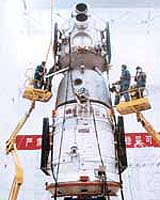
The historic manned mission Shenzhou-5 (SZ-5) is another step closer to blastoff with the arrival of its launch vehicle at the launch site, Wen Wei Po in Hong Kong reports today (Aug. 25).
After passing all rigorous testing, inspection and reexamination, the Changzheng-2F (Long March-2F) launcher left its manufacturer, the Chinese Academy of Launch Vehicle Technology (CALT) in here last week.
The launcher travelled non-stop on an express train first to a location near Jiuquan in the northwestern Gansu Province. The train then proceeded to the Jiuquan Satellite Launch Centre (JSLC) on the Dingxin Railway, the only military-operated railroad in China.
The newspaper reports that launch preparation personnel has also arrived at the same time.
At JSLC, launch preparation teams have begun the integration of the CZ-2F launcher and the SZ-5 spacecraft (Shenzhou means “Magic Vessel” or “Divine Vessel”) at the huge Vertical Assembly and Testing Building (VATB).
The stacking, testing and rollout of CZ-2F will all take place in a vertical fashion. This is unlike other Chinese launch facilities, which process launch vehicles horizontally.
The 100-meter tall VATB is the Chinese equivalent to the Vehicle Assembly Building at the Kennedy Space Center in the U.S.
When the stacked CZ-2F with SZ-5 aboard is ready to launch, a massive transport platform will move the launcher from VATB to the launch pad.
The transport platform will crawl slowly on a 20-meter wide track from the assembly building to the launch pad, which is 1.5 km away.
There has been no official announcement of the SZ-5 launch date. Unconfirmed information from the Xi’an Satellite Control Centre (XSCC) in Shaanxi Province said that the single-person mission might see its launch on Oct. 10.
Wen Wei Po today quotes unidentified officials as saying that the working launch date falls within the week that immediately follows the weeklong celebration of the National Day on Oct. 1. However, the specific launch date will depend on various conditions around that time.
Meanwhile a Chinese space official told Beijing Times yesterday (Aug. 24) that the kind of launch preparation accident in Brazil would not happen in China.
The accident, which occurred on Saturday (Aug. 23) at the Alcantara Space Center, resulted in at least 21 deaths.
Long Lehao, Director of the CZ-3 series of rockets, said that all Changzheng launchers would have “double safety” installation, such as redundant systems in circuit connections and signal transmission, to ensure trouble-free launches.
According to Long when the primary system fails, the redundant system would immediately kick in to replace the function of the failed system so as to secure the ignition and launching of the rocket.
