
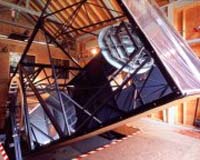
Workers are nearing completion of a new optical instrument that will be devoted exclusively to the search for extraterrestrial life. On the campus of Harvard University’s Oak Ridge Observatory, physicist Paul Horowitz and his team are building a 72-inch optical telescope outfitted with a special camera intended to search for artificial light signals from alien civilizations.
“We have been listening for alien signals for decades,” said Louis Friedman, executive director of The Planetary Society in Pasadena, Calif., which is funding the telescope. “It’s time we started to watch for signals as well.”
Optical SETI advocates argue that alien civilizations are at least as likely to use visible light signals for communicating as they are to use radio transmissions. Visible light travels easily through space, suffering little interference. A bright, tightly focused light beam, such as a laser, could shine 10 times brighter than the Sun and be observed at interstellar distances.
Unlike radio waves, laser-like light signals are unidirectional, making it possible to determine their source precisely. Because of their higher frequencies, light beams can send vast amounts of information. There also is a practical consideration. “Radio SETI requires large and expensive facilities; an optical SETI project is simpler and cheaper,” TPS said in a statement.
The structure and the telescope already are in place, and the electronic components and high- speed processors are nearing completion. Horowitz and his crew are now waiting for the installation of the custom-built 150 camera, which will be able to scan a wide swath of the night sky and record even the briefest of light signals. When fully operational, the new telescope will be the only large optical instrument in North America devoted to SETI, and the largest telescope east of the Mississippi River.
The instrument’s camera contains 32 computer chips with a combined data-processing rate of 3.5 terabits per second. Instead of using charge-coupled devices, Horowitz’s team is using an array of photo-multiplier tubes, which are about 1-million times more efficient at registering light than CCDs.
Since its establishment in 1980, by Friedman and the late astronomer Carl Sagan, TPS has funded SETI searches in the radio band of the electromagnetic spectrum, such as BETA and SERENDIP. The society also sponsored the SETI@home network, in which individuals volunteered the use of their idle computers to process incoming radio signals.
