
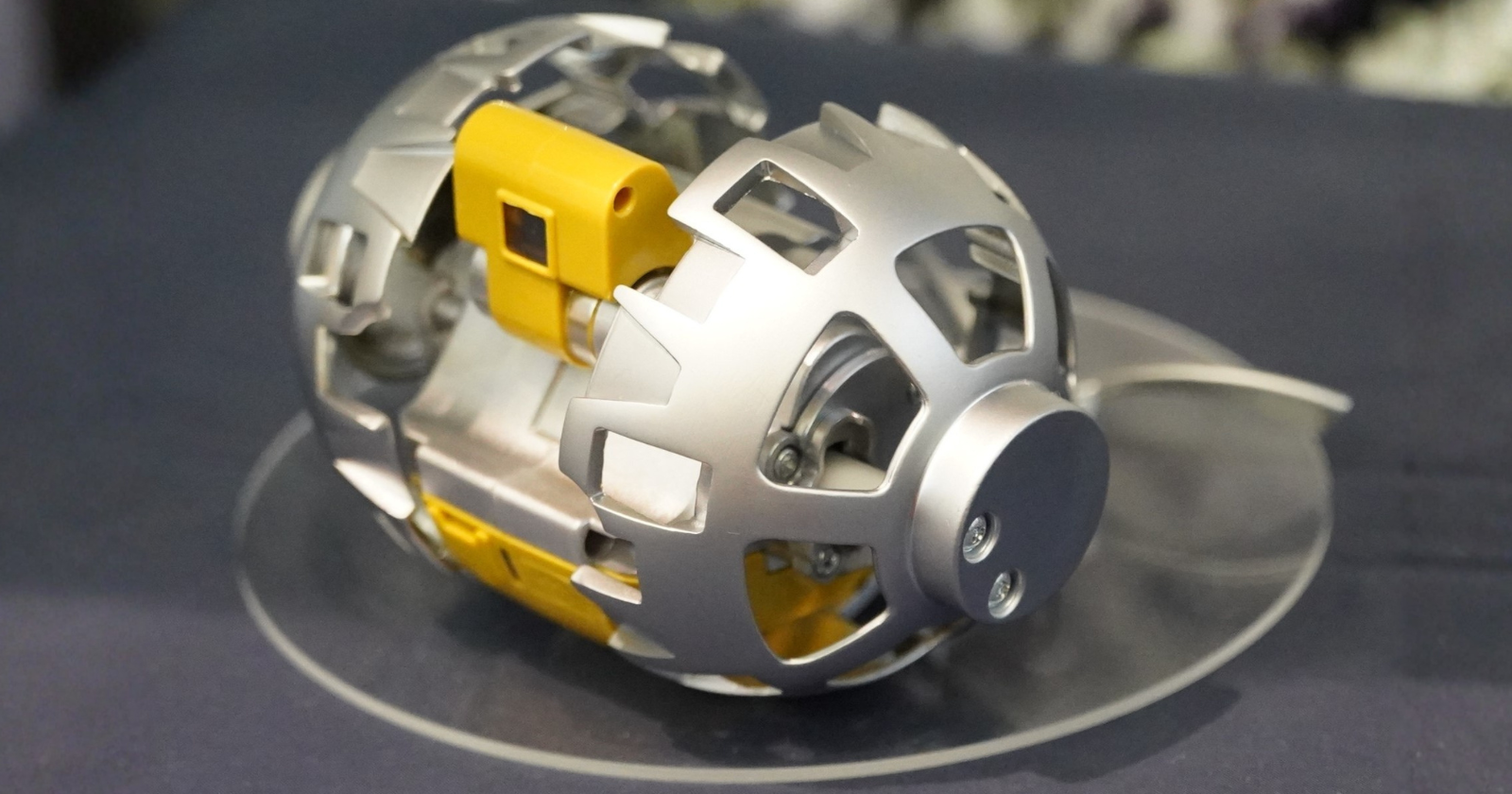
When JAXA engineers needed a self-deploying transformation mechanism small enough to survive the jolt of a lunar landing inside a metal sphere, they called Takara Tomy — the Japanese toy company behind the original 1984 Transformers line. The robot that came out of that collaboration, called SORA-Q, is eight centimeters across, weighs 250 grams, and spent roughly 100 minutes rolling across the Moon in January 2024. The full results of that mission, published in Science Robotics, suggest the future of planetary exploration may belong to swarms of tiny, cheap, autonomous machines working alongside larger spacecraft.
SORA-Q hitched a ride to the lunar surface aboard Japan’s Smart Lander for Investigating Moon (SLIM), which touched down on January 19, 2024, making Japan the fifth nation ever to soft-land on the Moon. What followed was an unusual experiment in miniaturization, autonomy, and — improbably — toy engineering.
A toy company’s quiet trip to deep space
SORA-Q is 8 centimeters across — about three inches — and weighs 250 grams. It was built by JAXA in partnership with Sony Group, Doshisha University in Kyoto, and Takara Tomy, the Japanese toy maker that produced the original 1984 Transformers line. The collaboration was not a marketing stunt. Takara Tomy’s decades of work on transforming mechanical toys gave the team a head start on the central engineering problem: how to fit a working rover inside a sphere small enough to survive the violent jolt of a lunar landing, then have it unfold itself into a functional vehicle without human help.
The result is a probe that arrived on the Moon as a metal ball, then split open into two hemispheres that act as wheels on either side of a central body, with a deployable camera mast and a small tail acting as a stabilizer. SORA-Q can move in two distinct gaits — a butterfly mode where both halves rotate together, and a crawl mode where they rotate independently to deal with inclines and rough terrain.
The name itself is a piece of marketing in miniature. Sora means universe in Japanese. The Q stands for question, quest, the Japanese word kyu (sphere), and the robot’s silhouette, which resembles the letter Q in the alphabet.
What actually happened on the lunar surface

SLIM landed near Shioli, a 270-meter-wide crater inside the larger 98-kilometer-wide Cyrillus crater, in the lunar region called Mare Nectaris. The landing was precise — JAXA had nicknamed SLIM the Moon Sniper for a reason — but not clean. A thruster failure during descent left the lander resting nose-down on the surface, with its solar panels facing the wrong way.
That awkward posture is how SORA-Q earned its keep. After being ejected just before touchdown, the little robot transformed, rolled clear, and used its onboard cameras to photograph SLIM in its compromised orientation. Those images helped JAXA engineers diagnose what had gone wrong with the lander and plan a power recovery once the sun angle shifted.
SORA-Q itself ran for about 100 minutes — 20 to 30 minutes short of its expected lifespan — before communications cut out, most likely because the battery on its relay partner, LEV-1, ran down. During that window it captured 12 high-resolution images of the surrounding terrain. Some of the data was lost in transmission, but enough came back to validate the core engineering claims.
Why two robots, not one
One of the more interesting findings concerns how the two small rovers worked together. SORA-Q did not talk to Earth directly. Instead, it relayed its data through LEV-1, a slightly larger hopping robot also deployed by SLIM. LEV-1 then beamed everything home.
This is a meaningful architectural choice. It means SORA-Q could carry less radio hardware, less power, and less mass, because it offloaded the hardest part of communication — punching a signal across roughly 240,000 miles of space — to a partner. The trade-off is dependence: when LEV-1 went quiet, SORA-Q effectively went deaf.
The mission showed that such platforms can serve as independent explorers, capable of accessing environments beyond the reach of a primary large spacecraft. Small rovers are not replacements for the Perseverance-class vehicles NASA sends to Mars. They are scouts, helpers, and pinch-hitters for the places larger machines cannot fit.
Why miniaturization matters now
The next decade of lunar exploration is going to involve a lot of cramped, dangerous places. NASA’s Artemis program is targeting the lunar south pole, where Shackleton Crater alone is 21 kilometers wide and 4.2 kilometers deep. Permanently shadowed craters there may hold water ice — the single most valuable resource for any sustained human presence on the Moon — but they are exactly the kind of terrain where a billion-dollar rover cannot safely go.
A swarm of expendable, transforming probes the size of a grapefruit looks very different in that context. They are cheap enough to lose. They are small enough to drop into a vent or roll down a crater wall. And because they are autonomous — SORA-Q used onboard image processing to avoid obstacles without any input from mission control — they can operate in places where communication delays or terrain blockage make remote piloting impractical.
The communications problem is itself a major focus of agency work. NASA-funded efforts are underway to deploy 4G and 5G cellular networks on the lunar surface, including a Nokia Bell Labs experiment to link a lander to a rover. If those networks come online, small rovers like SORA-Q gain something they currently lack: a persistent, high-bandwidth pipe back to Earth that does not depend on a single fragile relay partner running out of battery.
The buddy-cop model of planetary exploration
SORA-Q makes the case for a hybrid architecture that already has precedent. NASA’s Perseverance rover on Mars carried the Ingenuity helicopter, which operated for nearly three years and completed 72 flights before rotor blade damage grounded it in January 2024. That pairing — a heavy, instrument-rich primary vehicle plus a light, expendable scout — has become a template.
SORA-Q extends the template to the ground. A future mission could land a conventional rover and release a handful of small transforming probes to investigate specific features in parallel: a skylight into a lava tube, a boulder field, the floor of a permanently shadowed crater. Some of those probes would fail. Some would lose contact. Enough would return data to make the mission worth it.
This is also how Japan has tended to operate in deep space. JAXA’s Hayabusa missions to asteroids have repeatedly used small, dispersed landers — including the MINERVA hoppers and the European MASCOT probe — as supplements to the main spacecraft. The agency’s appetite for these smaller, riskier, technically inventive platforms shows up across its program, including in the surprises that emerged when Hayabusa2’s asteroid target turned out smaller and faster than expected.
What a toy company contributed that an aerospace prime could not
There is something worth pausing on in the SORA-Q origin story. JAXA did not approach Takara Tomy because it ran out of aerospace contractors. It approached them because the specific engineering problem — a robust, lightweight, self-deploying transformation mechanism — is something the toy industry has spent forty years solving on consumer budgets.
Toys have to be cheap, durable, and assembled at scale. They have to work the first time, every time, in the hands of children. The transforming mechanisms inside a Transformer figure are a kind of compressed industrial knowledge about hinges, joints, and cam-driven motion that aerospace firms simply do not have at the same level of refinement.
A toy version of SORA-Q is available for purchase in Japan. It rolls around a living room and takes pictures of cats. Its lunar twin, built with the same core mechanism, is now part of the ongoing story of planetary exploration.
The dividing line between a toy and a spacecraft, it turns out, is thinner than most people assume — and Japan has spent the last decade quietly figuring out how to walk along it.
