
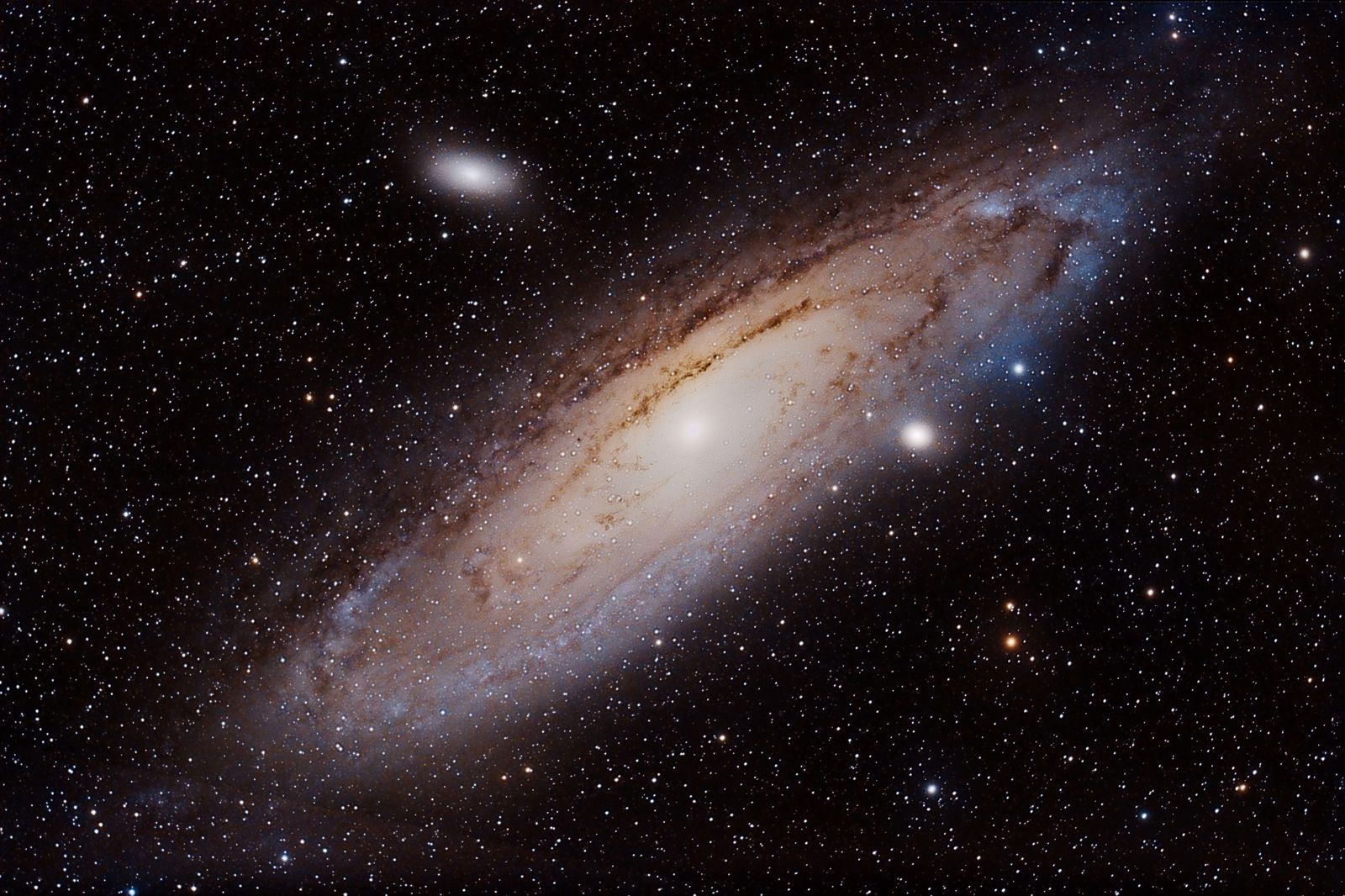
W2246f looks calm in exactly the place astronomers expected trouble.
The spiral galaxy sits about 1.2 billion light years from Earth, spans roughly 50,000 to 70,000 light years, and lies by chance in front of the far more famous WISE J224607.57−052635.0, the dust-obscured, hyperluminous galaxy at redshift 4.6. But the foreground galaxy has now become the stranger object in the frame.
Using the Multi-Unit Spectroscopic Explorer, or MUSE, on the European Southern Observatory’s Very Large Telescope, Evelyn J. Johnston and colleagues mapped W2246f region by region. Their May 2026 study found a galaxy whose central kiloparsec is old, quiet, and metal-poor, while the surrounding disk is still making stars.
That should not be the surprising part. Many galaxies age unevenly. The surprise is that W2246f shows no obvious scars of the kind of recent galactic violence often invoked to explain how spiral galaxies begin shutting down.
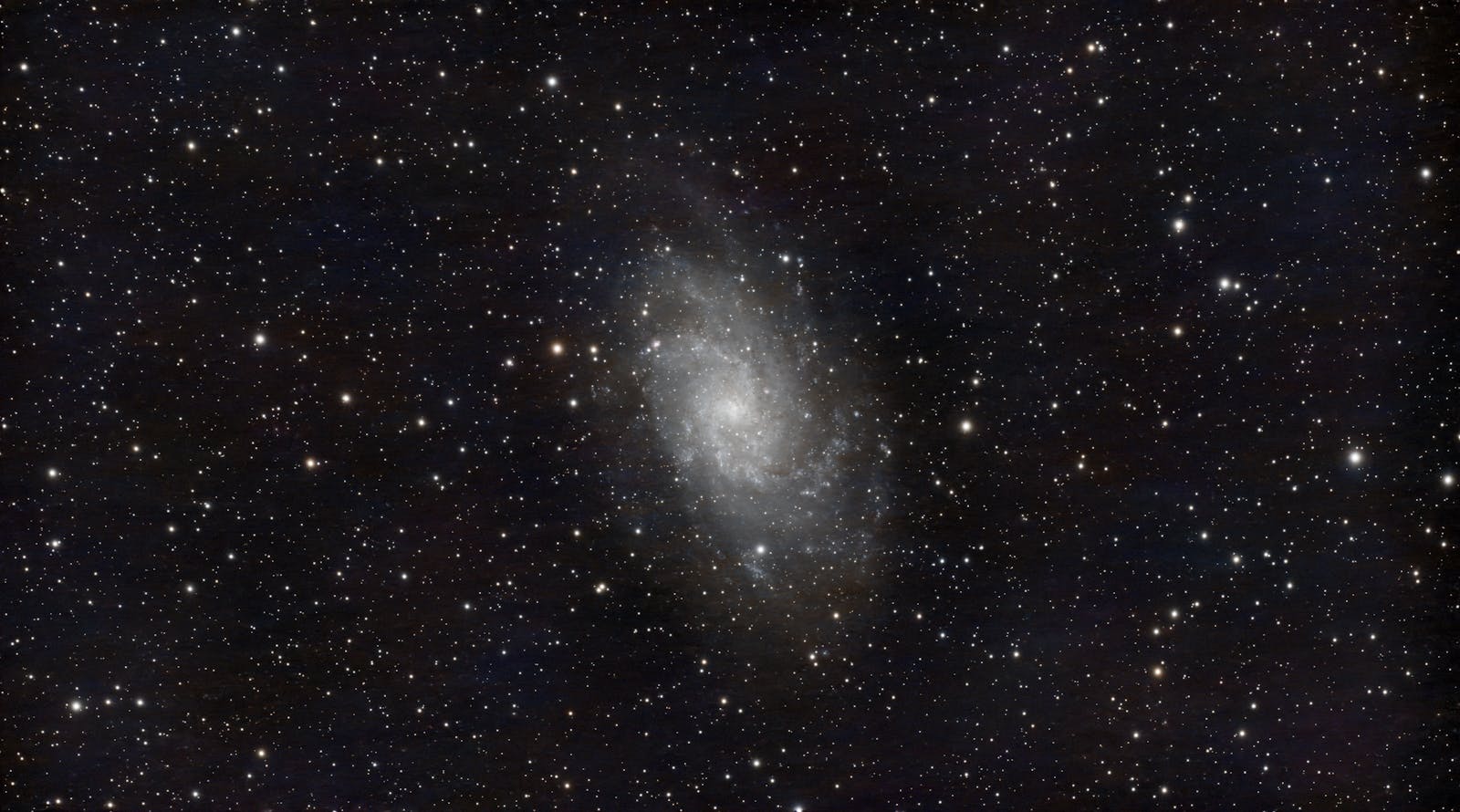
The calm galaxy in front of the monster
W2246f entered the data almost as an accident. The main target was WISE J224607.57−052635.0, also known as W2246−0526, a remote infrared-bright system whose light has traveled for about 12.5 billion years and which NASA described in 2015 as the most luminous galaxy then known.
That background object is anything but quiet. NASA’s Jet Propulsion Laboratory reported that it shines with more than 300 trillion suns, probably powered by a heavily obscured, rapidly feeding central black hole. A later Science study found evidence that it is assembling through a multiple merger at redshift 4.6.
W2246f is closer, less spectacular, and scientifically useful for the opposite reason. It is a foreground spiral galaxy with enough detail in the MUSE data to let astronomers separate its center from its disk, its old stars from its young ones, and its gas chemistry from its stellar history.
The observations were unusually deep for a galaxy at this distance. MUSE did not just produce a picture. It produced a datacube, with spectral information across the galaxy, so the team could read motions, emission lines, stellar ages, metallicities, dust extinction, oxygen abundance, and star-formation patterns across the disk.
The old center and the living disk
The central kiloparsec of W2246f is dominated by old, metal-poor stars and shows little ongoing star formation. The disk around it is still forming stars.
That split matches the class astronomers call a central low-ionization emission-line region galaxy, or cLIER galaxy. In these systems, the central low-ionization emission is not mainly powered by hot young stars, and it is not necessarily the signature of a blazing active galactic nucleus.
In W2246f, the Johnston team concluded that the central emission is primarily powered by hot evolved post-asymptotic giant branch stars, an elderly stellar population left behind after strong star formation has faded. The rest of the disk, by contrast, still carries the spectral signature of ongoing star birth.
This is why the galaxy matters. It appears to be a clean example of inside-out quenching, the process in which star formation shuts down first in the center of a galaxy and only later, sometimes much later, across the wider disk.
What MUSE did not find
The striking result is negative evidence. The team found no obvious distortion in W2246f’s visual morphology, stellar kinematics, or gas kinematics.
That lack of disturbance suggests W2246f has probably not undergone a significant interaction within the last billion years. There are no obvious tidal scars doing the explanatory work, no warped disk demanding a recent collision, and no clear sign that a companion galaxy recently stirred the system into its present state.
This matters because galaxy mergers are one of the standard dramatic routes to quenching. A collision can drive gas inward, spark a central burst of star formation, feed a black hole, heat or expel gas, and leave behind a system that stops making stars.
W2246f looks like a quieter case. The paper finds that the galaxy built most of its stellar mass about 6 to 7 billion years ago, while its present-day center has largely retired and its disk has not.
The result does not prove that mergers are unimportant. It does show that a spiral galaxy can carry a strong center-disk age contrast without the obvious wreckage of a recent merger.
A galaxy aging from the inside out
The chemistry reinforces the picture. W2246f’s stellar populations show evidence of an old central region, while the gas metallicity and star-formation-rate density drop in the same inner zone where the older luminosity-weighted stars are found.
That combination is what makes the galaxy more than a pretty foreground object. The center looks retired. The disk looks alive. The whole system looks structurally calm.
Astronomers use the term “retired” for regions where the emission lines are powered mainly by old stellar populations rather than by young massive stars. W2246f’s center fits that description, while its disk remains on the star-forming side of the diagnostic diagrams used in the study.
The team’s conclusion is careful rather than theatrical. W2246f is consistent with inside-out quenching, not with a recently disturbed spiral whose present state can be blamed on an obvious external trigger.
Why the quiet route matters
Quiet quenching is harder to see than violent quenching. A merger leaves streams, asymmetries, shells, warped gas, and other visible messes. Secular evolution, driven by internal structure and long-term gas supply, leaves subtler gradients in age, chemistry, and ionization.
That is why integral-field spectroscopy has become so important. Instruments such as MUSE and large galaxy surveys using spatially resolved spectra allow astronomers to stop treating a galaxy as one blended light source and start reading it as a set of neighborhoods.
The same wider field is being reshaped at both ends of cosmic time. Nearby Webb and Hubble work on nearly 9,000 star clusters in four galaxies has shown how massive clusters clear their birth clouds quickly, while NASA has separately reported a Webb case in which a roughly 50-million-solar-mass black hole appears to make up at least two-thirds of the mass of the early object QSO1.
Those early-universe findings show how fast galaxies and black holes can grow. W2246f shows the slower end of the story, after most of the stars are already in place and the remaining question is how a spiral fades without being visibly torn apart.
The lingering puzzle
W2246f is not important because it is the biggest, brightest, or most distant galaxy in the field. It is important because it is ordinary-looking in a way that makes the physics harder.
A violent merger would have been an easy story. A warped disk, a tidal tail, or a blazing nucleus would have given astronomers a culprit. Instead, the galaxy offers an old central kiloparsec, a living star-forming disk, and no obvious recent collision to blame.
For now, it sits in the foreground of a much louder cosmic object, quietly carrying the evidence of a slower transformation. Its center has aged first. Its outer disk is still lit by new stars. Between them is the part of galaxy evolution that does not explode, collide, or announce itself, but still changes the fate of the whole system.
