
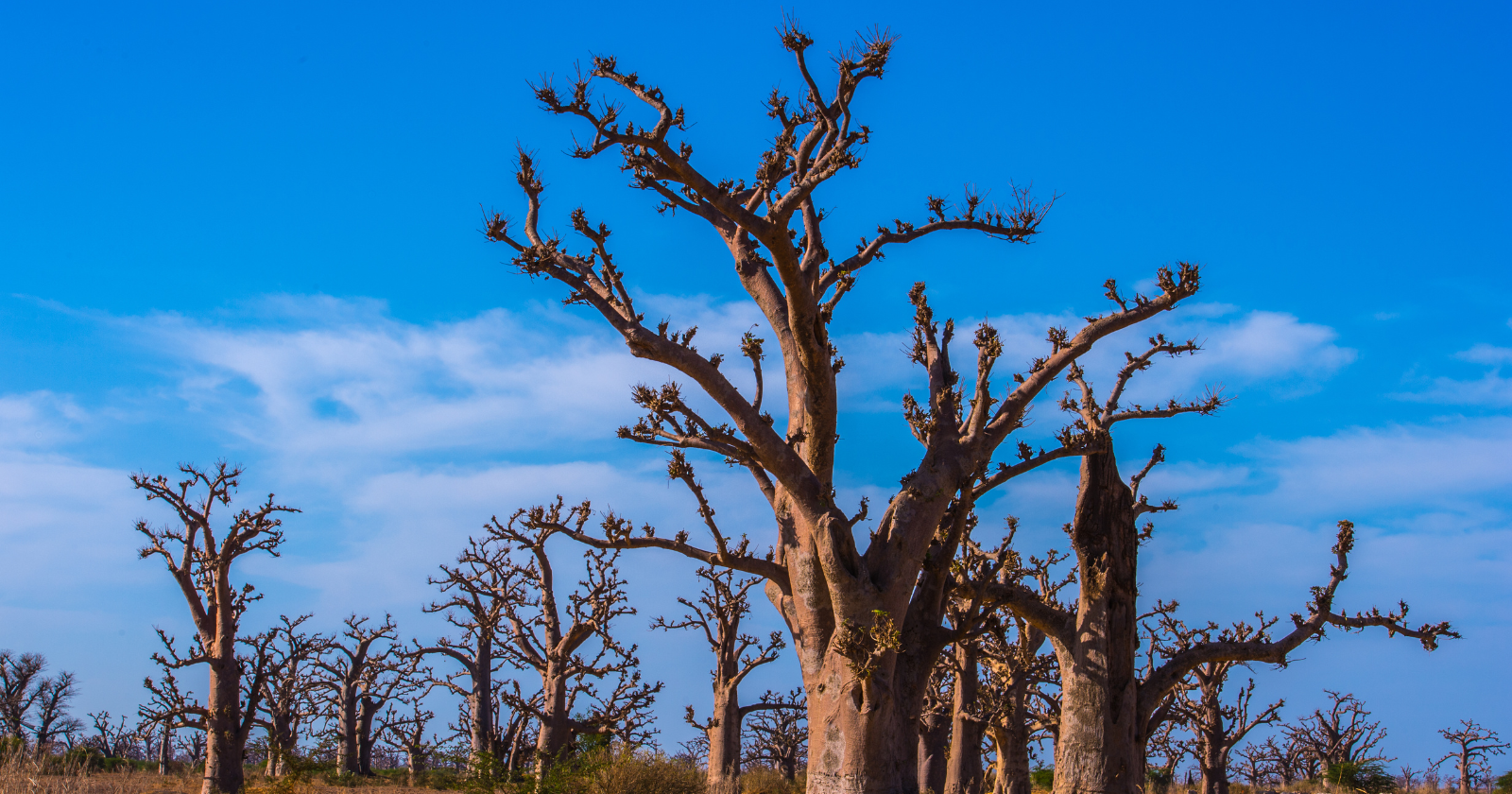
The Great Green Wall was pitched to the world in 2007 as an 8,000-kilometre living barrier — a corridor of trees running from Senegal on the Atlantic to Djibouti on the Red Sea, 15 kilometres wide, thick enough to hold back the advancing Sahara. Fifteen years into the project, roughly 4% of the trees are actually in the ground. The rest exists mostly on funding decks, in COP announcements, and in the sunburnt remains of plots where saplings were planted, fenced, then abandoned when the money ran out.
The gap between what was pledged and what is growing is the story of the Wall.
What was promised in 2007
The African Union formally endorsed the Great Green Wall in 2007, two years after Sahel-Saharan states first approved the concept at a summit in Ouagadougou. Eleven countries signed on: Burkina Faso, Chad, Djibouti, Eritrea, Ethiopia, Mali, Mauritania, Niger, Nigeria, Senegal, and Sudan. The pitch, as reported by The New Humanitarian, was elegant in its scale: a wall of trees 8,000 kilometres long and 15 kilometres wide, cutting across the width of the continent.
By 2030, the initiative aimed to restore 100 million hectares of degraded land, capture 250 million tonnes of CO2, and create 10 million green jobs. The Sahara had been marching south for decades, drying wells, swallowing farmland, and pushing families off land their grandparents had farmed. A living wall would stop it.
The framing was easy to sell. World leaders liked it. Donors liked it. It photographed well.
The 4% number
By 2020 — the original midpoint of the project — an internal review found that only about 4% of the original tree-planting target had actually been achieved. Mongabay’s reporting tracked the slow crawl of progress across the eleven countries and found that even the most generous accounting methods struggled to reach double digits.
The UN Convention to Combat Desertification, which backs the initiative, has since redefined what counts. The Wall is no longer described as a literal belt of trees but as a “mosaic” of restored landscapes — farmer-managed regeneration, protected pasture, water harvesting, native shrubs. Under that broader definition, assessments of restored hectares and project completion vary widely depending on the accounting method used.
Either way, the 2030 deadline is under serious strain.
The Ferlo plantation, and what happens when the money stops
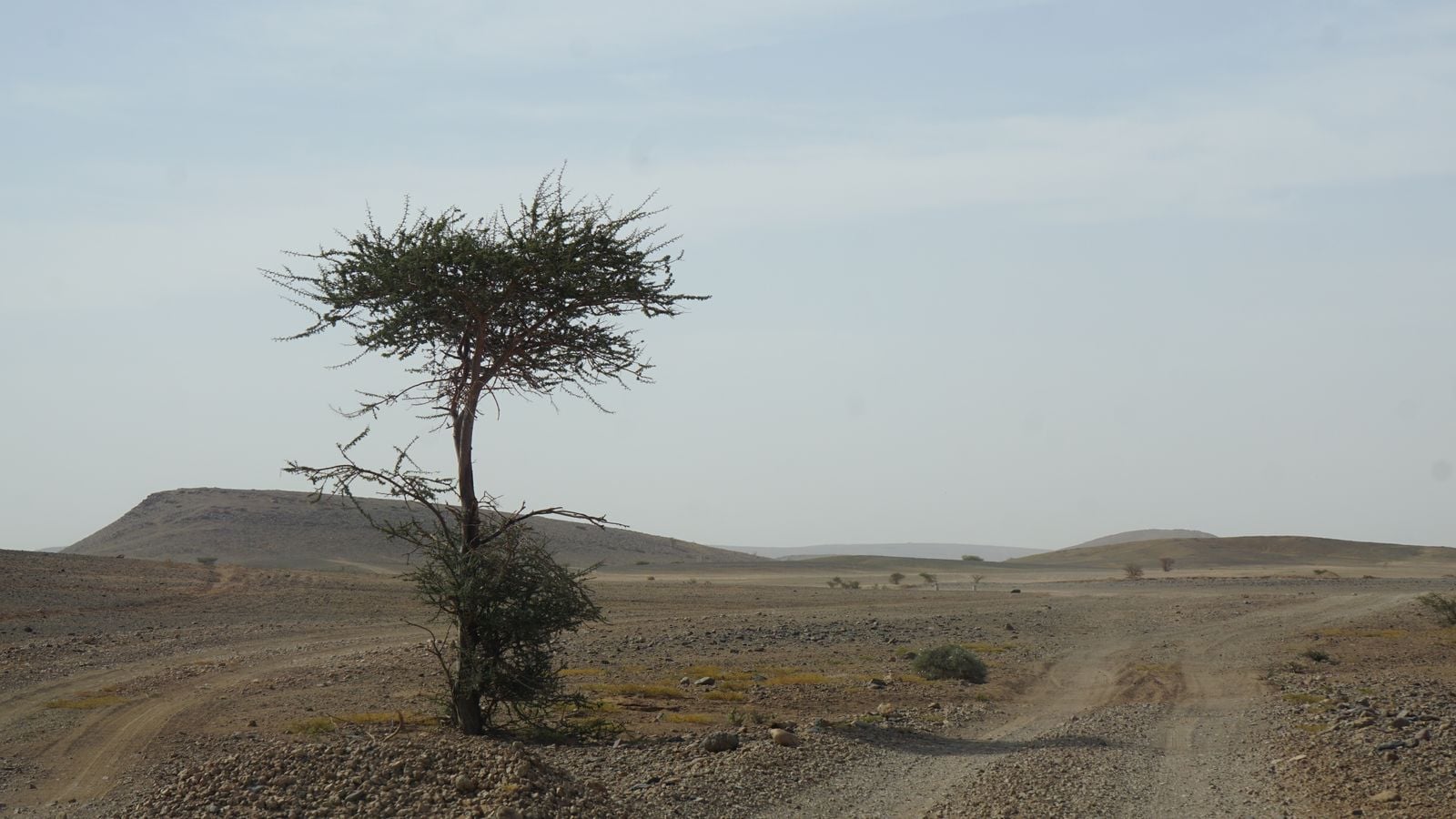
The clearest way to understand the gap between pledge and delivery is to stand at one of the plots. In Senegal’s Ferlo valley, near the village of Koyli Alpha, a 600-hectare acacia plantation was established in 2012. Wire fencing was strung around it. Thousands of saplings went into the ground. A green metal sign announced the project.
Thirteen years later, the plantation is indistinguishable from the surrounding landscape. The barbed wire lies collapsed in the dust. When the fencing broke and there wasn’t enough money to repair it, goats grazed the saplings down to nothing. The soil returned to sand. Only the rusted sign remains.
The same pattern repeats across the corridor. In southern Djibouti, a women’s cooperative in the village of Ab’Aydu spent five months clearing a rock-strewn hillside by hand, hauling stones away in empty rice sacks, after government workers promised Great Green Wall funding would drill them a new borehole. Contractors arrived. They began the drill. Then, as farmer Momina Seid told The New Humanitarian, they simply disappeared. The budget had run out. Abdulfatah Arab, head of Djibouti’s Great Green Wall agency, confirmed his office had received barely 10% of the funding it had been expecting.
A broken fence and a few lifeless trees are what remains.
Related: In 1982 the Soviet Union landed a probe on the surface of Venus that survived 127 minutes in heat that melts lead and pressure dense enough to crush a submarine — long enough to scan back two panoramas of flat basaltic rock under an orange-tinted sky before the heat finally ended the mission
Where the money actually goes
The funding story is where the accountability question gets sharp. In 2021, at Emmanuel Macron’s One Planet Summit, donors including the World Bank, the Green Climate Fund, and the European Union pledged an additional $14.3 billion to the Great Green Wall. Billions in additional funding have since been raised or pledged. The project still needs substantial additional funding to hit its 2030 target.
But money pledged is not money spent, and money spent is not money that reached a sapling. Freedom of Information requests filed by The New Humanitarian to the European Commission showed the EU contributed over €1.54 billion to the Great Green Wall between 2021 and 2023, with €123 million earmarked for Chad. Staff at Chad’s national Great Green Wall agency told the outlet that most of that money bypassed the agency entirely, going instead to international NGOs and consultancies running their own projects.
According to officials in Chad’s Great Green Wall agency, the country has struggled to receive promised international funding for the initiative.
Chad’s agency can barely afford to visit its own project sites.
Green neocolonialism, or just bad delivery?
In 2023, scientists raised concerns that the initiative was exhibiting characteristics of green neocolonialism. The scientists criticized Macron’s approach as undermining African sovereignty over the initiative. The critique has teeth. Annah Zhu, an assistant professor of environmental policy who co-authored a large-scale study on the Wall, found that only one out of 36 reforested plots surveyed in Senegal showed significant re-greening. The rest brought minimal benefit to either the environment or the communities living on the land.
Zhu argues that funded projects often reflect Western perspectives on Africa rather than local realities. Her co-author Amadou Ndiaye, at Amadou Mahtar Mbow University in Dakar, points out that traditional pastoral practices in the Ferlo valley go back thousands of years, and colonial-era attempts to settle nomadic herders around fixed boreholes failed for exactly the same reasons the new fenced reserves are failing now.
Ndiaye points out that traditional conservation approaches have been overlooked in favor of projects that attract larger funding.
The Koyli Alpha Community Wildlife Reserve, established in 2017 with EU, FAO, and Canadian funding of at least 25 million Canadian dollars, was meant to be community-managed and to become an eco-tourism hub. On the day The New Humanitarian visited, three guards were sitting under an acacia tree because the promised guard post had not been built in five years. Locals can no longer bring their cattle onto the land. The tourism never arrived.
What is actually working
The Wall is not a total failure, and pretending it is would flatten a more useful picture. In Niger, farmer-managed natural regeneration — a low-cost practice where farmers protect and prune young trees that sprout naturally on their fields — has restored roughly five million hectares of land, much of it before the Great Green Wall even existed as a brand. In Ethiopia’s Tigray region, terracing and community land management have brought degraded highlands back into production.
Native species with a proven survival record in Sahel conditions have shown better results: Acacia senegal, which produces gum arabic and fixes nitrogen, and Faidherbia albida, which drops its leaves in the rainy season and lets crops grow beneath it. These species survive because they belong. Imported seedlings watered for a season and then abandoned do not.
A 2025 Mongabay report on new data and tracking systems suggests the initiative is slowly moving toward a more honest accounting — satellite verification of restored plots, standardised monitoring across the eleven countries, and better coordination through the pan-African body based in Mauritania. The African Union’s 2024–2034 framework quietly reframes the Wall as a continent-wide land restoration and livelihood programme rather than a single belt of trees.
That reframing is more realistic. It is also an admission.
Why the Sahel matters
The stakes are not abstract. The Sahel sits between the Sahara and the wetter savannas to the south, and temperatures here are rising 1.5 times faster than the global average. The World Bank has warned that climate change could force 216 million people to move within their own countries by 2050, including as many as 86 million in Sub-Saharan Africa. The Great Green Wall was pitched as a stability project as much as an environmental one — a way to keep farmers on their land instead of watching them push north toward the Mediterranean or into refugee camps.
The region has form when it comes to abrupt ecological change. Space Daily has covered the collapse of the Green Sahara — a lush savanna with rivers, hippos, and giraffes that dried into the desert we know today in the span of roughly a century, roughly 6,000 years ago. Cave paintings made by people who watched the lakes vanish still survive on rock walls that now face open sand. The Sahara is not a permanent feature of the map. It moves.
The Wall was meant to slow that movement. On the ground, in villages like Koyli Alpha and Ab’Aydu, the movement is winning.
The accountability gap
Fifteen years in, the honest ledger looks like this. The pledge: 8,000 kilometres of trees, 100 million hectares restored, 10 million jobs by 2030. The delivery: roughly 4% of the original tree count in the ground, an expanded definition of “restoration” that gets the number to somewhere between 18 and 30% depending on who is counting, billions in announced funding that rarely reaches the national agencies meant to spend it, and hundreds of specific project sites where saplings died because the fence broke and nobody came back.
Terrorism and instability across the central Sahel have made things harder. Coups in Mali, Burkina Faso, and Niger have disrupted coordination. Jihadist violence has made it dangerous to reach some project areas at all, a problem PBS NewsHour has documented in its coverage of the region. But the collapsed fence at Koyli Alpha was not brought down by insurgents. It fell because the maintenance budget was not renewed.
The pattern across dozens of sites is the same: donor announces funding at a summit, project gets built to fit the funding cycle, funding cycle ends, project ends, land returns to sand. ZME Science’s reporting on the twenty-plus countries now nominally involved in the expanded initiative notes that the disconnect between pledged funding and disbursed funding remains the single biggest obstacle. Fact-checks by Snopes have pushed back on the popular image of a continuous green ribbon rising across Africa, which does not exist.
What exists is a scattered archipelago of plots — some flourishing, most failing, a few forgotten under rusted signs.
What five more years buys
The 2030 deadline is now 54 months away. At the current rate of delivery, hitting the original target would require planting or restoring more land in the next five years than has been done in the previous eighteen. Nobody involved in the project thinks that is going to happen. The framework has been quietly extended to 2034, and the definition of success has been widened to accommodate what is actually possible.
Momina Seid is still waiting for her borehole. The women’s cooperative at Ab’Aydu has not heard from a government contractor in years. The land has been dry for more than a season. The rice sacks they used to haul away rocks are still piled at the edge of the plot, sun-bleached now, holding down the corners of a barricade around a field that never got planted.
Somewhere in Brussels, in a filing cabinet, the funding for that borehole is booked as disbursed.