
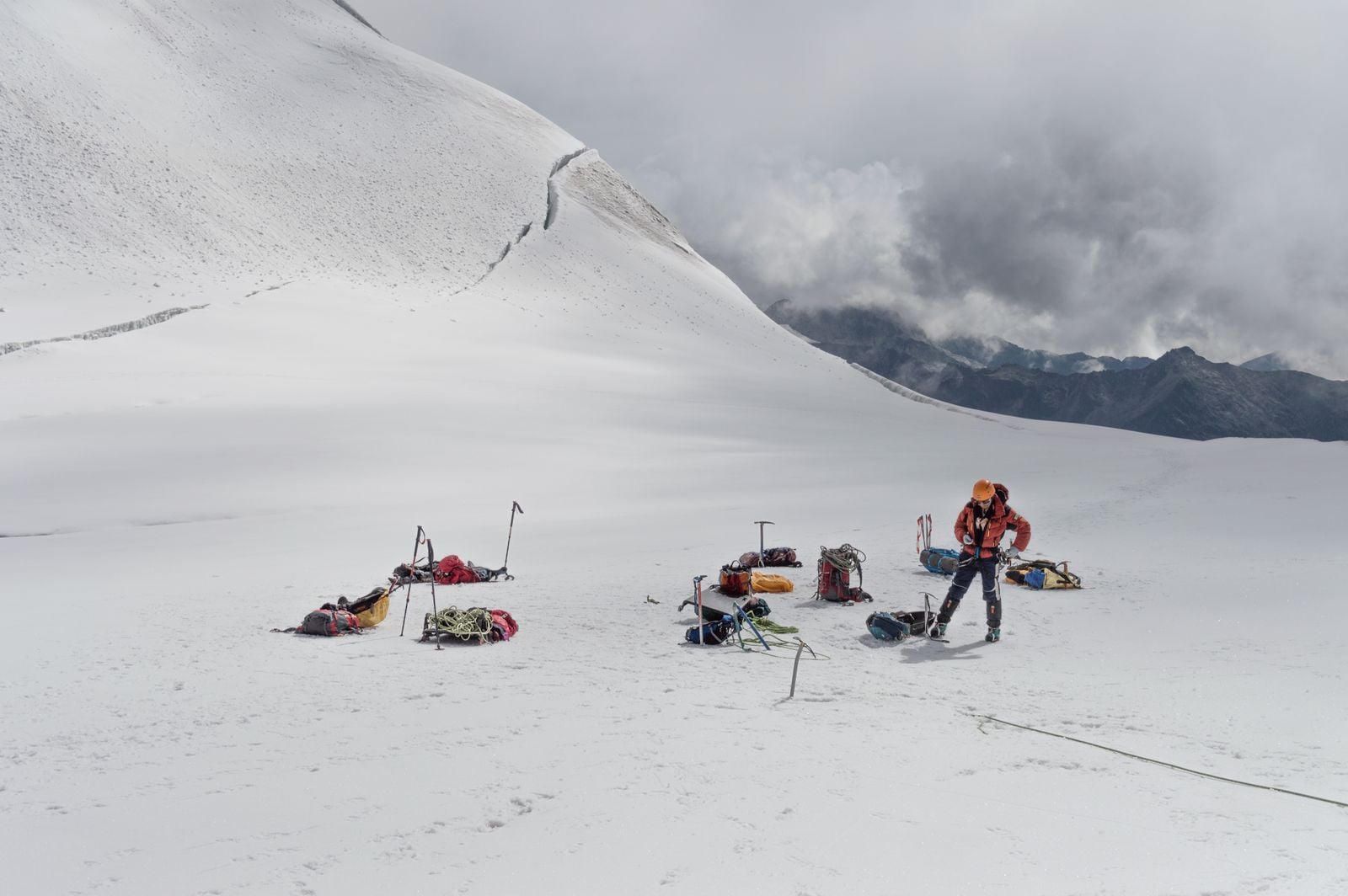
In late June 1970, Reinhold Messner staggered down the Diamir Face of Nanga Parbat with his younger brother Günther, both men frostbitten, hallucinating, and lost above 7,000 metres. For long stretches of the descent Messner was convinced a third climber was walking with them — a silent companion who kept pace on the ice, always just at the edge of his vision, never speaking, never falling behind. There was no third climber. The Messner brothers had summited the Rupal Face two days earlier, gone roughly 48 hours without food or a proper bivouac, and were the only two humans on that side of the mountain.
The phantom stayed with him until the glacier ran out.
The climb that broke him
The 1970 Nanga Parbat expedition was led by the German doctor Karl Herrligkoffer, and its objective was the massive Rupal Face. On 27 June, Reinhold and Günther Messner reached the summit at 8,125 metres, the first humans to complete the Rupal ascent. Günther had already begun to show signs of altitude sickness on the way up.
Descending the Rupal side, with weather closing in and no fixed ropes below them, was judged suicidal. So the brothers did something no one had done before: they went down the other side of the mountain, dropping onto the Diamir Face and improvising a traverse that had never been attempted. They had no map of the descent, no radio contact, and almost no food.
Somewhere on the lower Diamir, near the glacier at around 4,500 metres, Günther was caught by an avalanche. Reinhold, who had gone ahead to scout a route through the icefall, could not find his brother’s body. He kept walking. He walked out of the mountain barefoot in places, having lost his boots’ function to the cold. When he was finally picked up by woodcutters in the Diamir Valley, he had lost toes to frostbite.
And for much of the descent, he later wrote, he had believed a third person was on the rope with him.
The Third Man
The phenomenon has a name. Explorers and psychologists call it the Third Man Factor — the strong sensed presence of an unseen companion that appears in people pushed beyond the ordinary limits of endurance. Ernest Shackleton described it during his crossing of South Georgia. Frank Smythe described it near the summit of Everest in 1933. Charles Lindbergh reported voices in the cabin of the Spirit of St. Louis during his solo Atlantic crossing.
What links these accounts is not mysticism. It is the specific combination of conditions that produced them: severe sleep deprivation, caloric depletion, oxygen starvation, cold, monotonous sensory input, and a survival task that cannot be abandoned. The Messner brothers on the Diamir hit every one of those variables at once.
Above 7,000 metres, the partial pressure of oxygen drops dramatically from sea level. The brain, which consumes a substantial portion of the body’s oxygen supply, begins to run on a deficit. Judgment slows. Peripheral vision narrows. And the parts of the cortex that build the sense of a bounded self — the parietal regions that tell you where your body ends and the world begins — start to misfire.
What a hallucinating brain does with a companion
The sensed presence is not a visual hallucination in the ordinary sense. Most climbers who report it do not say they saw a face. They say they knew someone was there. Sometimes to the left, sometimes just behind. Steady. Silent. Helpful, occasionally — Smythe’s phantom seemed to steady him on a traverse.
The temporoparietal junction, a region that integrates signals about the body’s position in space, appears to play a key role. When those signals get scrambled — by hypoxia, by exhaustion — the brain seems to interpret its own body schema as belonging to someone else. You become your own companion.
This is the same neurological territory that shows up in astronaut debriefs after long-duration missions. Michael Collins spent 48 minutes of every lunar orbit cut off from radio contact on the far side of the Moon, describing not loneliness but a kind of quiet doubling of awareness. Some long-duration ISS crew members describe returning home and feeling, for weeks, like they are watching their own lives from a half-step outside the frame. The mechanism is not identical to Messner’s phantom, but the neural neighbourhood is close.
Forty-eight hours without food, two nights above 7,000
The numbers on the 1970 descent are worth stating plainly. The Messners had summited late in the day on 27 June. They bivouacked near the summit at roughly 8,000 metres with no tent, no sleeping bag, and no stove. On 28 June they began the Diamir traverse. By the time Günther was swept away, they had been continuously exerting themselves at extreme altitude for close to 48 hours without a proper meal and without meaningful sleep.
At those altitudes, the body burns through glycogen faster than it can be replaced even with food, and there was no food. Core temperature drops. Blood thickens. The brain’s threshold for producing a stable model of reality collapses.
Messner himself, speaking decades later, has described the descent as one of the two or three near-death experiences a person might have in a lifetime. In an April 2026 interview on Swiss television with Urs Gredig, he described such moments as terrifying — as though “you feel that it’s the end” — but also as some of the most powerful experiences a person can have.
The accusations, and the body in the ice
What followed the descent was not sympathy. It was 35 years of accusation. Members of the Herrligkoffer expedition, and later the expedition leader himself, argued that Reinhold had abandoned his brother to pursue the traverse for his own glory. Books were written. Lawsuits were filed. Messner’s account — that Günther had been alive at the top of the Diamir Face and had died in an avalanche low on the mountain — was called a lie.
In 2005, a melting glacier on the lower Diamir gave up a boot, a bone, and eventually enough remains for a DNA match. Günther Messner’s body was identified exactly where Reinhold had said it would be — swept down the west side, not left dying on the summit ridge. The location matched the route Messner had described in 1971, and the physical evidence effectively closed a controversy that had shaped his adult life. As Reinhold told reporters at the time, the discovery was less a vindication than a return.
Why the phantom appears when it does
The Third Man is not random. It clusters around a specific pattern of stressors — the same ones that were pressing on Messner on 29 June 1970. Extreme physical exhaustion. Isolation from any human help. A task that cannot be put down. Sensory monotony (white snow, white sky, white wall). And a real emotional stake: Günther was dying, or already dead, and Reinhold was alone.
Those who have collected these accounts argue that the sensed presence tends to arrive at the point of greatest need, and tends to be benign. It does not accuse. It walks with you. In some accounts, it appears to give direct instructions. In Messner’s case, he simply knew it was there.
There are quieter versions of this circuitry firing in ordinary life. The basal ganglia let a driver arrive home with no memory of the drive — a form of split awareness where the body executes and the conscious self is elsewhere. Daydreaming does something similar with the brain’s default mode network. The mind is capable of producing a passenger in the seat next to you long before conditions get as extreme as a Himalayan bivouac. Altitude and starvation simply turn the volume up until the passenger becomes solid enough to notice.
The route no one else has repeated cleanly
The 1970 Rupal-Diamir traverse remains one of the boldest lines in Himalayan mountaineering. Eight years later, in 1978, Messner returned to Nanga Parbat and became the first person to climb an 8,000-metre peak entirely solo, up a new line on the Diamir Face. He would go on to summit all fourteen 8,000-metre peaks, the first person to do so, and to cross Antarctica on foot.
The phantom did not return in the same form. But Messner has spoken often about the way that first descent rewired his understanding of what a human body and mind can do at the edge. In a later interview reflecting on how misfortune reshapes a climber, he described the mountains as a confrontation between human nature and wilderness — a place where control is partial and death is a constant variable in the equation.
The companion nobody meets in the valley
The Third Man does not arrive at sea level. It does not walk beside people in supermarkets or offices. It waits at the altitude where oxygen thins, where the body has run past its reserves, where the horizon flattens into one white sheet. It shows up when the brain, deprived of the signals it normally uses to draw a line between self and world, quietly draws a second figure on the other side of the line and lets it walk.
Messner came off Nanga Parbat missing toes, missing his brother, and carrying an account of a companion no one else had seen. For 35 years, people used the missing brother against him. The mountain kept the proof frozen in its glacier until it was ready to release it. The companion, whoever or whatever the exhausted brain had built out of the storm and the ice, walked back down with him and stayed just long enough to get him home.
