

Inside a steel cylinder the size of a household refrigerator, in a factory in Henan province, a sliver of graphite the width of a pencil lead is pressed between two anvils until it experiences about 50,000 atmospheres of pressure and 1,500 degrees Celsius. Two weeks later, a one-carat diamond emerges that is chemically, optically and structurally identical to a stone pulled from a kimberlite pipe in Botswana — and the wholesale price of that stone has fallen sharply in recent years, ending a price discipline the De Beers cartel had maintained for more than a century.
The machine is called a cubic press. China now operates thousands of them. The slogan “A Diamond Is Forever” — written by N.W. Ayer copywriter Frances Gerety in 1947 and named the advertising slogan of the 20th century by Advertising Age in March 1999 — still appears in jewellery store windows. The economics it built no longer hold.
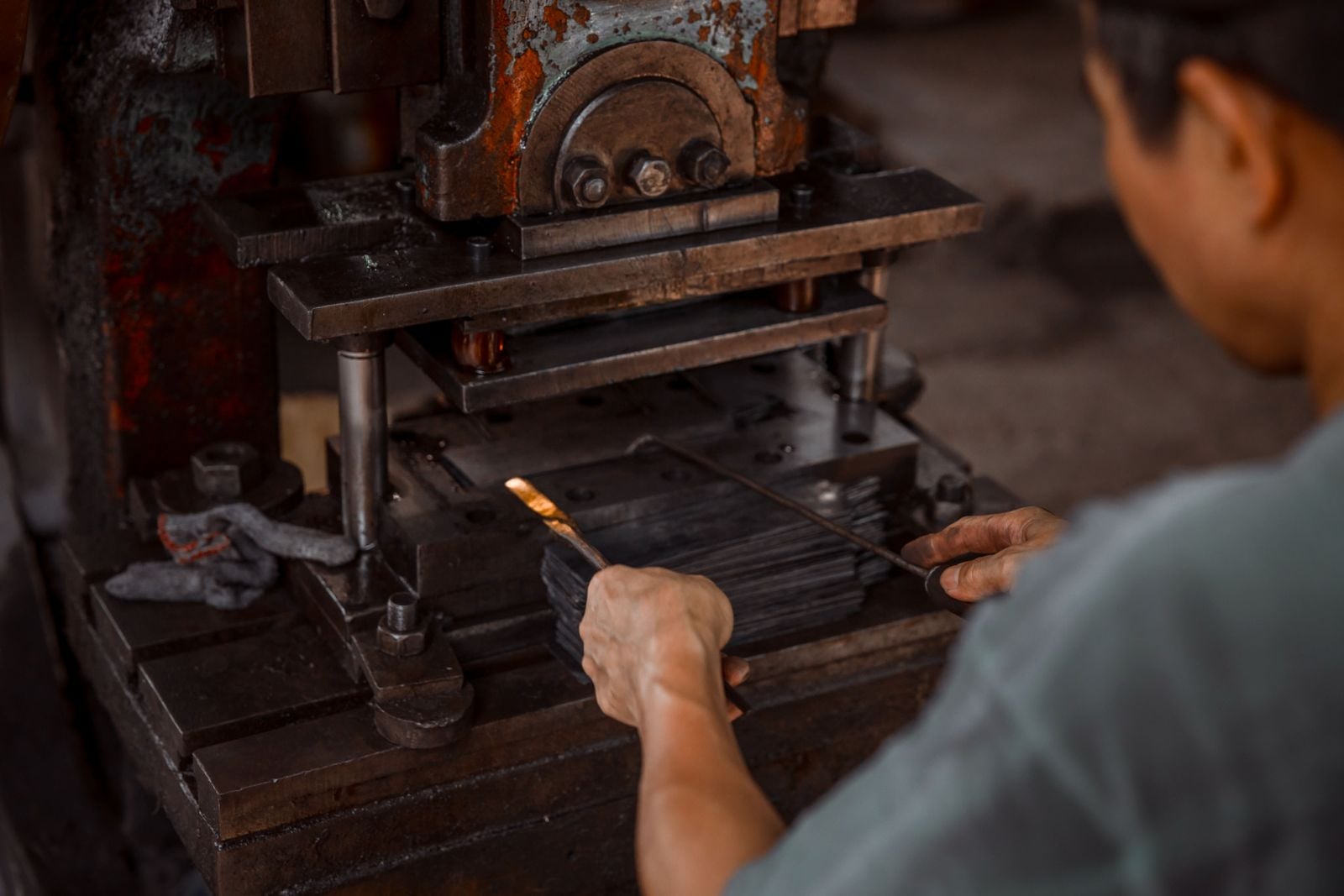
What is happening inside the press
The high-pressure, high-temperature method recreates the conditions roughly 150 kilometres beneath the Earth’s surface, where carbon atoms in the mantle rearrange themselves into the rigid tetrahedral lattice that makes a diamond a diamond. A small natural diamond seed is placed at the cool end of a growth cell. Above it sits a metal solvent — usually iron, nickel or cobalt — and above that, the carbon source.
Once the press closes, the metal melts. Carbon dissolves into the molten metal at the hot end, drifts toward the cooler seed, and crystallises onto it one atomic layer at a time. The growth rate is slow by industrial standards and astonishing by geological ones. A gem-quality one-carat stone, weighing about 200 milligrams, accumulates layer by layer over roughly ten days to two weeks.
A mined diamond of the same weight took, on average, between one and three billion years.
Why a gemmologist cannot tell them apart
The carbon atoms in an HPHT stone bond in exactly the same cubic crystal structure as those in a mined one. Hardness on the Mohs scale: 10. Refractive index: 2.42. Thermal conductivity: roughly 2,000 watts per metre-kelvin, the highest of any bulk material at room temperature. The Gemological Institute of America, which has graded natural diamonds since 1953, now grades lab-grown ones using the same 4Cs criteria, and its 2025 lab notes describe a batch of 26 Fancy Vivid yellow HPHT-grown diamonds ranging from 1.03 to 2.32 carats, color-graded at the very top of the yellow scale.
The only reliable way to tell an HPHT stone from a mined one is to look for telltale metallic inclusions left by the iron-nickel flux, or to use specialist instruments that pick up subtle differences in nitrogen distribution and phosphorescence. The naked eye cannot do it. A jeweller’s loupe cannot do it. Even a trained gemmologist with a standard microscope usually cannot do it without sending the stone to a lab.
The cartel that kept the price up for more than a century
De Beers was founded in 1888 by Cecil Rhodes after he consolidated control over the Kimberley diamond fields in South Africa. Ernest Oppenheimer extended that consolidation into a worldwide cartel through the 1920s and 1930s, eventually controlling, by various estimates, between 80 and 90 percent of the global rough-diamond trade for much of the 20th century. The strategy was simple: buy up supply from every new producer that emerged, stockpile inventory in London, and release stones into the market at a tempo that kept prices rising.
The strategy worked for an extraordinarily long time. From the 1947 launch of “A Diamond Is Forever” through the late 2010s, the marketed price of a one-carat round brilliant of decent colour and clarity rose almost monotonically. Edward Jay Epstein, writing for The Atlantic in February 1982, documented how N.W. Ayer’s campaign drove U.S. diamond sales from $23 million in 1939 to over $2 billion by 1979 — and how the resale market was deliberately suppressed so that consumers would never discover the wholesale-to-retail markup.
De Beers faced legal action for price-fixing in the early 2000s, including a guilty plea and fine to the U.S. Department of Justice, and a subsequent civil settlement that cost the company hundreds of millions of dollars. Even those penalties did not crack the price structure. The cubic press did.
The collapse, in numbers
Wholesale prices for natural one-to-two carat rough diamonds peaked in the early 2010s and again in the early 2020s before falling sharply. Industry observers report significant price declines for polished stones in recent years. De Beers has written down billions of dollars in diamond inventory value, and parent company Anglo American has announced plans to sell or spin off the unit. The company that decided what love costs is being broken up.
Lab-grown supply is the proximate cause. Allied Market Research valued the global lab-grown diamond market at $24 billion in 2022 and forecasts $59.2 billion by 2032, a compound annual growth rate of 9.6 percent. The same report notes that HPHT, while second to chemical vapour deposition in revenue share, is the fastest-growing production method, projected at a 9.8 percent CAGR through 2032 — precisely because HPHT produces stones chemically identical to mined ones, which is what high-end jewellers and industrial buyers increasingly want.
Retail prices for lab-grown stones now run well below comparable mined diamonds, with significant price gaps across most sizes and qualities.
The diamond was never priced on its physical properties. It was priced on the story attached to it: the cartel-controlled supply, the marketing campaign that linked it to lifetime commitment, the resale suppression that kept consumers from discovering its true secondary value. Each of those pillars rested on the assumption that diamonds were rare and that the rarity was natural.
HPHT and CVD do not make diamonds rarer. They make the question of rarity irrelevant. A factory in Zhengzhou can produce, in a single building, more carats per year than a mid-sized mine. Vast quantities of polished diamonds now sit in private hands worldwide — enough, as Epstein noted four decades ago, to collapse the resale market overnight if more than a small fraction ever came up for sale at once.
Luxury analysts are watching what happens at the top of the market. Forbes’ coverage of the 2025 luxury reports notes that the personal luxury goods market is facing its first major slowdown in 15 years, with aspirational consumers — those spending less than around $6,000 a year — pulling back sharply. The diamond engagement ring was, for seventy years, the entry-level luxury purchase: the moment a middle-class consumer crossed into the world of named brands and high markups. That entry ramp is now collapsing.
How China became the press capital of the world
Henan province, in central China, was already a hub for industrial superhard materials before gem-quality synthesis became commercially viable. The cubic press design — a six-anvil cubic-cell machine, cheaper to build and easier to operate than the older belt-press design pioneered by General Electric in 1955 — was refined by Chinese manufacturers through the 2000s. By the late 2010s, companies including Henan Huanghe Whirlwind, Zhongnan Diamond and Sino-Crystal were operating thousands of presses producing stones for both abrasive and gem markets.
The same Allied Market Research analysis identifies China as the world’s leading producer and exporter of lab-grown diamonds. India, historically the world’s diamond cutting and polishing centre, has moved aggressively into chemical vapour deposition production, with substantial government support and private investment flowing into the sector.
The shift in the Indian cutting industry is striking. The Bureau of Indian Standards now mandates clear labelling for lab-grown diamonds, partly to protect consumers and partly because Surat — where roughly 90 percent of the world’s diamonds are cut and polished — has reorganised its workshops around lab-grown stones, which now represent more than half of the city’s polished export volume.
The industrial use case that may matter more
The jewellery story is the loud one. The quieter story is that synthetic diamond is becoming a strategic industrial material. Diamond is the best thermal conductor known. It is transparent across a wide optical band. It is hard enough to cut almost anything. Companies are now growing diamond wafers for use as substrates in high-power semiconductor electronics, where the heat dissipation problem in silicon and gallium nitride devices is becoming the limiting factor.
De Beers’ own research division, Element Six, has deepened its focus on industrial lab-grown diamond production for semiconductor and power electronics. Diamond Foundry, a California-based producer, committed roughly €2.35 billion to a synthetic diamond wafer operation in Trujillo, Spain. The company that built the gem cartel is now competing in the same factory technology that destroyed it, but for a different end market.
The same physics that makes a one-carat HPHT stone indistinguishable from a Botswana mine output also makes it a candidate for the next generation of quantum sensors, where nitrogen-vacancy defects in the diamond lattice can be tuned to detect magnetic fields at room temperature. Some of the same labs producing engagement-ring stones produce quantum-grade single crystals on adjacent benches.
Lab-grown stones tend to lose resale value quickly, because the cost of producing them keeps falling: a lab-grown one-carat that sold for several thousand dollars a decade ago now sells for a fraction of that. Mined stones are not immune. Auction houses and jewellers report that secondary-market prices for one-to-three carat mined diamonds have softened materially since 2022, especially in the middle of the quality range where lab-grown alternatives are most competitive. The very top of the market — historic stones, large fancy colours, certified provenance — is holding up better, but even there the floor has moved.
What remains is the residual cultural weight of the slogan. “A Diamond Is Forever” was not a statement about chemistry. It was a statement about meaning, attached to a stone whose price was held aloft by the deliberate scarcity of a single company. The chemistry has been democratised by a steel cylinder in Henan. The meaning is up for renegotiation.
Somewhere in central China this afternoon, a press is closing on a graphite blank. In two weeks, it will open on a stone that, by every measurable criterion, is a diamond — the same lattice, the same hardness, the same brilliance, the same fire. A century-old price structure has already moved to meet it.
