
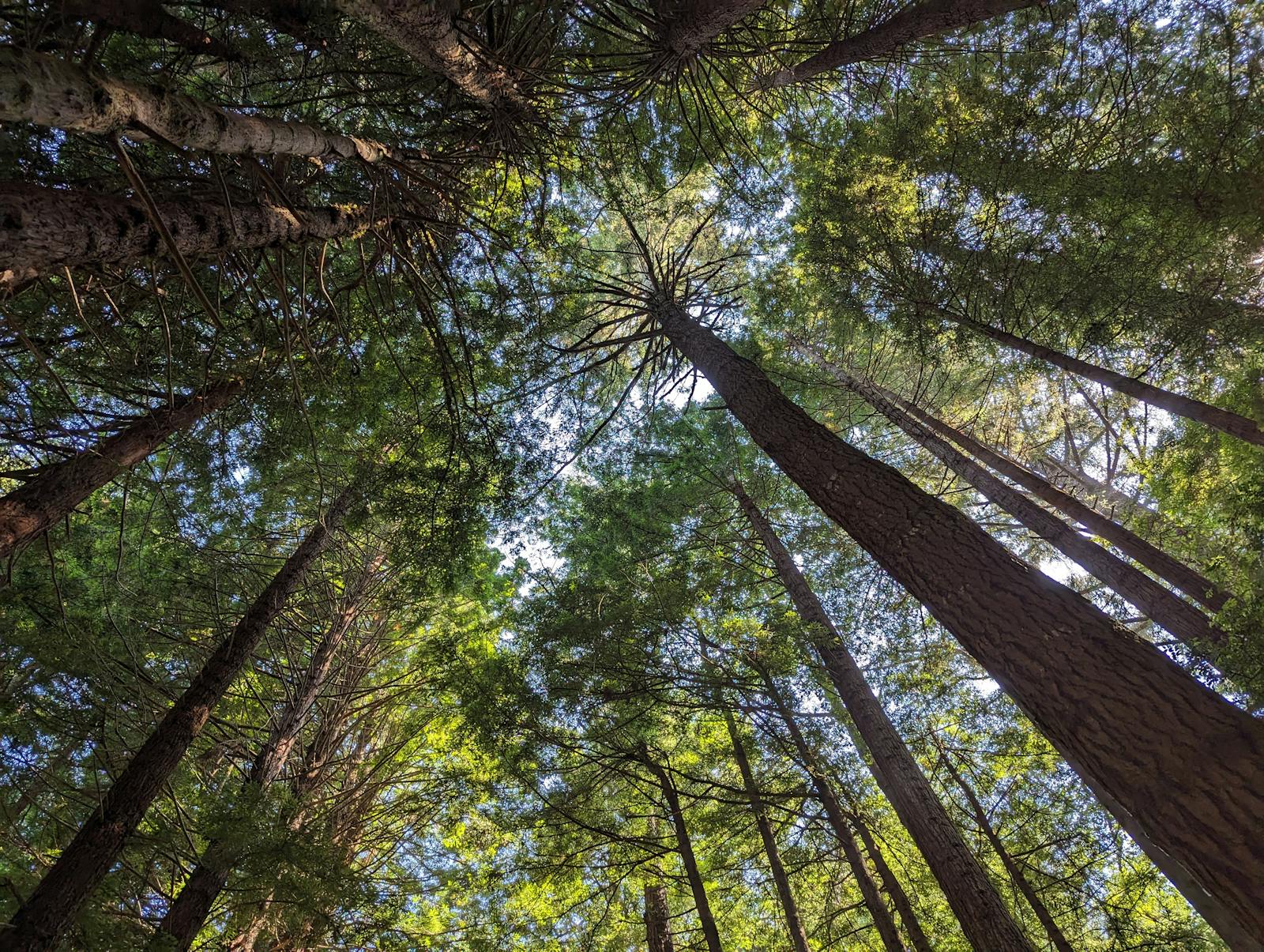
Hyperion stands roughly 380 feet tall in a fold of coastal forest in Northern California, a single coast redwood widely recognized as the tallest living thing on Earth. Its exact coordinates are not on any park map. Walk into Redwood National and State Parks asking for directions and a ranger will politely tell you no, and then warn you that getting caught near the tree carries a fine of up to $5,000 and up to six months in jail.
The secrecy is not theatrical. It is the response to what happened the last time a record-holding redwood became famous.
Hyperion was discovered in 2006 by naturalists Chris Atkins and Michael Taylor, deep in a trail-less drainage of the park. At about 115.6 metres, it took the world title from a redwood called Stratosphere Giant, and from a series of older champions whose names mostly belong to a small community of tree hunters. What changed after 2006 was the internet. Bloggers, travel writers and YouTubers started posting rough directions. Bushwhackers followed. By the late 2010s the forest floor under Hyperion had been compacted into a network of social trails, and the National Park Service decided the tree’s own visitors had become its biggest threat.
What a 380-foot tree actually looks like
Hyperion is taller than the Statue of Liberty from torch to foundation. It is taller than Big Ben. It is roughly the height of a 35-storey office tower. Standing on a forest floor, you cannot actually see the top of it. The canopy disappears into fog long before your eye runs out of trunk.
The trunk at Hyperion’s base is narrower than you might expect for a tree of that height, around 4.8 metres in diameter, because the giant is tall rather than massive. Other redwoods carry more wood. Hyperion simply reaches further into the sky.
Coast redwoods, Sequoia sempervirens, pull water up through their trunks against gravity using a column of negative pressure inside microscopic xylem tubes. Around 130 metres appears to be the practical ceiling for a tree on Earth, the point at which water can no longer be lifted to the topmost needles. Hyperion is within a few metres of that limit. It is, in a literal sense, near the physical edge of what a tree can be.
How a tree gets killed by admiration
The park’s case against tourism is specific. Leonel Arguello, Redwood National Park’s Chief of Natural Resources, told SFGATE in 2022 that visitor traffic was damaging the vegetation and potentially the root system of the very tree people were going there to visit, comments later carried by LAmag when the Park Service announced fines and jail time for visiting the area.
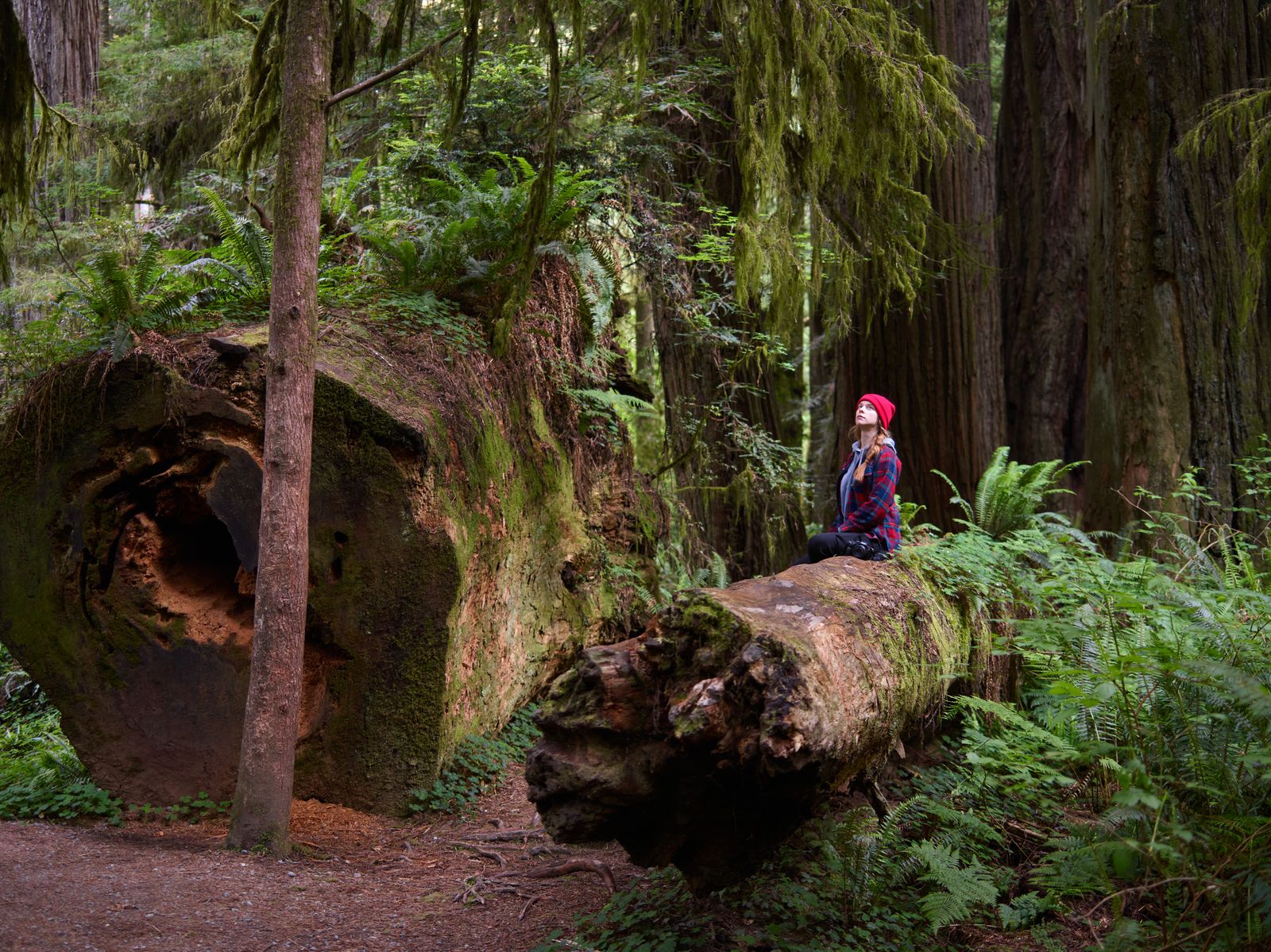
Redwoods have shallow root systems. There is no deep taproot anchoring a 380-foot tree against winter storms. Instead the roots spread laterally, sometimes more than 30 metres from the trunk, intertwining with the roots of neighbouring redwoods to form a kind of living scaffolding. Walk repeatedly over that scaffolding and the soil compacts. Water stops infiltrating. Fine feeder roots die. Fungi that the tree depends on for nutrient exchange begin to disappear.
Arguello described what rangers were finding at the base of Hyperion: trash, side trails worn through the ferns, human waste, used toilet paper. The area sits in a steep, fog-soaked drainage with no cell service. Lost hikers had to be rescued. The tree, meanwhile, was being slowly suffocated by the people who had come to admire it.
This is not the first time it has happened. Earlier record-holders suffered similar erosion at their bases once their locations leaked. The pilgrimage is often not worth it. The Park Service has been blunt that a view of Hyperion does not match its hype: the trunk is small compared with many other old-growth redwoods, and the tree’s height cannot be observed from the ground anyway.
Why redwoods grow this tall in the first place
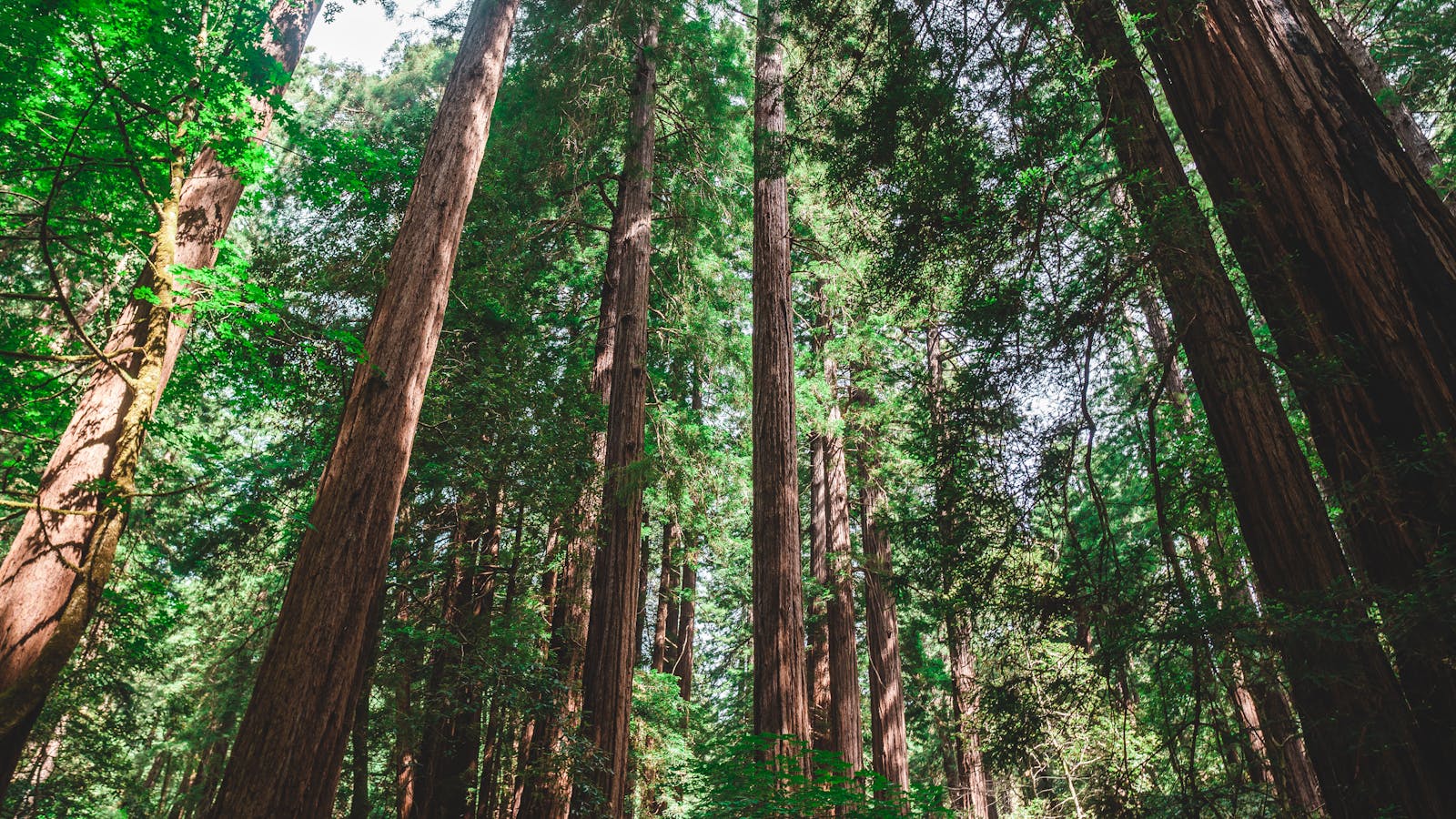
Coast redwoods occupy a thin sleeve of land along the Pacific from southern Oregon to Big Sur, perhaps 750 kilometres long and rarely more than 50 kilometres wide. The strip exists where summer fog rolls inland from the cold California Current and condenses on needles 90 metres up, where rainfall alone could not supply enough water. The trees drink from the air.
The soil is deep alluvial loam built by millennia of river flooding. Winters are mild, summers are cool, fires historically swept through often enough to clear understory but not hot enough to kill mature trees, whose bark can be a foot thick. The combination is rare on Earth. There is a comparable hotspot in Tasmania, where a 2025 study documented 18 mountain ash trees over 90 metres, including one named Centurion that briefly held second place behind Hyperion before bushfires in 2019 cost it about four metres of canopy.
The Tasmania study, published in the Australian Journal of Botany by Brett Mifsud, David Bowman and colleagues, mapped a band of giant eucalypts wedged between dry forests and temperate rainforests, in zones receiving roughly 1000–1500 mm of rainfall and 8–12°C mean annual temperatures. Hyperion sits inside the same kind of narrow envelope: a place where everything has to line up, climatically, for a tree to keep growing past 100 metres.
Hyperion itself is thought to be somewhere between 600 and 800 years old, meaning it was already a sapling when the Black Death swept Europe.
The strange politics of a secret tree
The National Park Service rarely tells the public it is not allowed to see something inside a national park. The Hyperion closure is unusual in that respect. It treats a single organism as needing the kind of access control more typical of an archaeological site or a nesting colony of endangered seabirds.
The policy has critics. Some argue that secrecy creates the very mystique that draws bushwhackers. Others note that the park is already strained by visitor numbers it was never designed for. The broader pressure on American parks is real. Yosemite has experienced severe crowding this season, with gridlock, towing, and miles-long entrance lines after reservations were eliminated. Redwood country gets a fraction of Yosemite’s traffic, but a single famous tree concentrates attention in a way that even a famous valley does not.
The compromise the park has settled on is to point visitors at other giants. The Grove of Titans in Jedediah Smith Redwoods State Park used to have its own off-trail problem until a 1,300-foot elevated boardwalk opened through the grove in 2022, after years of social trails carved through the root systems. The boardwalk is the working model: visitor access elevated above the soil it would otherwise crush. Hyperion is the model that proved the boardwalk was necessary.
What dying looks like for a 600-year-old organism
It is worth being careful with the word “dying.” Hyperion has not been formally declared in decline. What rangers have documented is the conditions that historically precede decline: compacted soil, severed feeder roots, altered hydrology around the trunk. Previous record-holding redwoods have lost their tops after years of similar pressure, though storms and natural processes may also have contributed.
A coast redwood does not die quickly. It can lose its crown to lightning, regrow a secondary leader, lose that, and continue for centuries. Many of the largest redwoods standing today are technically shorter than they were at peak, having had tops snapped off in storms a hundred years ago. The danger from foot traffic is slower. A tree that has spent 600 years building a relationship with a particular patch of soil can take decades to register the damage. By the time the symptoms are obvious, the cause is often irreversible.
This is part of why Live Science, in a survey of the world’s oldest trees, notes that the locations of several record-holding ancient trees, including the bristlecone pine Methuselah in the White Mountains of California, are deliberately not disclosed by the agencies that manage them. The pattern is clear. Once a tree’s name becomes famous, its address becomes a liability.
What this fact sits next to
There is something useful in holding Hyperion next to other examples of organisms or objects that humans have loved into damage. The Lascaux cave paintings were closed to the public in 1963 after visitor breath altered the air chemistry. The Mona Lisa sits behind glass partly because admirers kept trying to touch it. Old-growth forests in the Pacific Northwest have lost individual champion trees to selfie traffic.
Coast redwoods cannot be replicated outside their narrow Pacific strip. There are scattered planted groves at the margins, but the species’ true range is the fog belt where Hyperion grows. Colorado, for instance, had a redwood forest of its own once, but only in the geological sense: at Florissant Fossil Beds National Monument, southwest of Colorado Springs, around 30 petrified redwood stumps remain from a forest buried by volcanic mudflow roughly 34 million years ago. Hyperion’s grove cannot be reproduced. The fog, the soil, the centuries of fire and flood are not portable.
The tree you can see, and the one you cannot
If you drive Highway 101 through Humboldt County and pull into one of the marked groves, you can stand at the base of redwoods that are 350 feet tall, sometimes more, on a paved or boarded trail that holds back the soil compaction Hyperion’s grove never had a chance to escape. You will be looking at trees within 30 feet of Hyperion’s height, on trails built specifically so you can. The 30-foot difference is, in practical terms, invisible. You cannot see the top of any of these trees from the ground anyway. The canopy disappears into fog.
This is the quiet logic of the Hyperion closure. The tallest tree in the world is unreachable not because the park wants to deny visitors a view, but because the view it offers from any forest floor is the same view its slightly shorter neighbours offer, and those neighbours have boardwalks.
The tree itself is still up there, drinking fog, threading water 380 feet into the air through a column of negative pressure, growing maybe a centimetre or two in a good year. It has been doing this since roughly the time the Magna Carta was signed. The Park Service has decided, on balance, that the next few centuries of that quiet work are worth more than the photograph.
