

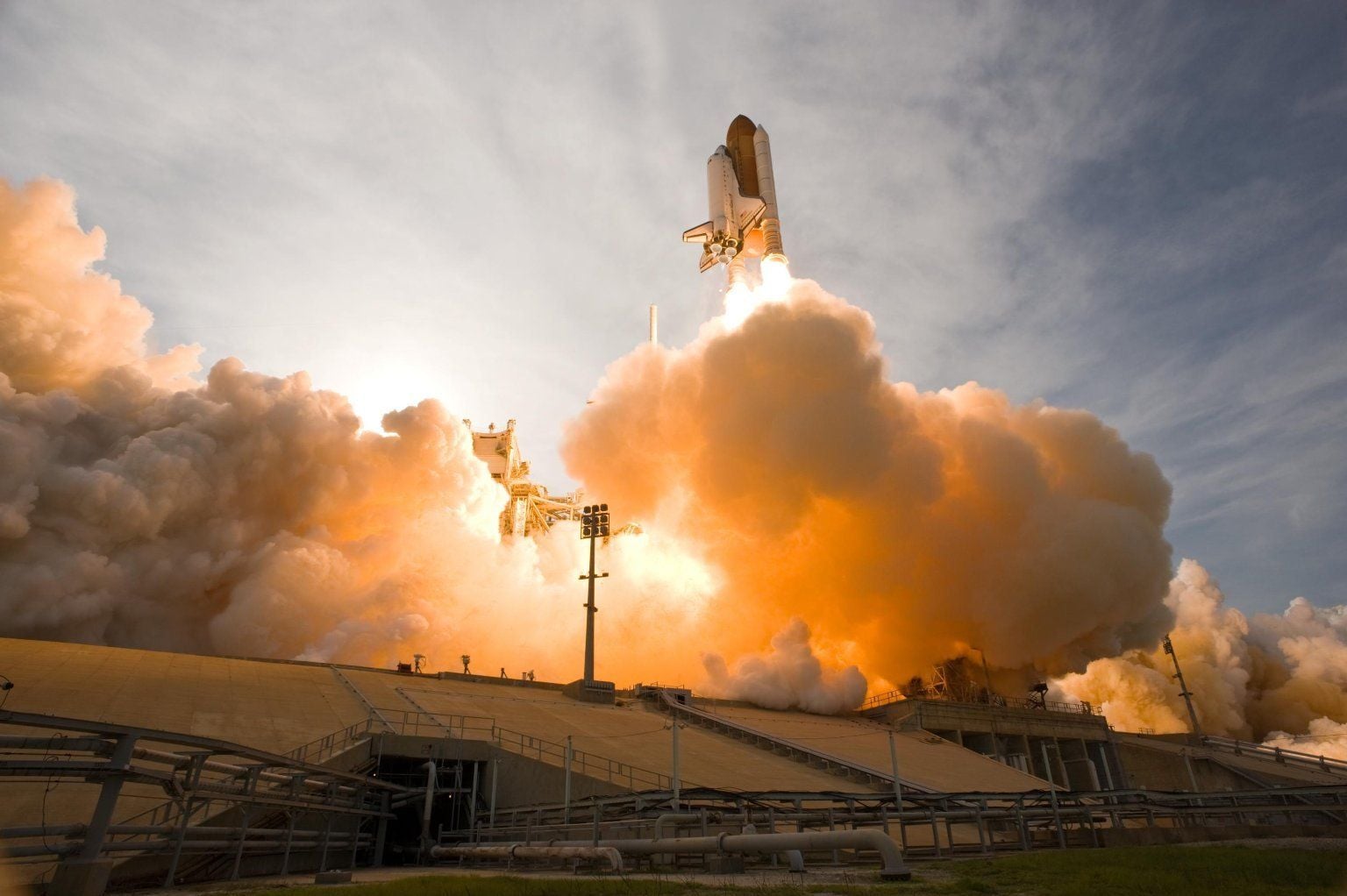
On 15 November 1988, a Soviet space shuttle called Buran lifted off from the Baikonur Cosmodrome in deteriorating weather, circled Earth twice, and returned to a concrete runway with no crew aboard. The flight lasted 206 minutes. The landing was automatic.
It was Buran’s first orbital flight and its last.
What Buran actually did on 15 November 1988
The weather was bad enough to make the launch memorable before the spacecraft ever left the ground. TASS’s history of the flight describes low cloud, snow and rain, with wind gusts reaching 20 metres per second. The state commission chose to proceed.
Eight minutes after launch, the Energia booster had done most of its work and Buran continued toward low Earth orbit. According to the European Space Agency, the uncrewed spacecraft completed two orbits before reentering and landing automatically at Baikonur.
The distinction matters. Buran was not merely remotely flown from launch to landing. The onboard control system executed the flight automatically, while ground systems tracked the spacecraft and supplied navigation corrections. The mission demonstrated what Roscosmos describes as the first automatic landing of a winged orbital spacecraft.
The most dramatic part came near the runway. Winds at the landing complex were strong and gusty, and Buran arrived at the key 20-kilometre guidance point carrying more energy than the nominal profile anticipated.
Its computer responded by taking a longer path around the approach area to bleed off that excess energy. A detailed reconstruction of the flight preserved by the Buran program archive says the orbiter crossed the runway axis, continued around the energy-dissipation cylinder, turned back toward final approach and touched down in an almost maximum allowable crosswind.
After a 1,620-metre rollout, Buran stopped with a lateral deviation of just 3 metres from the runway centreline.
Why it looked like NASA’s shuttle but worked differently
Buran’s silhouette was unmistakable. It had the same broad delta wing, black-and-white thermal protection pattern and large payload bay that made NASA’s orbiters some of the most recognisable machines ever built. The resemblance was not accidental, although describing Buran as a simple copy obscures how different the complete launch systems became.
The Soviet program formally began in 1976 amid concern that the American shuttle’s large payload bay and cross-range capability might have military uses. The Smithsonian National Air and Space Museum describes Buran as the Soviet response to the American shuttle program, while noting the long history of reusable spaceplane concepts that preceded both vehicles.
The largest engineering difference was behind the orbiter. NASA mounted three large cryogenic ascent engines directly on each shuttle orbiter and fed them from the external tank. Buran did not carry an equivalent set of three ascent engines. Energia supplied the main thrust needed to reach orbit.
That made Energia useful independently of Buran. The heavy-lift rocket was designed for payloads of roughly 100 tonnes to low Earth orbit, and its first flight in 1987 did not carry a shuttle. Space Daily has previously covered how Energia’s hardware later became a reference point for proposed super-heavy launch systems.
The automatic landing comparison with NASA also needs care. The American shuttle had sophisticated autoland software capable of guidance through approach and toward touchdown. But a NASA lessons-learned record says the existing automated approach system was never fully flight-tested, and fully automated landing, rollout and braking remained an additional capability that would have required qualification.
Every operational shuttle landing therefore still had a crew aboard. Buran’s 1988 mission demonstrated something operationally different: an orbital spaceplane returning from space and completing its runway landing without a crew.
What the automatic landing system really decided
The computer did not simply look at the wind, decide that the planned direction was unsafe, and choose another runway approach in the way a human pilot might. That version compresses a more interesting piece of guidance software into an easier story.
Buran approached the landing complex through a predefined guidance geometry designed to let the spacecraft dispose of whatever energy remained after reentry. At the 20-kilometre guidance point, its speed was still within allowable limits but higher than nominal.
Post-flight analysis found that the computer therefore selected a longer energy-dissipation trajectory. It banked left, crossed the runway axis and used more of the available approach cylinder before turning back toward final approach. Strong gusty winds were part of the conditions that day, but the documented decision was fundamentally about reaching the runway with the correct energy and geometry.
That distinction makes the accomplishment less anthropomorphic and more technically impressive. The software did not have to “think like a pilot.” It had to keep a powerless glider the size of an airliner inside a mathematical corridor while velocity, position and atmospheric conditions departed from the nominal case.
Then it had to put the landing gear on the concrete. It did.
Why there was never a second orbital flight
The first mission was supposed to be the beginning rather than the climax. Later plans included longer-duration flights and operations connected with the Mir space station. NASA’s history of Mir notes that the station’s Kristall module even carried a docking port originally intended for Buran.
But Buran was reaching flight readiness at exactly the moment the system that financed it was beginning to fail. The project spread across an enormous industrial network: TASS records 1,206 Soviet enterprises and organisations participating in Energia-Buran.
Then the political map changed. The Soviet Union dissolved in December 1991. Baikonur became part of independent Kazakhstan, while design bureaus, factories and suppliers that had once belonged to a single state found themselves divided across new borders and collapsing budgets.
By 1993 the Energia-Buran program had been shut down. Later Russian proposals repeatedly returned to reusable winged spacecraft, and Space Daily documented both attempts to revisit the shuttle concept and plans to reuse Buran-era hardware in the Kliper program.
Buran itself never moved beyond its single orbital mission.
The roof collapse and the machines that survived
The flown orbiter remained at Baikonur until 12 May 2002. Workers were carrying out maintenance on the roof of Building 112 when large sections of the structure collapsed. Eight workers were killed, and Buran was destroyed beneath the debris along with Energia hardware. Contemporary accounts attributed the failure to a combination of heavy rain, deterioration and the condition of the roof; Popular Science’s history of the program traces the spacecraft from its 1988 flight to the collapse.
The loss created a strange historical distinction. The Buran that actually went to orbit no longer exists, while several machines that never reached orbit survived it.
One is OK-GLI, the atmospheric flight-test vehicle fitted with jet engines for approach and landing trials. It completed 25 test flights and is now displayed at the Technik Museum Speyer in Germany.
Another is the nearly completed second orbital vehicle, 1.02, commonly nicknamed Ptichka. It remains at Baikonur. Its ownership has been the subject of years of dispute, which makes the simple claim that it is “the property of Kazakhstan” too definite.
A third flight article, Item 2.01, commonly associated with the name Baikal, followed a different path. After years in storage and at film-related sites, it was transferred in 2024 to the Museum Complex in Verkhnyaya Pyshma near Ekaterinburg. The museum now has a dedicated Buran exhibition centre built around the surviving vehicle.
Some of Energia’s engineering also outlived the shuttle. The RD-180 engine used by American Atlas launch vehicles was derived from the RD-170/171 family developed around Energia. Space Daily has followed that connection through the decades-long use of Russian RD-180 engines on Atlas rockets.
The machine that made the flight left no museum exhibit. What remains of it is film, telemetry, photographs and a concrete runway at Baikonur. On a cold morning in November 1988, Buran came through cloud and crosswind, crossed the runway’s axis high above the ground, curved back toward the approach and finally rolled to a stop three metres from the centreline. Fourteen years later, the roof above it came down.