
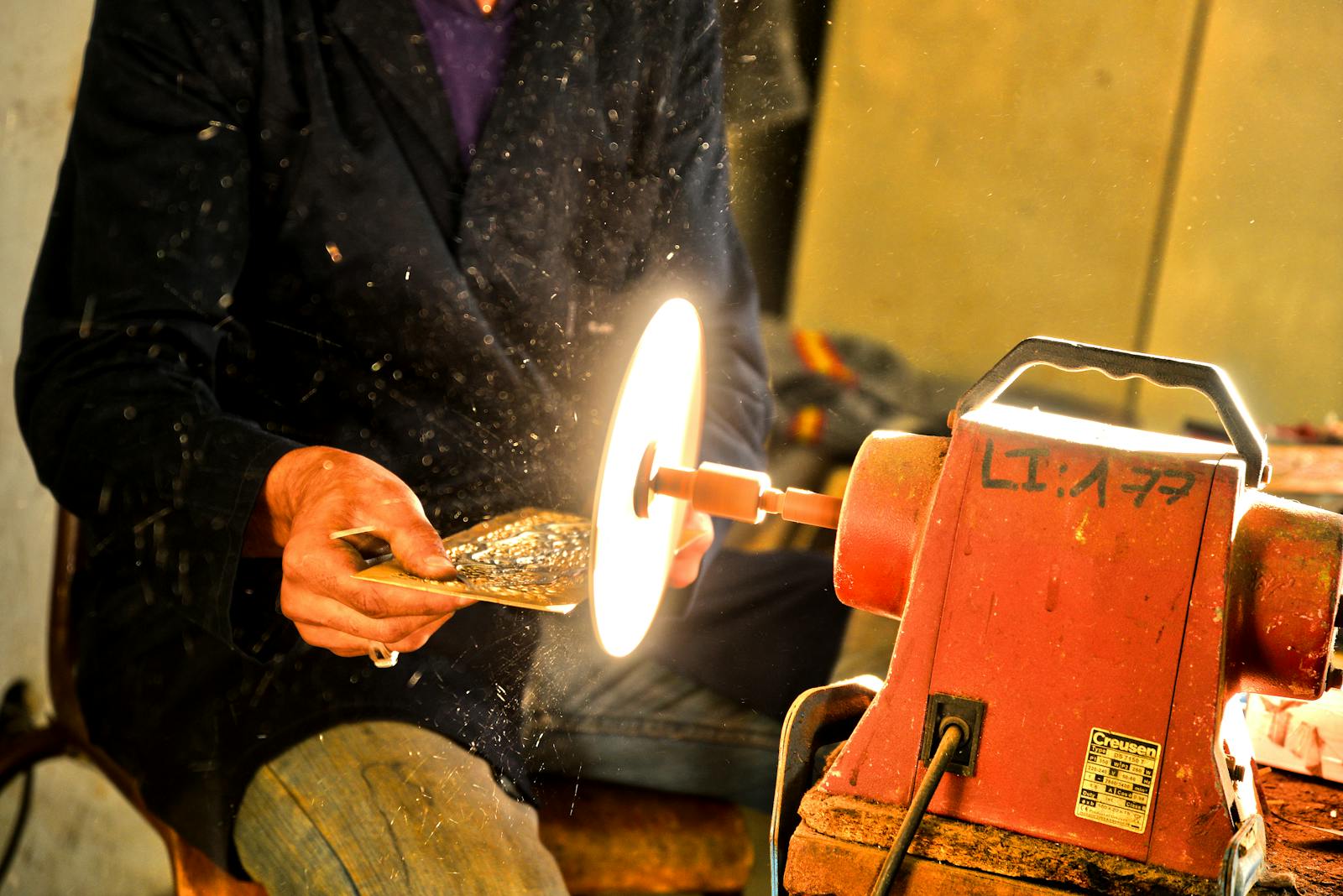
The Hubble Space Telescope’s primary mirror, a 2.4-meter disc of ultra-low-expansion glass, was ground to the wrong shape by roughly 2.2 micrometers at its outer edge. That is about one-fiftieth the width of a human hair, a deviation smaller than a single red blood cell. It was enough to blur every image the telescope sent home for the first three and a half years of its life.
The reason the error went undetected on the ground is stranger than the error itself. The instrument built to verify the mirror’s shape, a device called a reflective null corrector, had been assembled with one of its internal components positioned out of place. The mirror was checked against a ruler that was itself wrong. When the mirror perfectly matched the ruler, the engineers concluded the mirror was perfect. It was, in fact, perfectly polished to the wrong specification.
How a flake of paint blinded a space telescope
The grinding of the mirror began in 1978 at the Perkin-Elmer Corporation in Danbury, Connecticut. The glass blank had been cast by Corning Glass Works, then moved through multiple facilities for shaping and final polishing. Optical technicians worked at night because vibrations from trucks on a nearby interstate were enough to disturb the precision of the work.
To shape a curve that exact, you cannot use a human eye or a caliper. Perkin-Elmer engineers built a custom measuring system called a reflective null corrector, which projected a pattern of laser light onto the mirror to confirm the curvature. The corrector itself contained a small lens, a field lens, and a flat metal reference mirror. The geometry of those internal parts had to be set to within fractions of a millimeter.
Something went wrong inside that device. A small flake of paint had chipped off the end cap of the corrector, exposing bare metal. The laser used to align the device was reflecting off the wrong surface. The result was that the corrector was effectively operating as though one of its internal mirrors was sitting 1.3 millimeters out of position.
That tiny offset propagated outward. The primary mirror was ground to be too flat at its outer edge by about two micrometers. Hubble was designed to focus most of its incoming light into a tight central core. The flawed mirror could manage only a fraction of that. The rest of the light spread into a faint halo around every star.
Two months of celebration, then the press conference
Discovery launched Hubble on April 24, 1990. The first focus images came back in May. Within weeks, NASA engineers running calibration routines realized the point-spread function, the shape of a star as recorded on the detector, was wrong. Light that should have been concentrated in a pinpoint was smeared into a fuzzy ring.
NASA called a press conference and announced the telescope had spherical aberration. Newspapers reported on the problem with sensational headlines, and late-night hosts made jokes about the flawed telescope. Members of Congress demanded answers. NASA had spent years to build the most ambitious astronomical instrument in human history, and it could not focus.
The data was there. Nobody read it.
What makes the Hubble mirror story unusually painful, rather than just unlucky, is that the flaw was detectable on the ground. Perkin-Elmer used two other measuring devices during fabrication, an inverse null corrector and a refractive null corrector, both of which gave readings that disagreed with the primary reflective null corrector. Those readings suggested the mirror had spherical aberration.
The disagreement was filed away. The reflective null corrector was treated as the authoritative measurement, and the optical team trusted it. The 1990 Allen Report, the NASA-commissioned failure review chaired by Jet Propulsion Laboratory director Lew Allen, found that the data revealing these errors were available during fabrication but were not recognized and fully investigated at the time.
There was also a final opportunity that nobody took. After the finished mirror was coated in late 1981, members of the Perkin-Elmer fabrication team began assembling the documents they would need for a thorough end-to-end review of the optics. The Pulitzer-Prize-winning investigation of the failure, reported by Robert Capers and Eric Lipton, recounts that the team was told to stop by Perkin-Elmer’s own project management, which was operating under intense cost and schedule pressure from NASA and could not justify the additional weeks of work. The mirror had been coated, signed off on, and was effectively considered done.
A complete end-to-end optical test of the assembled telescope would have been expensive and would almost certainly have caught the aberration. NASA had declined to require one. The eventual repair mission cost far more.
The washer that might have saved everything
One particular detail of the Perkin-Elmer assembly has haunted the engineering retrospectives. During the build of the reflective null corrector, technicians used metering rods to set the spacing of the internal optics. A small shim, essentially a washer, was used to make a fine adjustment. A retrospective engineering analysis traced the geometry of the error back to the position of that shim and the chipped paint that obscured the laser’s true reflection point.
If a technician had noticed the bare metal, or if the disagreement among the three null correctors had been escalated, the mirror would have been reground or the testing procedure corrected. Instead, the chipped paint sat unnoticed and the wrong reading was logged as gospel.
The fix: corrective glasses for a telescope
The mirror itself was beautifully made. It was polished to within nanometers of a smooth surface. It just happened to be a smooth surface of the wrong curvature. That precision turned out to be the saving grace. Because the aberration was uniform and predictable, opticians on the ground could calculate exactly the inverse error and grind a small set of correcting mirrors that would cancel it out.
The instrument they built was called COSTAR, the Corrective Optics Space Telescope Axial Replacement. It carried ten small mirrors on robotic arms that deployed into the light path of Hubble’s older instruments. A new camera, the Wide Field and Planetary Camera 2, had its own internal correction built directly into its optics.
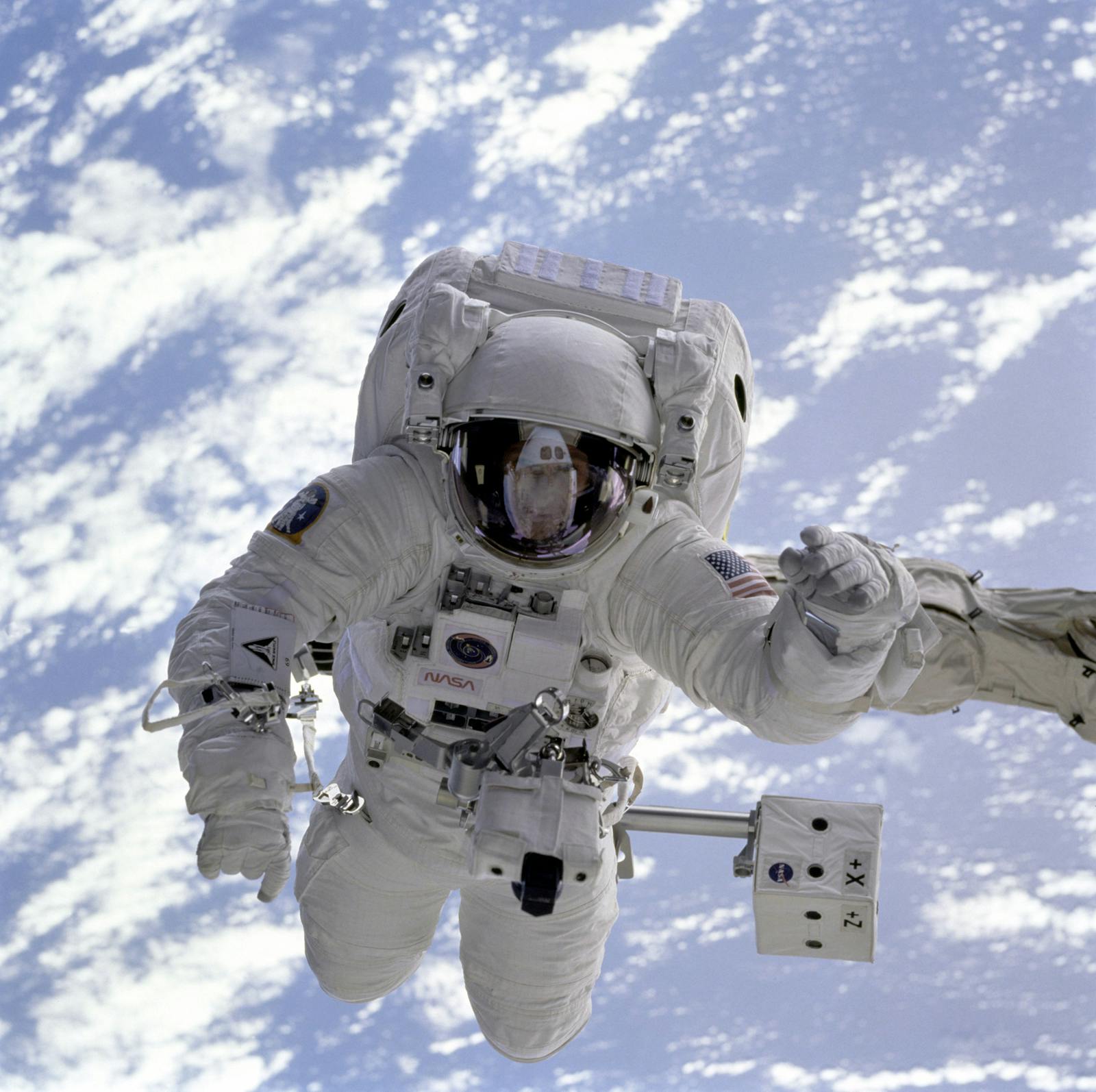
In December 1993, the crew of space shuttle Endeavour, on mission STS-61, flew to Hubble and performed five spacewalks in five days. Story Musgrave, Jeff Hoffman, Kathy Thornton, Tom Akers, and Claude Nicollier installed COSTAR and the new camera, replaced gyroscopes, and upgraded the solar arrays. When the first new images came back, the stars were points of light. Hubble could see.
What the corrected telescope went on to do
Once it could focus, Hubble began producing the observations that defined modern astronomy. It refined the expansion rate of the universe with enough precision to pin its age at 13.8 billion years. It captured the Hubble Deep Field, an image of thousands of galaxies in a tiny patch of sky. It found supermassive black holes at the centers of galaxies. It produced the Pillars of Creation.
And it kept going. Decades after its troubled debut, Hubble continued to publish discoveries that would have been impossible from the ground. The instrument that nearly ended NASA’s reputation in 1990 became one of the most productive scientific machines ever built.
The lesson that shaped its successor
The cost of the Hubble mirror flaw was paid in cash, in reputation, and in years of delayed science. The deeper cost was institutional. NASA spent the 1990s rebuilding trust through five servicing missions, each of them flown by shuttle crews who could physically reach the telescope in low Earth orbit.
That capability does not exist for the James Webb Space Telescope. Webb sits a million miles from Earth at the Earth-Sun L2 point, beyond the reach of any current crewed spacecraft. If Webb had launched with a Hubble-style aberration, there would have been no Endeavour, no COSTAR, no rescue.
Which is why Webb was tested differently. The mirror segments were measured by multiple independent optical systems, cross-checked against each other, and verified end-to-end as an assembled telescope inside a vacuum chamber at the Johnson Space Center. The engineers who designed those tests knew the story of the chipped paint, the unread data, the broken ruler. They built around it.
A coda in micrometers
The original Hubble mirror is still in orbit, still doing science. The aberration is still there, sitting on the surface of the glass, two micrometers shallower than it was supposed to be. Every photon Hubble has captured for three decades has bounced off a flawed curve. The error was never fixed. It was only outsmarted, first by a refrigerator-sized box of correcting mirrors, then by successive generations of cameras that carried their own corrections built into the optics.
The mirror is a kind of monument to how thin the margin between triumph and disaster can be in precision engineering. Two micrometers. One chipped flake of paint. One test that was not run. The width of nothing, ground into a piece of glass orbiting above the Atlantic, still sending back pictures of the early universe.
