
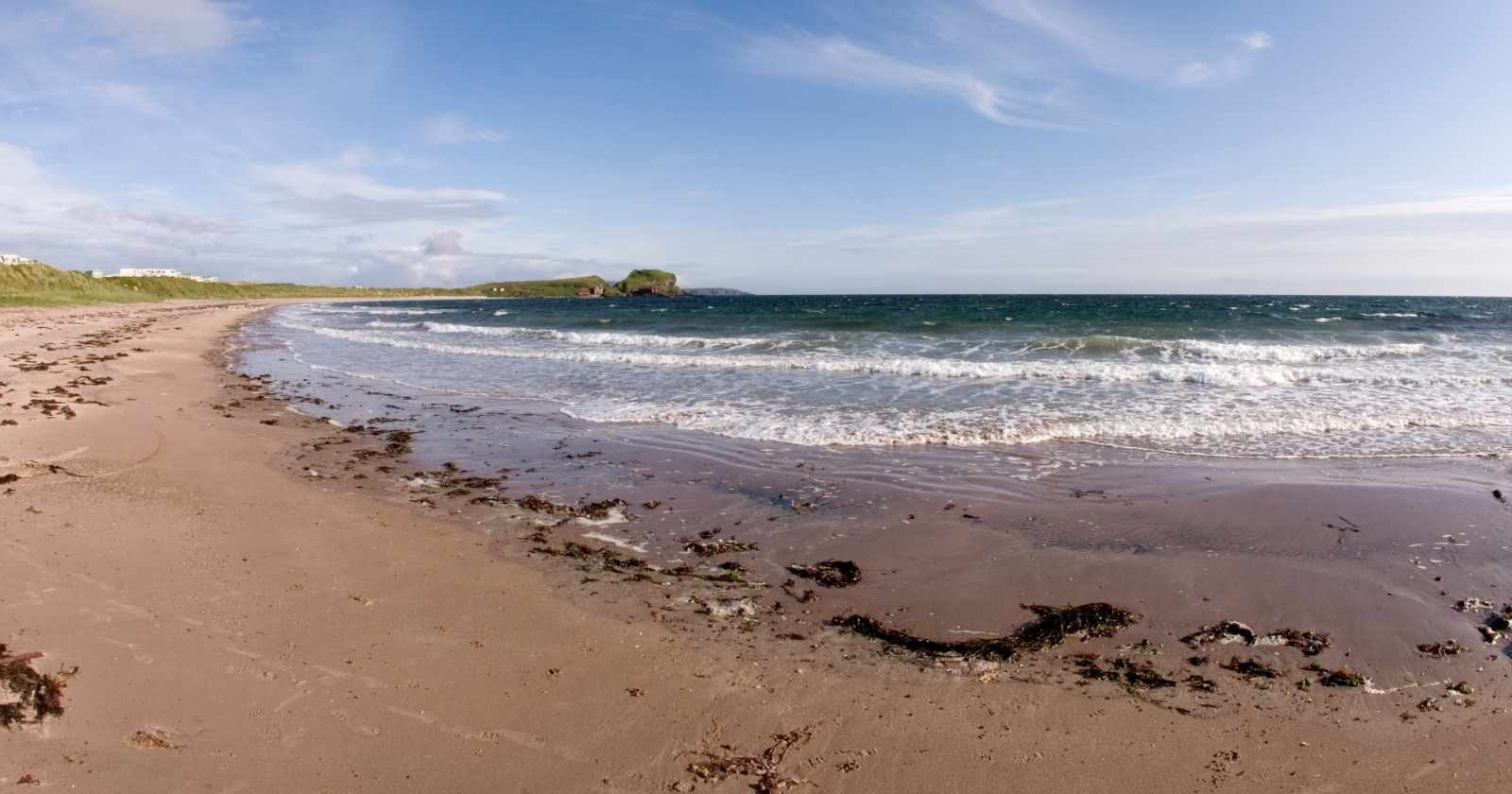
The longest animal ever measured on Earth is not the blue whale. It is a thin, slimy, rust-coloured ribbon worm that washes up on Scottish and Welsh beaches after storms, looking like a tangled bootlace someone dropped in the surf. A single specimen recovered at St Andrews in 1864 was recorded at up to 55 metres long when relaxed — roughly the length of an Olympic swimming pool laid end to end, and longer than the largest blue whale ever weighed.
The animal is Lineus longissimus, the bootlace worm, and it is usually only 5 to 10 millimetres wide. Stretched out, it would lie across more than half a football pitch. Coiled up in a tidepool, it looks like a wet shoelace.
And when you poke it, it bleeds poison.
A worm longer than a whale
Blue whales top out around 30 metres. The bootlace worm, when fully relaxed and uncoiled, has been measured at nearly twice that. The species typically runs 5 to 15 metres, but exceptional specimens push past 30, and the 19th-century St Andrews animal — washed ashore after a storm — remains the benchmark.
The measurement comes with an asterisk. Ribbon worms are absurdly stretchy. Their bodies are built around a hydrostatic skeleton, basically a fluid-filled tube wrapped in muscle, which means the same worm can be a metre long when contracted and ten metres long when relaxed. Length, for a nemertean, is more like a range than a fixed number.
That elasticity is also why the animal is so hard to study. Pull one out of the mud and it snaps back. Drop it in a jar and it dissolves into a knot of mucus. The Scottish specimen was only measurable because it had been thrown onto the sand and stretched flat by the tide.
What it actually is
The bootlace worm belongs to a phylum called Nemertea — the ribbon worms — a group of mostly marine predators that hunt with an eversible proboscis fired out of the head like a harpoon. There are roughly 1,300 known species, and most are obscure enough that even marine biologists rarely think about them. As a single undergraduate at Bodega Bay recently demonstrated, you can still find eleven new species of them in a few months of tidepool sampling on the California coast.
Most ribbon worms are small. The bootlace worm is the outlier — the giraffe of the phylum, except thinner than a phone charger and longer than a humpback. It lives in cold water along the coasts of Britain, Norway, Sweden, and down into the western Baltic, usually buried in mud or tangled under rocks in the intertidal zone.
It feeds on other invertebrates: small crustaceans, polychaete worms, anything soft enough to subdue. The proboscis fires, wraps the prey, and delivers the toxin.
The neurotoxin in the mucus
The poison is what made the bootlace worm interesting to biochemists. When the worm is disturbed, it secretes thick, sticky mucus that coats whatever is touching it. In 2018, a team led by Ulf Göransson at Uppsala University isolated the active peptide from that mucus and published the structure in Scientific Reports. They named it nemertide α-1.
The compound targets voltage-gated sodium channels — the ion gates that nerve cells use to fire electrical signals. Nemertide α-1 jams the inactivation gate open, so the channel cannot reset. The nerve fires, and fires, and fires, until the muscle locks and the animal seizes. Then it dies.
The lab tested it on German cockroaches, fruit flies, and Varroa mites. Cockroaches dropped within minutes. Crabs exposed to small doses became paralysed. Mammalian sodium channels barely responded, which is why the worm has never been considered dangerous to humans handling it — the molecule is shaped for arthropod biology, not ours.

Why a slow worm needs a fast poison
A bootlace worm cannot chase anything. It crawls at the pace of a slug, and most of its body is occupied with being long rather than being fast. The neurotoxin solves that problem. A crab that wanders into the mucus film around a buried worm has its nervous system shut down before it can react. The proboscis fires, the prey is wrapped, and the worm hauls it in.
Some observations suggest crabs in shared tanks may become sluggish when a bootlace worm is present, though whether this occurs at biologically relevant concentrations in natural tidepools remains unclear.
The mucus also works as a defence. Seabirds and fish that try to eat the worm get a mouthful of toxic slime and learn quickly. Specimens washed onto beaches are usually left alone by scavengers.
An insecticide candidate from a Welsh beach
The reason a Swedish chemistry lab spent years on a British seaworm is that nemertide α-1 is, structurally, a useful molecule. Modern insecticides work by hitting insect ion channels — neonicotinoids target acetylcholine receptors, pyrethroids target sodium channels — and resistance is rising in every major pest species. A novel toxin that locks insect sodium channels open, but spares mammals, is exactly the kind of lead compound agrochemical research wants.
The Uppsala team has suggested nemertide α-1 could be developed into a selective insecticide, and the broader nemertean toxin family — there are at least a dozen related peptides in the worm’s mucus — represents a largely unexplored chemical library.
This is the same pattern that has played out across pharmacology for decades: an obscure animal turns out to be a chemistry factory, and the molecule becomes a drug or a pesticide before the public ever learns the species exists. The bootlace worm is now in that pipeline.
How long they live, and what we still don’t know
Until recently, biologists assumed ribbon worms lived about three years. That assumption broke in early 2026 when a related species, Baseodiscus punnetti, was confirmed to have lived at least 26 years in a tank at William & Mary, after being collected from the San Juan Islands in the late 1990s. The worm, nicknamed B, shows no signs of aging.
If a small ribbon worm can live three decades in captivity, the lifespan of a 30-metre bootlace worm in the cold mud of a Welsh estuary is genuinely unknown. It could be a few years. It could be much more. Nobody has tagged one and come back to check.
The longest specimens may simply be the oldest — animals that have been quietly extending themselves through the sediment for decades, picking off crustaceans, secreting their mucus, never seen until a storm flings them onto a beach where a Victorian naturalist or a modern dog-walker finds them and assumes something has gone wrong with a fishing net.
The animal under the seaweed
The bootlace worm sits in a strange category of biological fact. It is the longest known animal on Earth, it produces one of the most potent invertebrate neurotoxins ever isolated in northern European waters, and almost nobody has heard of it. There are no documentaries. There is no charismatic footage. It does not photograph well, because most of the time it looks like a wet rope.
Bootlace worms are not rare along the coasts of Britain and Scandinavia. Walk a rocky Scottish beach after a winter storm and there is a reasonable chance one is somewhere in the wrack line, coiled in kelp, waiting for the next tide.
If you find one, do not pick it up with bare hands. The mucus will not kill you. But it will sting, and it will stick, and somewhere inside the molecules clinging to your fingers is a peptide that a cockroach would not survive.
