

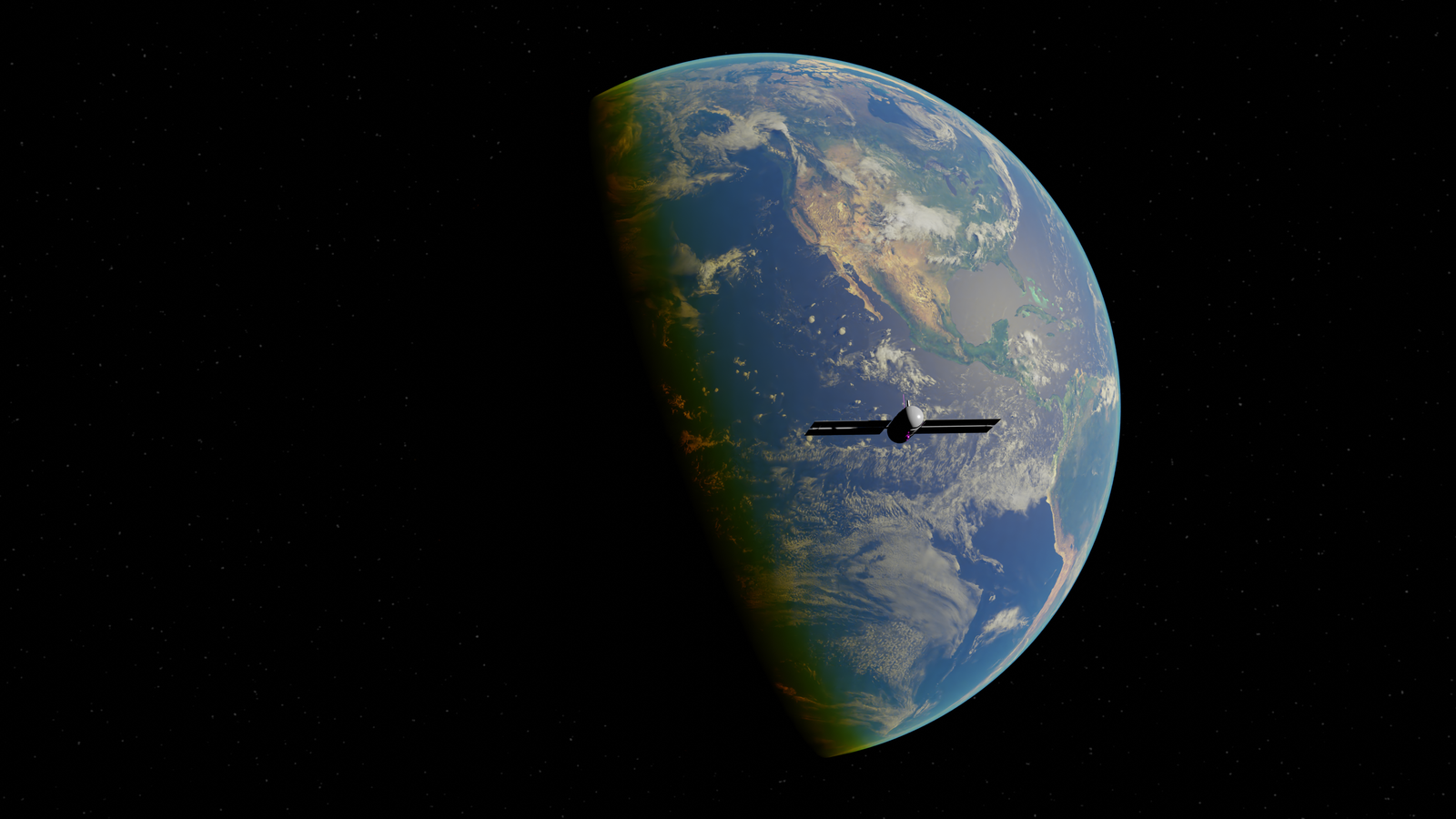
In April 2024, the World Economic Forum and McKinsey & Company put the global space economy at $630 billion in 2023 and projected it could reach $1.8 trillion by 2035, accounting for inflation. The World Economic Forum report and McKinsey’s summary make clear that the number extends far beyond rockets and satellites.
The phrase about the next decade being the industry’s most transformative did not come from that 2024 report. It appeared in an April 2026 UC San Diego feature that cited the WEF forecast and then showed what space-enabled research already looks like on its own campus.
That distinction matters because the $1.8 trillion figure is built around a widening definition of the space economy. It includes hardware in orbit, but also economic activity on Earth that depends on communications, positioning, navigation, timing and Earth-observation systems.

What the $1.8 trillion actually measures
McKinsey divides the market into “backbone” and “reach” applications. Backbone covers satellites, launchers and services such as broadcast television and GPS, while reach covers businesses in other industries that use space technology to generate revenue.
In 2023, the report put backbone applications at $330 billion and reach applications at $300 billion. Its simplest example is Uber: satellites provide positioning signals, phones receive them, and a terrestrial service turns that infrastructure into a product used by drivers and riders.
The report does not say that rocket builders will collect most of the $1.8 trillion. The World Economic Forum’s release says more than 60% of the projected increase will come from five broad areas: supply chain and transportation, food and beverage, defence, retail and consumer lifestyle, and digital communications.
It also treats climate monitoring and disaster warning as examples of value created beyond direct space-industry revenue. A satellite measuring storms, ice or crops can matter economically because of the decisions made with its data on the ground.
Why cheaper access changes the arithmetic
The cost of reaching orbit is one reason those downstream uses have multiplied. In an August 2026 report, Goldman Sachs attributed the shift to reusable launch systems, smaller satellites, advances in computing and modern manufacturing.
Lower launch costs change the threshold for what can be put in orbit and how often it can be replaced. That trend sits behind the broader decline in launch costs that has pushed spaceflight toward more repeated, higher-volume operations.
But cheaper launch is not the same thing as saying launch providers capture the whole forecast. The WEF-McKinsey model is explicitly broader: a larger share of future value comes from services and industries that use orbital infrastructure rather than build it.
That is also why a projection this large cannot be read as a stock-market target or a guaranteed revenue pool. It is an estimate of economic activity across categories whose boundaries will keep changing as satellite services become embedded in products that consumers may never think of as “space.”
Where UC San Diego actually fits
UC San Diego offers a concrete view of that boundary, but its strongest medical examples are experiments that actually go to orbit, rather than ordinary wearable sensors assumed to need satellite backhaul.
The university’s Sanford Stem Cell Institute reported in March 2026 that it had launched 18 sets of scientific research to the International Space Station, with more projects being prepared. The work includes stem cells, brain organoids and regenerative-medicine research connected to cancer, neurological disease and other conditions.
Researchers use the stresses of spaceflight and microgravity to study how cells behave under conditions that can accelerate some biological changes. The experiments are packed into small automated laboratories, turning low Earth orbit itself into part of the research apparatus.
On the climate side, Scripps Institution of Oceanography is leading a NASA Earth-observation mission called the Earth Dynamics Geodetic Explorer. EDGE was selected by NASA in February 2026 to measure forests, glaciers, ice sheets, sea ice and coastal regions with imaging lidar, with a launch readiness date no earlier than 2030.

Those projects are much cleaner examples of the overlap between space infrastructure and activity on Earth. One sends biological experiments upward; the other sends measurements downward.
They should not be treated as proof that every medical device or climate program belongs inside McKinsey’s total. The report models broad categories of space-enabled economic activity, while university research can create scientific value long before it becomes commercial revenue.
The forecast is a model, not a measurement
The $630 billion figure describes an estimated 2023 market. The $1.8 trillion figure describes 2035, so it necessarily depends on assumptions about adoption, access, investment and the continued spread of satellite-enabled services.
The authors themselves frame the number as an estimate, not an endpoint already locked in. Their report asks how large the backbone and reach categories could become and what factors will determine the trajectory through 2035.
That makes the categories as important as the headline total. When navigation, Earth observation or satellite communications become inputs to transportation, retail, agriculture or insurance, part of the economic value moves outside companies that most people would identify as space businesses.
The uncertainty cuts both ways. Payload’s summary of the 2024 report described a downside case of $1.4 trillion by 2035 if alternatives to space-based positioning emerged alongside flatter cost and accessibility trends.
Why space technology disappears into ordinary products
A camera sensor offers a useful precedent. In the early 1990s, Eric Fossum and his team at NASA’s Jet Propulsion Laboratory developed a CMOS active-pixel sensor while trying to reduce the size and power demands of spacecraft cameras.
JPL says the technology later became ubiquitous in digital cameras and smartphones. The path from a spacecraft engineering constraint to a component carried in billions of pockets is the kind of downstream effect that makes a narrow definition of the space economy hard to maintain.
The same history sits behind Space Daily’s look at how CMOS imaging moved from spacecraft engineering into everyday cameras. By the time the technology is inside a phone, most users no longer experience it as a space technology at all.
The WEF-McKinsey “reach” category is an attempt to account for that kind of indirect dependence without pretending that every dollar from a phone, delivery service or farm belongs to the space sector. What matters is the part of the activity enabled by space infrastructure.
What 2035 would actually mean
The WEF forecast is therefore less a prediction about how many rockets will launch than a claim about how deeply orbital systems may become embedded in ordinary economic activity. Communications, positioning and Earth observation are the infrastructure layer; the visible products can be somewhere else entirely.
UC San Diego’s work makes that abstraction physical. A sealed laboratory can circle Earth with living cells inside it, while a satellite sends laser pulses toward ice and forests so researchers can measure changes across the planet.
By 2035, neither scene may look unusual. The $1.8 trillion forecast depends on exactly that possibility: space technology becoming common enough that much of its economic value is felt on Earth, long after the hardware overhead has disappeared from view.