

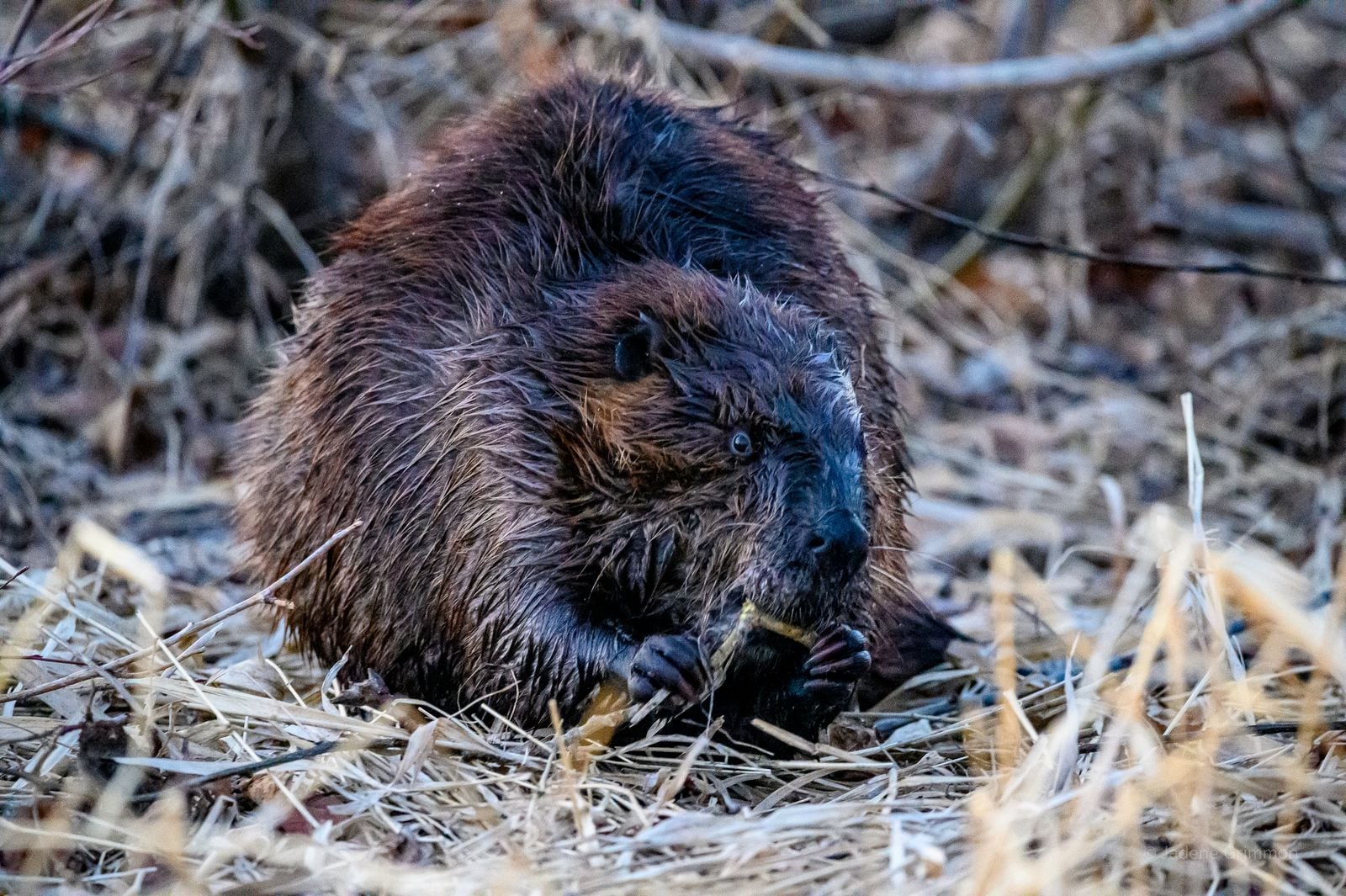
The animal is the Eurasian beaver, Castor fiber, and its North American cousin Castor canadensis. An adult weighs 16 to 30 kilograms, roughly the mass of a Labrador. It fells trees with orange incisors that never stop growing, drags the trunks into a stream, packs the gaps with mud and stones, and within a season converts a fast-moving channel into a chain of ponds and saturated meadows. The dam is usually less than two metres tall. The hydrological effect reaches hundreds of metres upstream and out into the floodplain. Field measurements in restored beaver reaches — in Devon, in Utah, in eastern Oregon — have recorded water tables rising by 30 centimetres to well over a metre in the wet ground behind the dams, with the biggest lifts on incised valley floors where the stream had cut down and dried out the surrounding soil. That saturated ground is the trick. Waterlogged peat and marsh soils decompose so slowly that they hold, per hectare, more carbon than the forest canopy standing above them. A 20-kilo rodent, in other words, engineers the conditions under which soil out-stores trees.
How the dam changes the valley
A beaver’s ambition is narrow. It wants deep, still water it can swim in without exposing its back to wolves or eagles, and an underwater entrance to its lodge that won’t freeze shut. Everything else is a side effect.
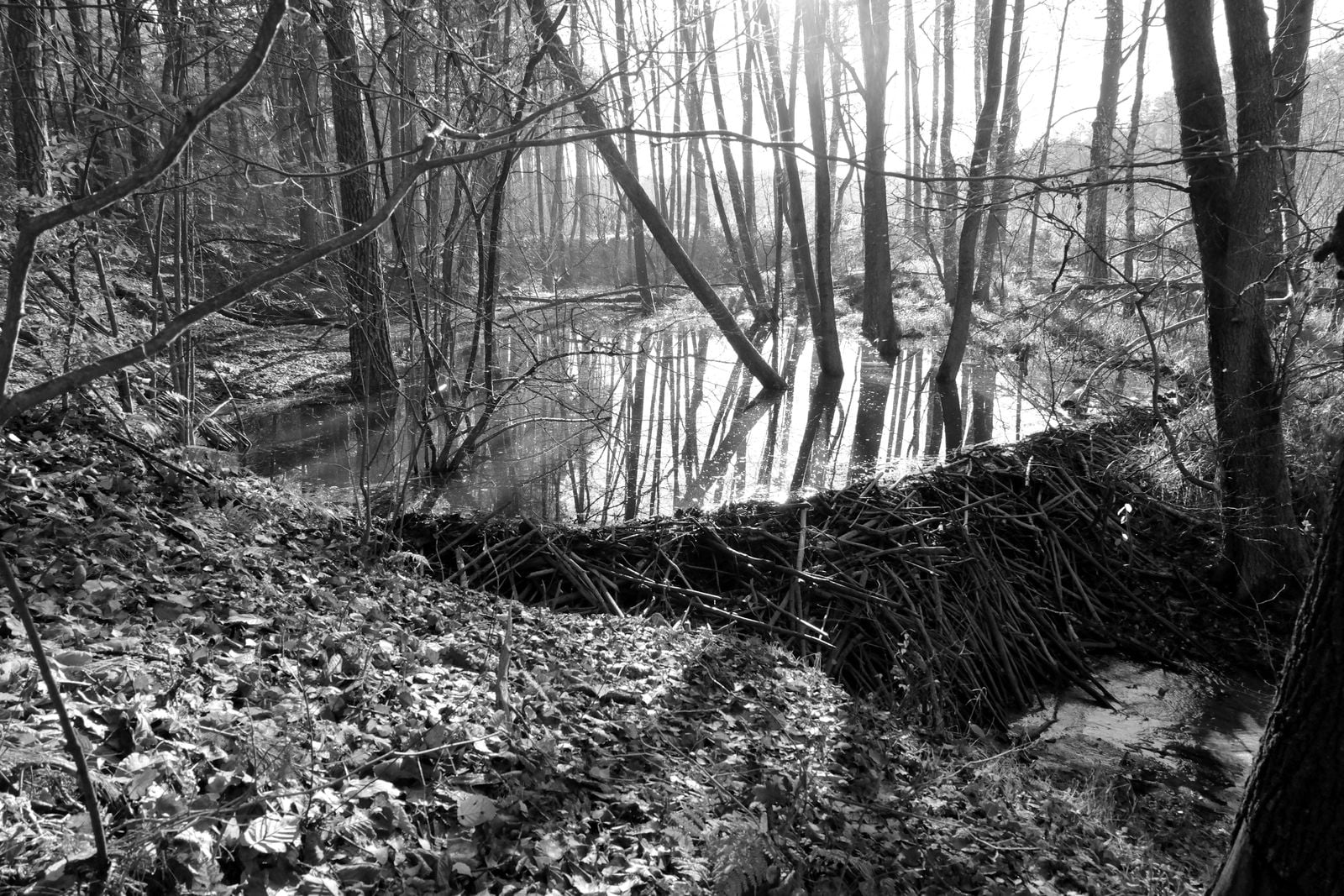
To get that pond, the animal cuts alder, willow, aspen, birch. It wedges the butt ends into the streambed at an angle, weaves finer branches into the gaps, and plasters the upstream face with mud and river-bottom sediment scooped up in its forepaws. The resulting structure is porous enough to leak steadily but tight enough to raise the water level upstream by a metre or more. Behind the dam, current slows to almost nothing. Silt drops out. The channel widens. Water pushes sideways into the old floodplain.
Then the water table follows. Groundwater sits at the level of the nearest surface water, so when the pond rises, so does the saturated zone in the surrounding soil, sometimes for a hundred metres on either side. Meadows that had been dusty by August stay green. Willows sprout. Sedges move in. The valley bottom becomes a wetland.
The clearest modern data on beaver hydrology comes from a fenced enclosure in Devon, England, where Eurasian beavers were released in 2011. Over the next decade, researchers tracked water flow, sediment and chemistry as the animals built dams along a small stream that had previously run straight through pasture. Peak storm flows leaving the site fell substantially. Sediment loss from the upstream farmland was captured in the ponds — hundreds of tonnes of it, laced with fertiliser nitrogen and phosphorus that would otherwise have reached the river. The water table in the surrounding wet meadow rose. Willow, rush and sedge replaced the grass monoculture. What had been a drainage ditch became a mosaic of pools, wet woodland and boggy ground. Similar work in the western United States — on Bridge Creek in Oregon, in the Escalante drainage in Utah — has shown that beaver dams and their human-made analogues can raise incised stream water tables by close to a metre within a few years, reconnecting streams to floodplains that had been dry for a century.
Why wet soil beats dry forest at holding carbon
Forests store carbon in trunks, branches and roots. Wetlands store it underground, in soil that never fully decays. The difference matters. Wood eventually burns, rots or is logged. Waterlogged organic matter, starved of oxygen, can sit intact for centuries.
Wetlands cover less than 10 percent of the world’s land surface but hold roughly 20 to 30 percent of the carbon stored in soil. When Anthony Stewart and colleagues at the University of Washington included previously unmapped wetlands under the forest canopy, the watershed’s estimated carbon-storage capacity rose fivefold. The wet ground under the trees was holding five times more carbon than the trees themselves had been credited with.
That is the ratio beaver ponds tap into. The animal doesn’t grow the carbon. It creates the anaerobic soil conditions that stop carbon from leaving.
How do you actually measure carbon staying put in mud? A team buried tea bags across 180 wetlands in 28 countries — green tea for organic matter that breaks down quickly, rooibos for the slower-decaying kind. Bags were buried 15 centimetres deep, GPS-tagged, and pulled up over three years. The mass that remained is a proxy for how much carbon the soil had preserved. Freshwater wetlands and tidal marshes had the highest remaining mass — meaning the least decay, the most carbon retained. Beaver ponds are freshwater wetlands. The study also found that warmer temperatures always drove more decomposition of the rooibos, the hard-to-degrade fraction. The carbon everyone assumed was locked away for centuries turns out to be temperature-sensitive.
That is one reason the beaver’s engineering matters now. A beaver pond does not just create wet soil. It creates cool wet soil, shaded by willows and cottonwoods, fed by groundwater rather than sun-warmed runoff. The animal builds the exact conditions the tea-bag study identifies as best for keeping carbon in the ground.
The catch: age, warmth, and methane
Wet ground is not an unlimited carbon vault. A study of two constructed freshwater wetlands in Ohio, tracked for 29 years, found their rate of carbon capture declined sharply as they aged. Early on, the wetlands buried carbon aggressively as new plants colonised bare mud. After a decade or two, the sequestration rate dropped. The soil filled up. The system approached a steady state.
Beaver ponds behave the same way, and then some. Beavers abandon ponds. Dams breach. When a pond drains, its soil is exposed to air, and microbes get to work on the carbon that had been safe underwater. Some of that carbon washes downstream. Some vents to the atmosphere as CO2. Beavers also flood soils that then emit methane — a shorter-lived greenhouse gas but, molecule for molecule, far more warming than CO2 over a twenty-year window.
The net carbon accounting depends on how long the wetland persists, what vegetation grows in it, and how much methane bubbles up. Studies in boreal and temperate systems generally find beaver ponds are net carbon sinks over decades, especially when they replace incised, eroding channels. The math tightens in warm climates. Louisiana’s coastal marshes, one of the planet’s densest carbon reservoirs, release large volumes of stored carbon back to the atmosphere when they are lost, according to LSU wetland scientist Kanchan Maiti. Louisiana loses a football field of wetland every 100 minutes and holds 40 percent of all U.S. wetlands.
What a rodent does that a policy cannot
Governments have spent decades trying to build what a beaver builds for free. Constructed wetlands, restored oxbows, engineered floodplain reconnections — all attempt to reproduce the hydrology a colony of beavers assembles in a few seasons using their teeth.
The efficiency gap is stark. A single beaver family, four to eight animals, can maintain a kilometre of dammed stream. Their maintenance cost is willow bark. They respond to breaches in real time. They add new dams when the pond silts up. They abandon and rebuild in response to floods. No human wetland-restoration crew works at that resolution.
The animal’s political footprint is also small. Beavers do not consult stakeholders. They flood roads, culverts and hay meadows without warning. In much of Europe they were hunted to near-extinction by the early 20th century for fur and castoreum; reintroductions beginning in the mid-20th century in Scandinavia, Germany, France, the Netherlands and, more recently, Britain, have restored populations across most of their historic range. The Eurasian beaver is now protected under European law. In Britain, wild-living beavers were granted legal protection in 2022.
The carbon value of intact wetlands remains poorly quantified in many national inventories, which means the animals doing the work — and the ecosystems they build — are undercounted in climate accounting.
The soil under the trees
Look at a beaver pond in cross-section and you see something the satellite view misses. The visible pond is only the top of the system. Below it and around it is a wedge of saturated soil that extends into the valley walls, sometimes tens of metres. That wedge is where the carbon accrues.
In the Cerrado of central Brazil, seasonally flooded wetlands called veredas hold far more carbon per hectare than the surrounding savanna — recent measurements put peat stocks in these systems in the range of a thousand tonnes of carbon per hectare, orders of magnitude above typical dry savanna soils. The above-ground vegetation is unremarkable — palms, grasses, sedges. The carbon is in the peat below. The same asymmetry holds in Washington’s Olympic forests: the trees are magnificent, but the wet soil under them is where the carbon actually lives. (See also Costa Rica’s forest recovery story and work on tropical forest carbon accounting.)
Beavers are the largest freshwater engineers of that soil layer in the northern hemisphere. They cannot outweigh a Douglas fir. But they can flood the ground the fir is growing in, and once that ground is flooded, its carbon accumulates faster than the forest can add wood.
A twenty-kilo climate machine
The reintroduction ledger keeps growing. Beavers are back on the Otter in Devon, the Knapdale peninsula in Scotland, the Klamath Basin in California, the Elwha after the dam removals, and in stretches of the Danube where they were absent for two centuries. Wildlife agencies in Utah, Idaho and Oregon are training landowners to install beaver dam analogues — post-and-brush structures that mimic a dam until real beavers move in and take over. The animal is being treated, quietly, as infrastructure.
The scale is worth holding in mind. A pre-colonial North American beaver population is estimated at 60 to 400 million animals, with hundreds of millions of dams. By 1900, fewer than 100,000 remained on the continent. What Europeans hunted out was not just a fur-bearing rodent. It was the hydrological state of a continent — the wet meadows, the slow streams, the saturated valley bottoms, the carbon-holding soil that all of that maintained.
The current North American population is estimated at around 10 to 15 million. A fraction of what it was. Still enough, in the right valleys, to raise water tables by close to a metre and reset the carbon budget of the ground beneath the trees. All of it done by an animal that weighs less than a bag of cement, chews wood at night, and has no idea it is doing any of this.