
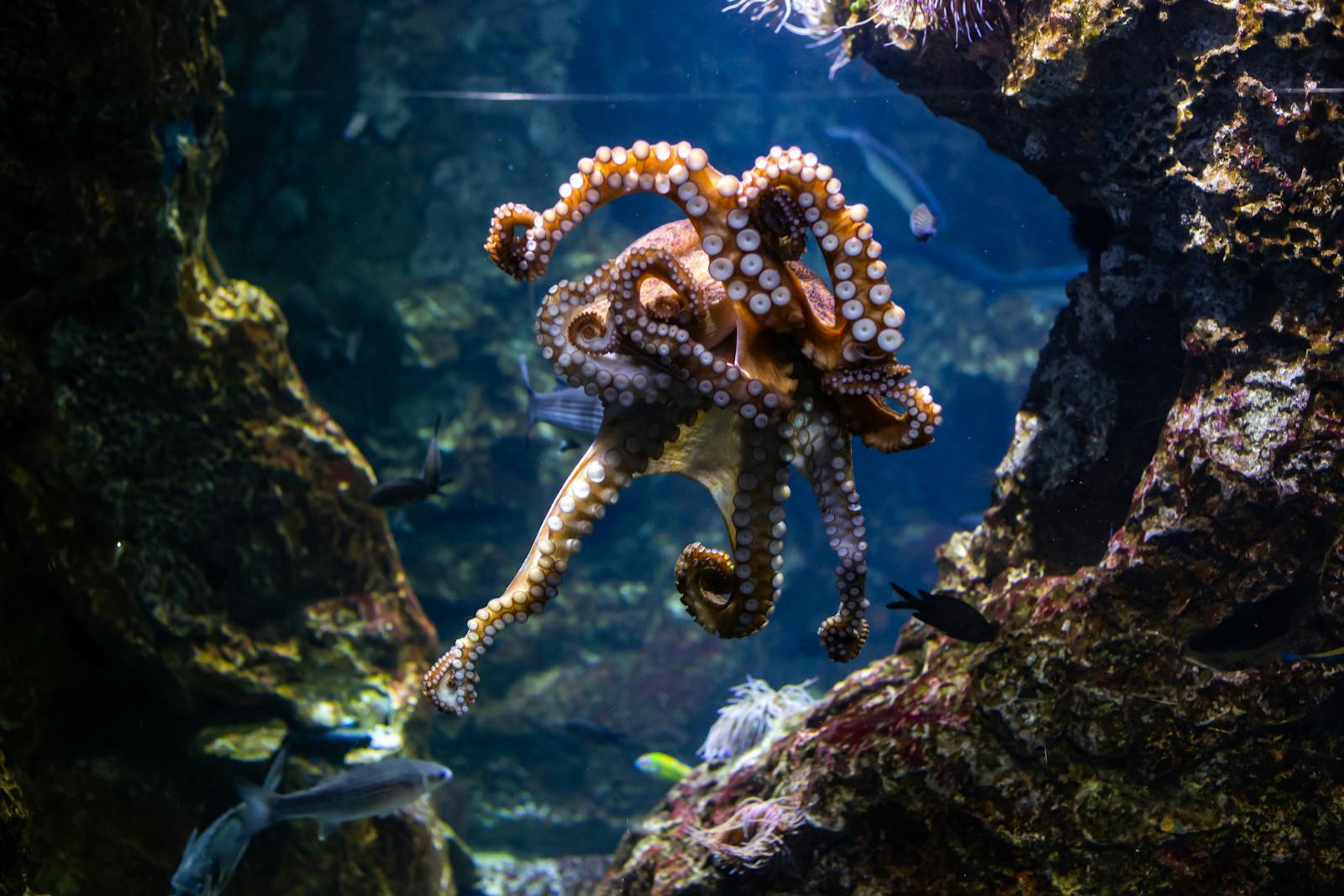
An octopus reaching into a crevice is not simply moving a limb the way a human moves a hand. The arm is lined with suckers that can touch and chemically sample the surface around it, while a large share of the animal’s nervous system sits inside the arms themselves.
That is the fact that makes octopus anatomy feel almost like science fiction. The common octopus has around 500 million neurons, and the Natural History Museum in London notes that about two-thirds of them are in the arms, not in the central brain. The animal still has a central brain, but it does not run the body like a single executive issuing detailed orders to eight passive limbs.
The headline arithmetic reads like a riddle. Nine brains. Three hearts. Blue blood. Eight arms that can taste, move, grip, explore, and respond with a degree of local control that has no close parallel in vertebrate bodies.
Nine brains, but not in the cartoon version
The phrase “nine brains” is shorthand, but it is not pure myth. An octopus has one central brain wrapped around the oesophagus, plus major nerve structures running through each arm. Those arm nerve cords are packed with neurons and can handle a surprising amount of local sensory and motor processing.
Call them ganglia if you want to be technical. Call them mini-brains if you want the image to land. The important point is that octopus arms are not puppets on strings. They are more like semi-independent workers connected to a central coordinator.
What the central brain still does
The central brain matters. It helps coordinate the animal’s overall behaviour, learning, memory, vision, and broad intentions. When an octopus sees prey, chooses a direction, or solves a problem, the central brain is still part of the story.
But the arms are not waiting for every instruction. They contain local circuitry that allows them to probe, taste, grip, adjust, and explore. The central brain can guide the mission while the arms work out many of the details.
Each arm can taste and react
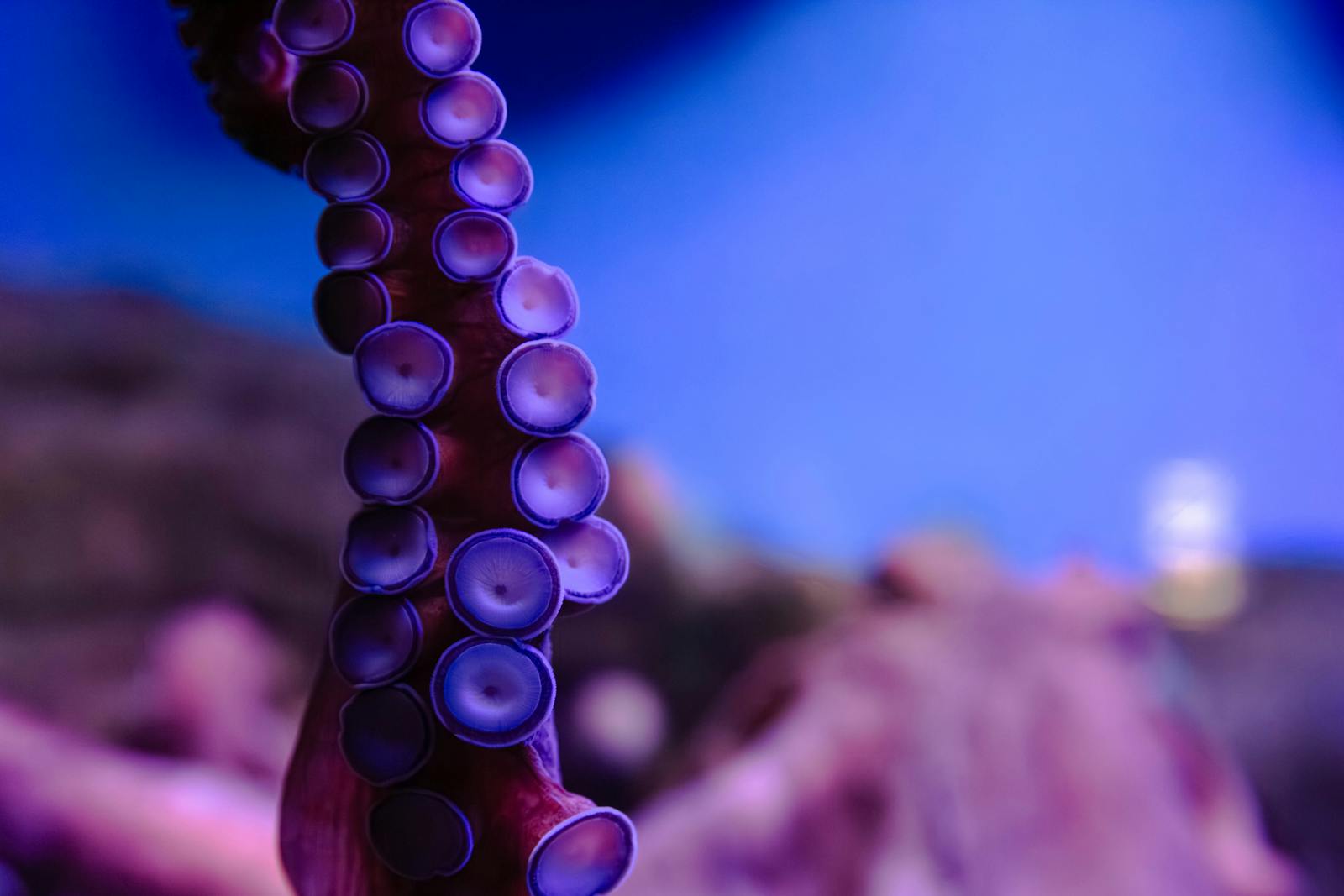
The suckers are not just suction cups. They are sensory organs. They help the octopus feel texture and chemically sample what they touch, which is why people often describe octopuses as tasting the world with their arms.
A 2025 paper in Bioelectronic Medicine recorded neural activity from detached octopus arms and found that electrical signals in the arm could predict movement responses very quickly after stimulation. The clean version is not that the arm is “thinking” like a separate animal. It is that the arm contains enough local circuitry to turn sensation into action without needing the central brain to micromanage every twitch.
That distinction matters. A severed or isolated arm can still respond to stimulation, but a living octopus is a whole animal. Its intelligence comes from the interaction between central control, arm-level processing, sensation, muscle, and environment.
The arms are built in segments
The distributed nervous system is not a loose tangle. A 2025 Nature Communications study on cephalopod arms found that the axial nerve cord running through the octopus arm is organised into repeated neuronal segments. That gives the arm a modular structure for controlling movement and mapping the suckers along its length.
In practical terms, that means different parts of the same arm can participate in different pieces of a task. One section may be anchoring to a rock while another explores a crack. One sucker may be sampling a surface while another is adjusting grip. The arm is not a simple cable. It is a living, sensing, flexible control system.
Three hearts, and why they need them
The three-heart system is the second strange piece of the animal. Two branchial hearts pump blood through the gills, where it can pick up oxygen. A third systemic heart sends that oxygenated blood through the rest of the body.
This arrangement helps support an active animal with a demanding body plan. Octopuses crawl, squeeze, hunt, hide, jet through water when they need to, and operate eight flexible arms filled with sensory and motor machinery. The circulatory system has to keep up.
Why the blood is blue
Human blood is red because haemoglobin uses iron to carry oxygen. Octopus blood is blue because it uses haemocyanin, a copper-containing oxygen carrier. The same Natural History Museum article explains that this copper-based protein works well in cold and low-oxygen ocean conditions.
When oxygenated, octopus blood can look blue. When it loses oxygen, it can become much paler. The effect is one of those details that sounds invented until the chemistry catches up with the image.
What a decentralised body changes
The deeper question is not whether octopuses are intelligent. They solve problems, learn, explore, manipulate objects, and show flexible behaviour. The stranger question is where their intelligence lives.
In vertebrates, people are used to thinking of a central brain as the command centre and the body as the machinery that carries out instructions. The octopus complicates that picture. Its central brain is important, but so are the arms, the suckers, the nerve cords, and the feedback loops between touch, movement, and decision.
That makes the octopus feel alien not because it came from another planet, but because it represents a different evolutionary answer to the same problem: how to build a body that can sense the world, decide what matters, and act quickly enough to survive.
An ancient experiment in being a mind
Cephalopods and vertebrates split from each other hundreds of millions of years ago. The last common ancestor of humans and octopuses was nothing like either species today. Complex octopus behaviour, camera-like eyes, problem-solving, and distributed motor control evolved along a very different path from the one that produced mammals and birds.
That is why octopuses are so useful to think with. They show that intelligence does not have to be built around a body like ours. It can be centralised, distributed, embodied, tactile, chemical, and soft-bodied all at once.
Why roboticists care
Engineers building soft robots have been paying attention for a reason. Controlling a flexible arm with no bones is a brutal computational problem. Every point along the arm can bend, twist, shorten, lengthen, grip, and press against the world.
A 2022 paper in Frontiers in Robotics and AI argued that conventional central planning would be computationally intractable for an octopus-style arm. The octopus points to a different approach: put more intelligence into the limb itself, let local control solve local problems, and allow the central system to guide rather than command every detail.
That is not just biology trivia. It is a design philosophy. You do not always need a bigger central brain. Sometimes you need smarter edges.
The strangeness, all the way down
Add it together and the animal becomes even stranger. An octopus has three hearts, copper-based blue blood, a central brain wrapped around the oesophagus, and most of its neurons distributed through eight arms that can taste, grip, explore, and respond with local control.
It is not nine separate minds arguing inside one body. That would go too far. But it is also not one brain puppeteering eight obedient limbs. The truth is more interesting: a body in which control is shared, sensation is spread out, and intelligence is partly built into the arms that touch the world first.
The next time you watch an octopus slip through a hole the size of its eyeball, you are not watching a single command centre drag eight limbs behind it. You are watching a nervous system distributed through a soft body, solving the world by touching it.
And every sucker, on every arm, is sampling the dark as it goes.
