
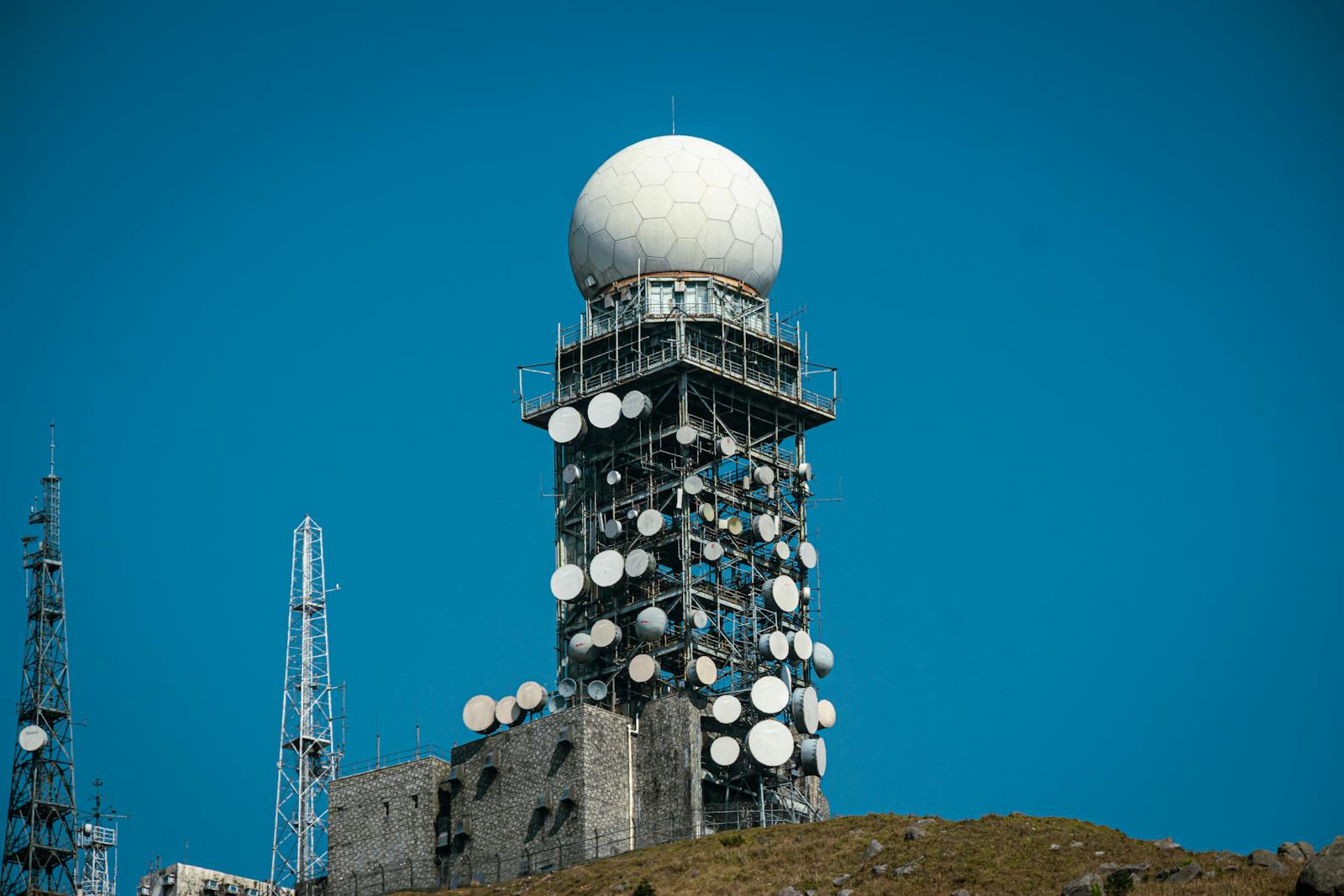
Ground stations have moved from the quiet edge of space infrastructure to the center of military targeting calculations. The shift, accelerating since 2022, is forcing satellite operators, regulators, and defense planners to rethink assumptions baked into commercial space architecture for decades.
The pattern is now unmistakable. A cyberattack disabled Viasat KA-SAT terminals across Europe around the time Russian tanks crossed into Ukraine. Subsea cables to Arctic ground stations have been damaged. Ground infrastructure has faced attacks in conflict zones. Cloud computing facilities have been targeted by drones. The physical and digital plumbing that connects orbit to Earth is being treated, by adversaries, as legitimate wartime terrain.

The 90-minute problem
According to a SpaceNews report on the industry’s evolving threat posture, satellite architectures that depend on a small number of ground sites can produce significant downlink latencies before processing even begins. For commercial Earth observation that is acceptable. For a military commander watching armor mass on a border, it is not.
Extended latency periods create operational challenges. In the opening hours of a fast-moving invasion, time matters. Tanks advance. Positions change. The Russian convoy that satellite imagery captured advancing on Kyiv in February 2022 became the iconic image of why latency matters in modern conflict.
Distributed networks change that math. Ground station operators with geographically diverse antennas can reduce downlink latency when traffic flows across multiple sites.
Regulation lags the threat
The technical capacity to reroute satellite traffic across continents already exists. The legal authority to do it, on the timescale that matters, often does not.
Ground stations must be licensed to transmit to specific spacecraft, and those licenses are geographically limited. National regulators — the FCC in the United States, Ofcom in the United Kingdom, ANFR in France, and their counterparts elsewhere — each maintain their own approval processes, frequency coordination requirements, and review timelines. A station authorized to talk to one satellite over one band cannot simply pivot to another mission, or to another spacecraft in the same constellation, without a corresponding amendment.
That mismatch — instant rerouting capability paired with multi-week licensing timelines — is one of several operational vulnerabilities that adversaries can exploit. Take down a primary site, and traffic cannot legally hop to a backup until paperwork catches up. Operators interviewed in the SpaceNews reporting describe pre-licensing more sites than they expect to use as a hedge, precisely because emergency authorizations cannot be relied on to materialize within a useful window. The implicit message: peacetime bureaucratic rhythms are not compatible with wartime infrastructure resilience, and regulators have only just begun to grapple with that gap.
Cables, drones, and the limits of redundancy
Even a perfectly distributed antenna network depends on something less glamorous: fiber. Ground stations downlink data, but that data still needs to travel somewhere — usually through undersea cables that no satellite operator controls.
In January 2022, one of two fiber-optic cables connecting the Svalbard ground station to the Norwegian mainland was severed on the Arctic seabed, an incident detailed by Reuters reporting on Arctic security. The Svalbard site is used by Western space agencies to gather signals from polar-orbiting satellites. Backup connectivity was disrupted. The cause was never definitively established, which is itself part of the problem: cable damage sits in a gray zone between accident, sabotage, and act of war.
Air-based attacks have moved from theoretical to demonstrated. Cloud computing infrastructure in the Middle East has faced drone targeting. The targeting of a British airbase on Cyprus by drones, reported by The Guardian, illustrated how cheap aerial weapons can reach previously secure Western military assets — and how host nations may respond by questioning the political arrangements that allow such facilities to exist at all.
The cumulative picture: ground infrastructure faces threats from cyberspace, the seabed, and the air simultaneously.
The Viasat precedent
The 2022 Viasat KA-SAT attack remains the clearest case study of what happens when ground-based systems are weaponized in coordination with kinetic operations. The attack disrupted terminals across Europe, with significant impact in Ukraine. UK and US intelligence later attributed the operation to Russia, with the British National Cyber Security Centre assessing with high confidence that Moscow was responsible, according to BBC reporting on the attribution.
What made Viasat important was not just the scale of disruption but the timing. The attack occurred in close proximity to Russian forces crossing into Ukraine. Satellite communications were treated as a legitimate first-strike target, on par with air defenses or command nodes.
That precedent has reshaped commercial planning. Operators serving defense customers — even indirectly, through dual-use imagery or communications contracts — now have to assume their ground infrastructure may be considered a combatant asset by adversaries.
The orbital alternative — and its catch
One response to terrestrial vulnerability is to push more functions into orbit. Inter-satellite optical links can move data between spacecraft directly, reducing dependence on any single ground site. Companies including SpaceX and several defense-focused operators have moved aggressively in this direction, and recent commercial activity such as BlackSky’s Gen-3 assured access agreements reflects how defense customers are paying for resilience as a feature, not an afterthought.
The catch is that orbit is not a sanctuary. Anti-satellite weapons demonstrated by multiple states can produce debris fields that cascade across orbital regimes, threatening assets far beyond the intended target. Pushing critical functions into space does not eliminate risk so much as relocate it to an environment where damage may be less reversible.
The strategic question is whether in-orbit relays genuinely improve resilience or simply trade one set of vulnerabilities for another. Cable cuts can be repaired in days. A serious debris-generating event in low Earth orbit could affect operations for years.
The shape of resilient space infrastructure
Pulled together, the conversations among ground station operators, satellite companies, and defense planners point in a single direction: resilience in space infrastructure is no longer something that lives inside any one antenna, satellite, fiber line, or licensing regime. It is a property of the whole system, or it does not exist.
That reframing carries real consequences. Geographic distribution, regulatory agility, end-to-end redundancy across the full data path, and the dissolved line between commercial and military assets are not four separate to-do items — they are facets of the same shift. An operator that hardens antennas but ignores fiber, or builds a global footprint but cannot legally use it under pressure, has not built resilience; it has built the appearance of it. Adversaries have already shown they will probe the seams.
The 2022 Viasat attack served as a wake-up call. More than four years on, the alarm is still ringing, and the industry is finally beginning to design space infrastructure as if every link in the chain — orbital, terrestrial, legal — were a target, because in the new operating environment, each one is.
Photo by Shreyaan Vashishtha on Pexels
