
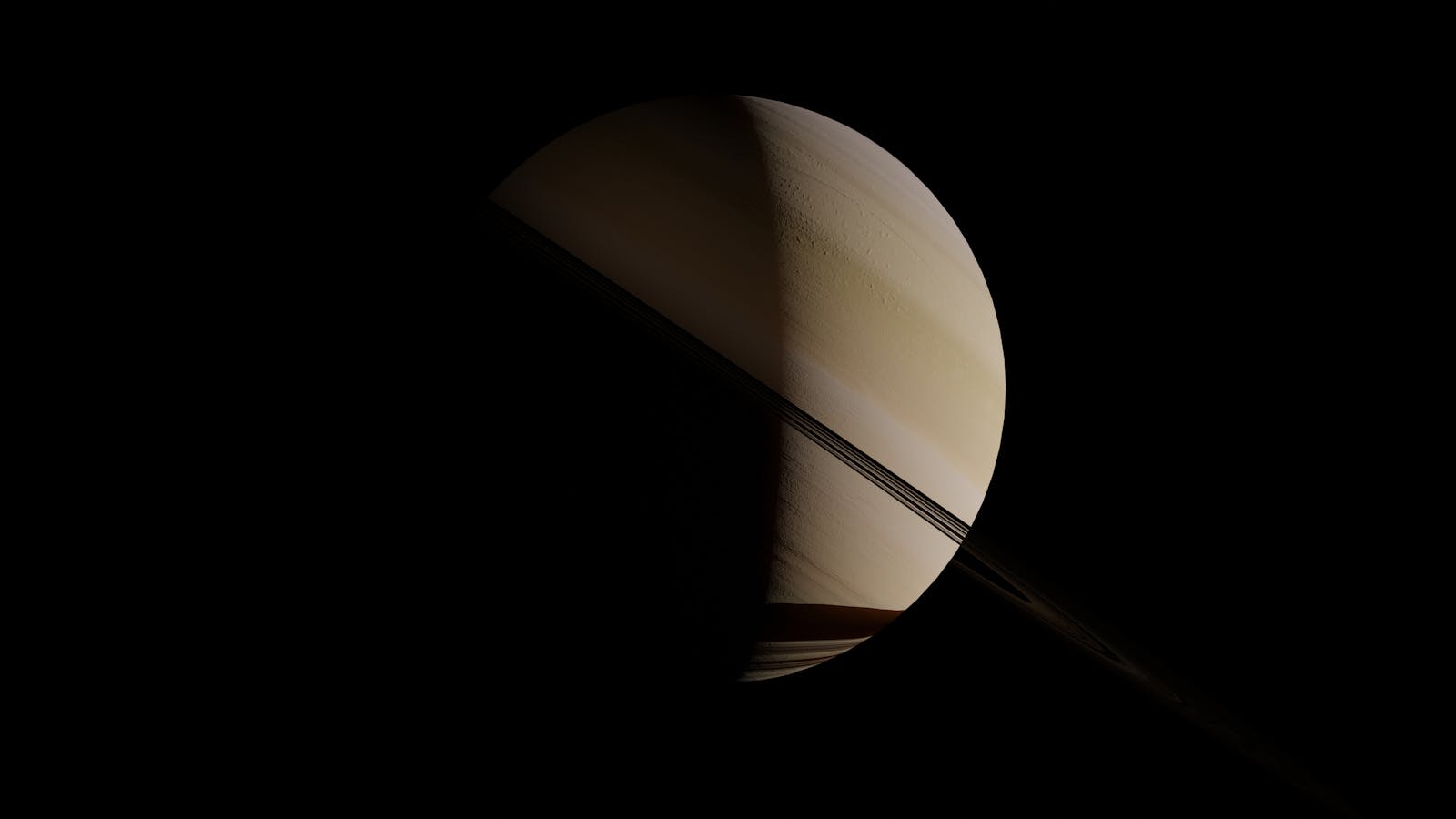
Saturn’s largest moon is not about to become a funded astronaut destination. But a June summit in Boulder, Colorado is trying to move Titan out of the science-fiction category and into the long-range planning conversation before future Moon and Mars decisions absorb the field’s attention.
The Humans to Titan Summit, scheduled for June 11-12, 2026, will bring together engineers, scientists, industry figures, academics, and experts in both robotic and human spaceflight. Its stated goal is to explore whether Titan could become the next human exploration destination after Mars, what such a mission would require, and what work would need to start now.
The idea sounds outlandish until the destination is taken seriously on its own terms. Titan has a thick atmosphere, low gravity, stable surface liquids, and a chemical environment that has long intrigued astrobiologists. It is also vastly farther away than any place humans have ever attempted to visit. That tension is the point of the summit: Titan is both unusually compelling and unusually hard.
A summit to map the unmapped
According to reporting by Space.com, the summit is meant to gather people who rarely work on Titan in the same room: planetary scientists, robotic mission specialists, human exploration planners, industry representatives, and academics.
The summit’s own framing is deliberately ambitious. It asks whether Titan could be considered after the Moon and Mars, how that might be done, and what precursor work would be needed before the idea can be treated as more than a conference thought experiment.
That distinction matters. A two-day meeting does not create a NASA program. It can, however, produce a shared vocabulary, a list of technical barriers, and a clearer sense of whether Titan belongs anywhere in the long-range human exploration architecture.
The robotic groundwork is already real
No serious crewed mission gets proposed without robotic precursors, and Titan already has a rare place in exploration history. The European Space Agency’s Huygens probe landed on Titan on January 14, 2005 as part of the Cassini-Huygens mission, descending through the moon’s atmosphere and returning data from the surface. NASA describes it as the first spacecraft landing in the outer solar system and the most distant landing from Earth.
The next robotic step is far more ambitious. NASA’s Dragonfly mission is a nuclear-powered rotorcraft designed to fly from site to site on Titan, studying its surface composition, habitability, atmosphere, geology, and prebiotic chemistry. NASA said in April 2026 that the rotorcraft’s primary structure was taking shape, with major body panels delivered and testing continuing.
Dragonfly also shows why Titan planning is so difficult. The mission has already faced cost growth and schedule pressure. Physics World reported on a NASA watchdog review that criticized the agency’s management of the $3.3 billion mission, citing schedule slips and nearly $1 billion in cost increases. If a robotic mission to Titan is hard to keep on track, a human mission would be a generational undertaking.
Why Titan keeps pulling people back
Titan’s appeal rests on a combination found nowhere else in the solar system. NASA describes it as the only moon known to have a substantial atmosphere and the only place besides Earth known to have liquids on its surface. Those liquids are not water, but methane and ethane, moving through clouds, rain, rivers, lakes, and seas.
For human explorers, Titan would be strange in ways that are both inviting and punishing. Its gravity is low. Its atmosphere is thick. In principle, that combination makes aerial mobility far easier than on Mars. Some advocates have even argued that humans could fly through Titan’s atmosphere with winged equipment in the right conditions.
But the friendliness ends quickly. Titan is bitterly cold, with surface temperatures around minus 290 degrees Fahrenheit. Its atmosphere does not provide breathable oxygen. Any human presence would require heavy protection, power, insulation, life support, and a mission architecture far beyond anything now being built for the Moon or Mars.
The Moon and Mars still come first
Any Titan plan has to fit into a sequence that begins much closer to home. The last Apollo Moon landing was Apollo 17 in 1972. NASA’s Artemis program has now restarted crewed lunar flight: Artemis II splashed down on April 10, 2026, after sending four astronauts around the Moon for the first crewed lunar mission in more than five decades.
The next steps are meant to push toward lunar surface operations, a more sustained human presence near the Moon, and eventually Mars. That sequencing leaves Titan far beyond the current program horizon. The summit’s practical purpose is not to leapfrog those priorities, but to ask whether decisions made for the Moon and Mars could also leave room for a later outer-solar-system destination.
That is where the timing becomes important. Space architecture tends to harden around budgets, vehicles, propulsion assumptions, life-support systems, and institutional habits. Once those choices are made, destinations that do not fit them can be sidelined for decades.
The institutional reality check
The biggest obstacle to a human Titan mission is not whether Titan is interesting. It is whether any space agency, coalition, or future public-private architecture could justify the cost, risk, travel time, and technical complexity.
Even Mars remains unresolved as a human destination. The Moon is still being rebuilt as a proving ground. Robotic precursors, heavy-lift launch, in-space propulsion, nuclear power, radiation protection, closed-loop life support, and deep-space logistics all remain central challenges before Titan can become more than a long-range concept.
Dragonfly may become the most important near-term test case. If it succeeds, it will give scientists and planners a richer understanding of Titan’s surface, atmosphere, mobility environment, and operational hazards. If it struggles further, it will also sharpen the argument that Titan is scientifically irresistible but institutionally brutal.
What Boulder can and cannot decide
A two-day gathering in Boulder will not produce a funded crewed Titan program. It will not move Titan ahead of the Moon or Mars. It will not solve propulsion, life support, budgets, or the political patience required for an outer-solar-system human mission.
What it can do is force a more concrete question: if the purpose of human spaceflight is to expand beyond familiar worlds, does Mars represent the outer edge of serious planning, or the next step toward something more distant?
Titan is the only body in the solar system besides Earth known to have stable surface liquids. It has weather, a substantial atmosphere, organic chemistry, and a landscape that can be scouted by flying robots. Those facts do not make a human mission imminent. They do make Titan difficult to ignore.
The summit’s value will depend on whether it produces something more durable than enthusiasm: technical priorities, precursor needs, possible timelines, risk categories, and a realistic sense of what would have to be true before humans could ever stand on Titan. If it does, Titan may enter the conversation as a distant but serious destination. If it does not, it will likely remain where it has been for years: scientifically magnetic, technically daunting, and easy for planners to postpone.
That is the choice Boulder is being asked to frame. Not whether humans are going to Titan soon, but whether the space community should start planning as if Titan might one day matter.
Photo by Zelch Csaba on Pexels
