
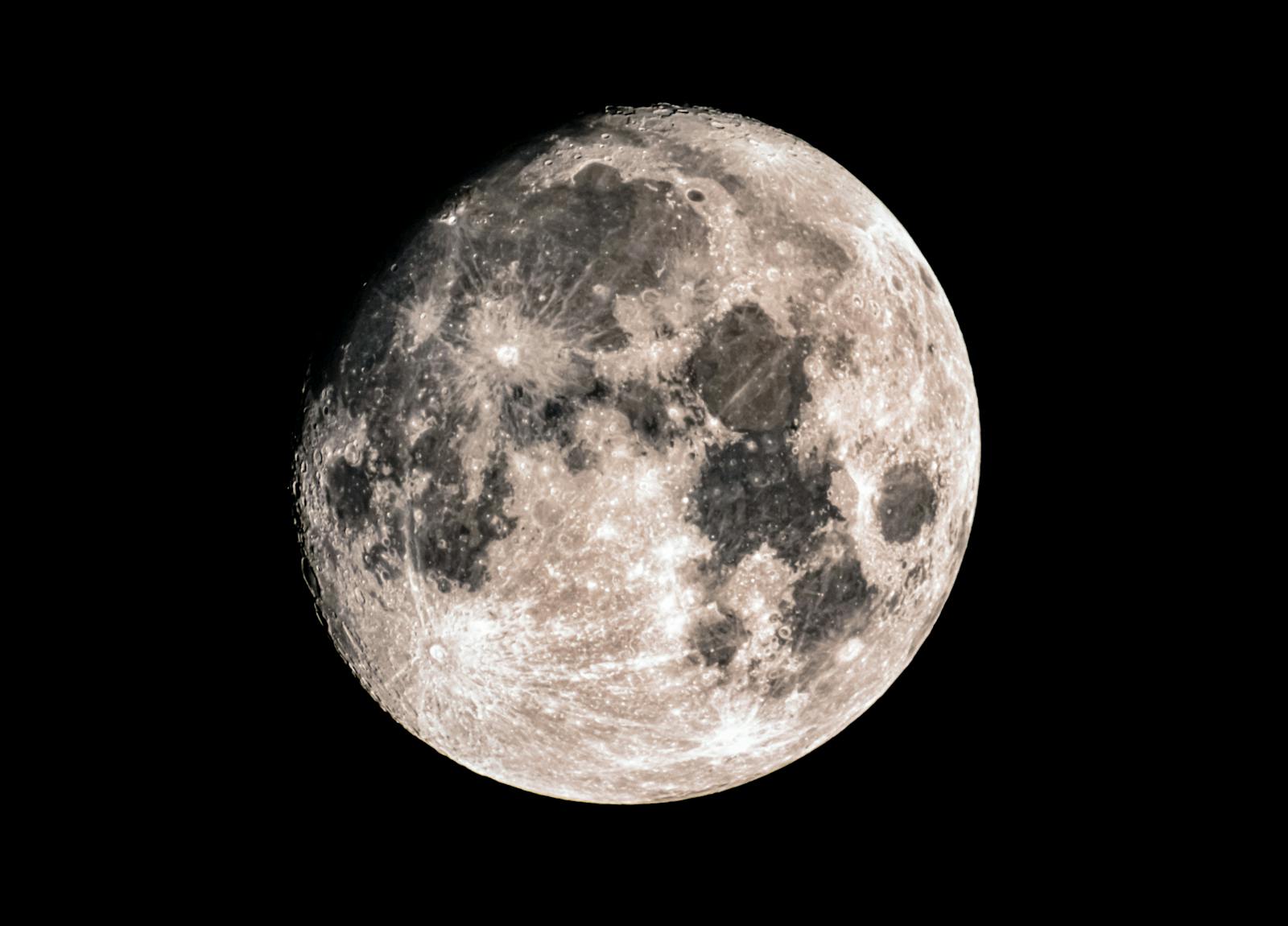
The asteroid that carved the Moon’s largest scar may have arrived from the north, struck at a shallow angle, and flung pieces of deep lunar material across hundreds of kilometers of the far side. A new Science Advances study suggests fresh details about the formation of the South Pole–Aitken basin — and it places future Artemis astronauts close to one of the most scientifically valuable debris fields on the Moon.
That matters because the South Pole–Aitken basin is not just another crater. It is the Moon’s largest and oldest acknowledged impact basin, and scientists have long treated it as one of the best possible windows into the lunar interior.
If the modeling is right, astronauts working near the lunar south pole may not need to drill through the Moon to touch ancient interior material. Some of it may already have been excavated, shocked, scattered, and mixed into the surface they will sample.
A 260-Kilometer Impactor, Striking North to South
The South Pole–Aitken basin sprawls across the lunar far side and is widely recognized as the oldest and largest confirmed impact basin on the Moon. Researchers have long agreed that something enormous hit there. They have not agreed on the impactor’s size, speed, structure, or direction.
The new simulations narrow the best-fit scenario to a differentiated impactor roughly 260 kilometers wide, traveling at about 13 kilometers per second, and striking the Moon at a shallow angle on a north-to-south trajectory.
That word “differentiated” matters. It means the impactor was not just a simple rubble pile or uniform asteroid. It had separated into layers, with a denser core and a rockier outer shell, more like a small planetary body than an ordinary chunk of debris.
In the model, that structure helps explain the basin’s unusual shape. The researchers argue that the dense core kept moving downrange during the impact, helping produce the tapered form of the basin instead of a more circular scar.
The geometry of the basin also points southward. The basin tapers toward the south, the crustal transition differs between the northern and southern sides, and earlier work has identified thorium- and iron-rich material southwest of the basin. Taken together, those features fit better with a southward impact than with the northward trajectory often assumed in older interpretations.
The Butterfly Pattern
Shallow impacts do not throw debris evenly. They smear and scatter it. In the simulations, material excavated by the South Pole–Aitken impact forms a broad, uneven ejecta pattern around the basin, including deposits that reach toward the lunar south polar region.
That pattern matters because the Moon’s mantle is a scientific prize. The lunar magma ocean model holds that the young Moon was once largely molten, then gradually separated into crust, mantle, and chemically distinct reservoirs as it cooled. Scientists have built much of that history from Apollo samples, meteorites, orbital spectroscopy, and later robotic sample-return missions, but direct access to deep mantle-related material remains limited.
The broader field of lunar surface geochemistry combines returned samples, orbital data, and in-situ measurements to reconstruct the Moon’s volcanic, thermal, and chemical history. Mantle-rich ejecta from a giant impact would be a different kind of evidence: messy, shocked, and mixed, but potentially tied to depths that no astronaut has ever sampled directly.
Why Artemis Sits in the Middle of the Story
NASA has spent years studying landing regions near the lunar south pole, drawn by permanently shadowed craters that may preserve water ice and nearby areas that offer useful lighting, terrain, and communications conditions. In 2024, the agency identified updated candidate regions for Artemis III near the south pole, including areas such as Nobile Rim, Haworth, Malapert Massif, Mons Mouton, and Slater Plain.
Those sites were chosen for mission safety and science value, not because of a single new impact model. But the new simulations add a sharper geological possibility: some south polar landing areas may sit within reach of South Pole–Aitken ejecta that includes material excavated from deep below the original lunar surface.
The study authors write that Artemis astronauts landing in the south polar region may be able to sample ejecta from the South Pole–Aitken event. In practical terms, that means astronauts collecting ordinary-looking regolith could pick up fragments that were blasted outward billions of years ago from far deeper inside the Moon.
That would give Artemis a second scientific storyline alongside water ice. The mission would not only test hardware, mobility, surface operations, and resource questions. It could also put human geologists onto terrain shaped by the most consequential surviving impact event on the Moon.
A Moving Target Schedule
The Artemis architecture has shifted significantly. NASA announced in February 2026 that it was adding another mission to the sequence and revising the program’s build-up toward surface landings. The agency described the change as a way to test more of the system step by step before committing astronauts to a landing attempt.
According to NASA’s own announcement, the updated plan adds a more robust Artemis III test approach before later landing missions. SpacePolicyOnline reported that the revised plan makes Artemis III an Earth-orbiting mission rather than the first lunar surface landing, with a surface return targeted after that.
The lander remains one of the program’s biggest variables. SpaceX holds a NASA Human Landing System contract using Starship, and Blue Origin is also developing a lander for the Artemis campaign. NASA has continued to evaluate how those systems fit into the revised sequence.
Schedule changes matter to the science case, but they do not erase it. Whether the first crewed south polar landing happens on the original mission number or a later one, the target region remains close to terrain that these models identify as scientifically rich South Pole–Aitken ejecta.
What the Velocity May Imply About the Impactor
The best-fit impact speed of about 13 kilometers per second is also a clue about the impactor’s original path through the early solar system. In the study, that relatively low impact speed is consistent with an object on an Earth-like orbit before collision, rather than a much faster body arriving from a highly inclined or more distant trajectory.
That is a striking inference, but it should be treated carefully. The simulations point to a plausible impact scenario, not a recovered asteroid with a known address. The object that carved the Moon’s largest basin may have come from a population of inner solar system bodies whose histories overlapped with the formation zones of the terrestrial planets.
Future samples could test pieces of that story. If Artemis crews return South Pole–Aitken ejecta, laboratory analysis may help separate lunar material from traces of impactor contamination. Isotopes, trace elements, and mineral chemistry could then be compared against the model’s predictions.
That would make the samples valuable for two reasons at once. They could clarify the Moon’s interior history, and they could help test what kind of object delivered one of the most violent blows preserved on the lunar surface.
The Stakes Beyond Geology
Artemis is not running on a purely scientific clock. China has said it aims to land astronauts on the Moon before 2030, and its lunar ambitions also point toward the south polar region. That has turned the Moon’s south pole into a place where geology, resources, engineering, and geopolitics overlap.
The usual public framing centers on flags, bases, water ice, and strategic presence. The new modeling adds another layer. The first crews to work near the south pole may also be working across debris from an impact that reshaped the Moon’s early history.
Earlier research has already suggested that the South Pole–Aitken impact may be tied to major lunar asymmetries and to the distribution of unusual chemical reservoirs on the Moon. A 2025 Nature study argued that a southward impact could explain thorium- and iron-rich ejecta near the basin and noted that proposed Artemis landing sites sit on the downrange rim and ejecta blanket.
The new simulation work builds on that picture by modeling a differentiated impactor and showing how its structure, speed, and trajectory could have produced the basin’s tapered shape. It does not settle every debate about the South Pole–Aitken basin, but it gives future missions a more specific prediction to test.
Verification, Not Speculation
The strongest part of the finding is that it can be checked. The ejecta is either present in measurable quantities near Artemis landing areas, or it is not. The chemistry either fits a deep lunar source mixed with impactor material, or it points somewhere else. The modeled butterfly-like distribution either helps explain the samples, or future data will force scientists to revise it.
That is the rare situation where a human spaceflight program can test a specific computational model with rocks collected by astronauts. Sample-return geology often surprises researchers. Here, the surprise may come with unusually clear expectations already written down.
If the rocks come back and match the model, the South Pole–Aitken story becomes much sharper. If they do not, planetary scientists will have an even more interesting problem: why the Moon’s largest scar looks the way it does, and why its deepest clues ended up somewhere else.
Photo by Sarowar Hussain on Pexels
