

Scientists in Germany have reported the first direct detection of upper-atmospheric pollution linked to the reentry of a specific piece of space debris, after a SpaceX Falcon 9 upper stage burned up over Europe in February 2025 and left behind a measurable plume of lithium.
The finding does not prove a catastrophe is unfolding above Earth. It does something more basic, and potentially more important: it shows that a single reentering rocket stage can be chemically traced after it breaks apart in the upper atmosphere.
In a study published in Communications Earth & Environment, researchers reported a tenfold enhancement of lithium atoms at about 96 kilometres altitude over Kühlungsborn, Germany, roughly 20 hours after the uncontrolled reentry of the Falcon 9 upper stage.
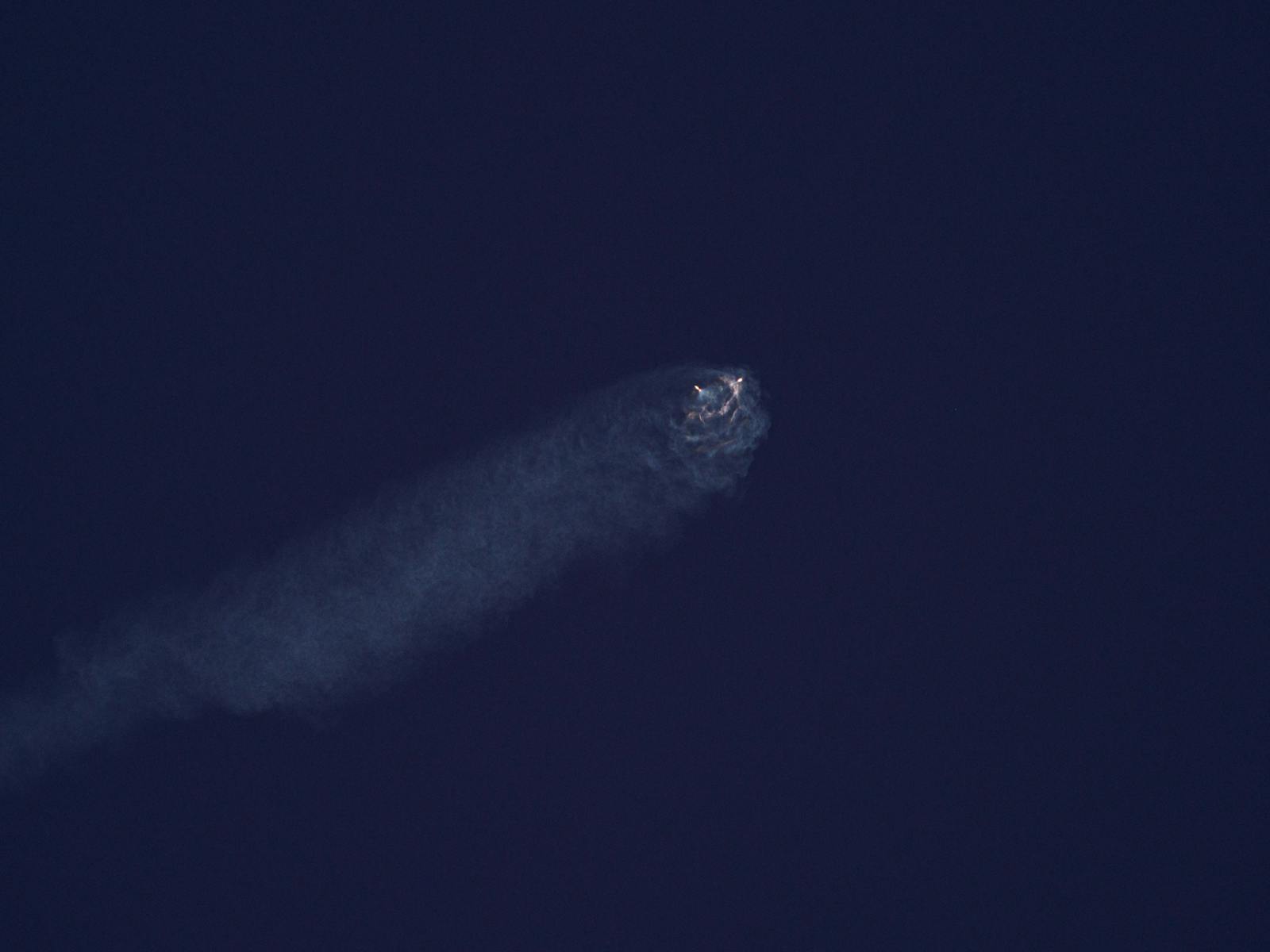
A fireball that became an atmospheric experiment
The Falcon 9 upper stage reentered Earth’s atmosphere on 19 February 2025 at roughly 100 kilometres altitude, west of Ireland. The event produced a visible fireball as the stage broke apart over Europe, and fragments were later recovered near Poznań, Poland.
What people on the ground could see was the spectacle: the streaking fireball, the reports of debris, the familiar drama of uncontrolled reentry. What researchers later found was the chemical afterimage.
The lithium plume did not pass over Germany at the exact moment of breakup. Instead, wind modelling traced the air mass detected above northern Germany back to the Falcon 9 reentry path off Ireland. That distinction matters. The discovery was not a simple visual sighting of debris. It was an atmospheric fingerprint reconstructed with lasers, wind data and modelling.
What the lidar actually detected
The team used a resonance fluorescence lidar, a laser-based remote-sensing instrument, to measure lithium atoms in the mesosphere and lower thermosphere. Shortly after midnight UTC on 20 February 2025, the instrument detected a sharp lithium signal between roughly 94 and 97 kilometres altitude.
According to a Nature Portfolio press release on the paper, the authors found that the most likely origin of the plume was the path of the Falcon 9 upper stage that had reentered over the Atlantic Ocean about 20 hours earlier.
Lithium is useful because the natural background is small. The study estimated the natural lithium input from cosmic dust at about 80 grams per day. A single Falcon 9 upper stage, by contrast, is estimated to contain about 30 kilograms of lithium in the aluminium-lithium alloy used in its tank walls.
That does not mean all of the rocket’s lithium appeared in one neat cloud over Germany. Reentry chemistry is more complicated than that. Some material changes form as it descends, and the researchers describe the observed lithium as a tracer: a visible sign that engineered material from the rocket entered an atmospheric layer where such material is normally scarce.
Why one metal plume matters
The finding is important because it links a known reentry to a specific chemical signal. Until now, much of the concern around reentering space hardware has been modelled, inferred or measured indirectly.
This time, researchers could point to a particular event, a particular altitude range and a particular chemical enhancement. The study describes it as the first measurement of upper-atmospheric pollution resulting from space debris reentry, and the first observational evidence that space-debris ablation can be detected by ground-based lidar.
That makes the Falcon 9 event less of an isolated curiosity and more of a proof of method. If lithium can be tracked this way, future instruments may be able to build a clearer picture of what other spacecraft materials leave behind as they burn up.
The bigger concern is not just lithium
Lithium is the headline result because it is relatively easy to detect and rare at these heights. But researchers are also interested in other materials associated with rockets and satellites, including aluminium compounds and metals used in spacecraft hardware.
Space.com reported that the Leibniz team wants to use newer lidar instruments to measure multiple metal compounds and better estimate how much of the material entering the atmosphere is human-made rather than natural.
The caution here is important. The February 2025 measurement does not by itself show how much damage reentry pollution causes to ozone, climate or upper-atmospheric chemistry. It shows that the pollution is real, detectable and traceable. The next question is what repeated injections of spacecraft material do over time.
Megaconstellations make the question harder to ignore
Reentry is not a rare endpoint anymore. Satellites are increasingly designed to deorbit and burn up at the end of their lives, which helps reduce long-lived debris in low Earth orbit. But that same disposal strategy moves the environmental question downward, from orbit to the upper atmosphere.
The scale of planned orbital activity is the reason scientists are paying attention. AFP, via Phys.org, reported that there are around 14,000 active satellites orbiting Earth, while China and SpaceX have filed proposals involving extremely large future constellations.
Those proposals may never be fully built. But even partial growth in satellite fleets would mean more launches, more retired spacecraft and more reentries. The Falcon 9 plume shows that at least some of that material can be followed after it burns.
A regulatory gap above the weather
The atmosphere does not fit neatly into existing space regulation. Orbital debris rules usually focus on collision risk and keeping low Earth orbit usable. Ground safety rules focus on surviving fragments. Climate and air-quality rules focus mostly on the lower atmosphere.
The chemical effects of material deposited tens of kilometres above the weather sit in between those regimes.
That is why scientists are calling for better monitoring before the traffic increases further. The point is not to claim that one rocket stage changed the atmosphere in a lasting way. The point is that humanity is now putting enough engineered material into orbit that its disposal route needs to be measured, not guessed.
What comes next
The German measurement was partly a fortunate catch: a known uncontrolled reentry, favourable winds and a lidar capable of seeing a lithium signal at the right altitude. Most reentries will not be observed so neatly.
The next step is a wider monitoring network and instruments that can track more than one chemical signature. A single lidar station can show what is possible. It cannot yet answer how much spacecraft material is being added globally, how it spreads by latitude or season, or which compounds matter most for long-term atmospheric chemistry.
For now, the significance of the Falcon 9 event is visibility. A rocket stage burned up over Europe. A plume moved across the continent. A laser in northern Germany caught its chemical trace. For the first time, scientists could tie a specific reentry to a measurable signature in the upper atmosphere.
That is not the final answer to the space-debris pollution problem. It is the moment the problem became directly observable.
