

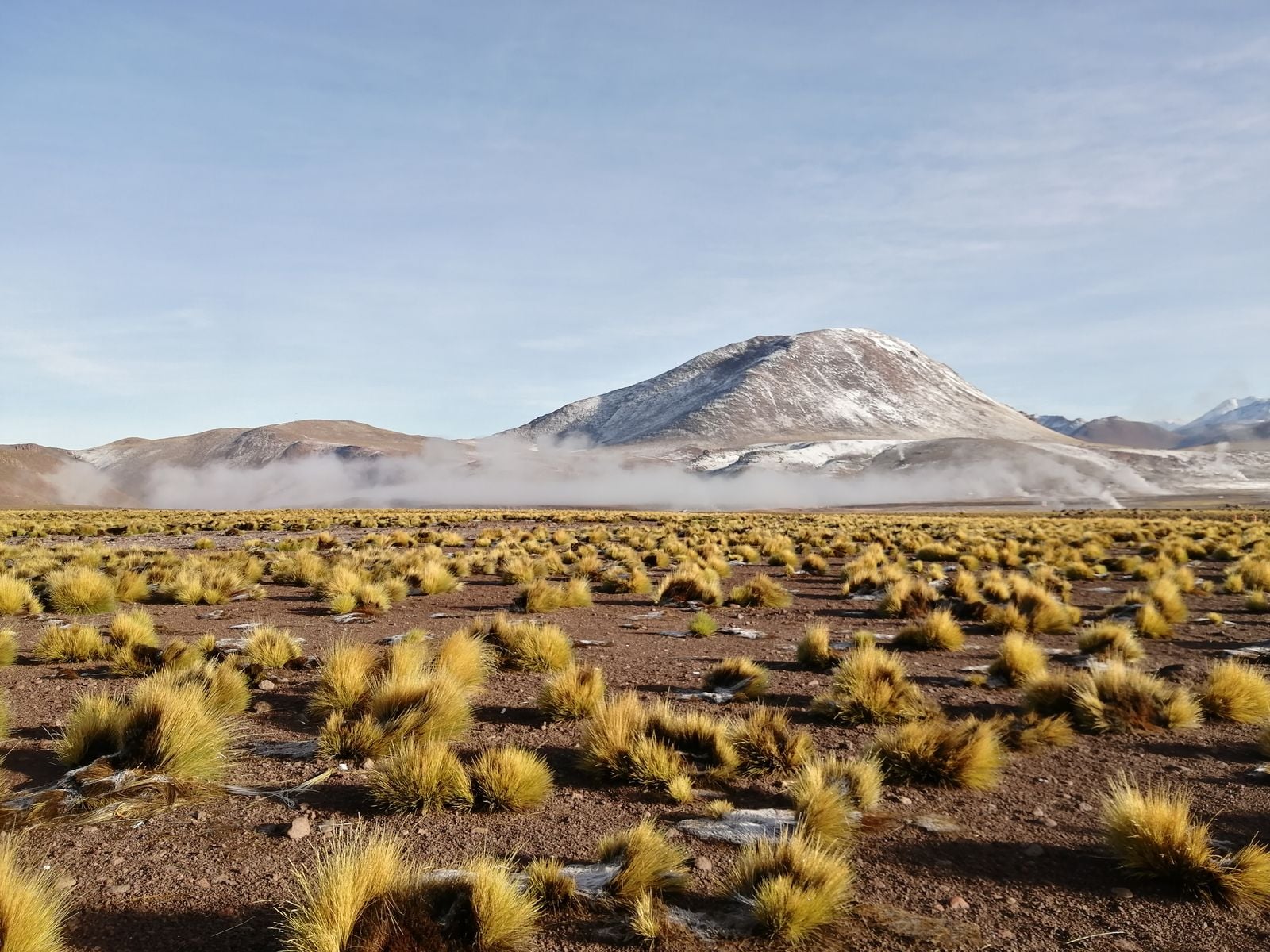
In the hyperarid core of Chile’s Atacama Desert, there are rain gauges that have sat on their tripods for entire human generations without ever registering a measurable drop. Not a trace. Not a mist reading. The instruments work. They simply have nothing to record. Some stretches of the desert between the Andes and the Pacific receive an estimated 1 to 3 millimetres of precipitation a year, and other stations show flat zero across the whole instrumental record.
And yet, at dawn, the stones are wet.
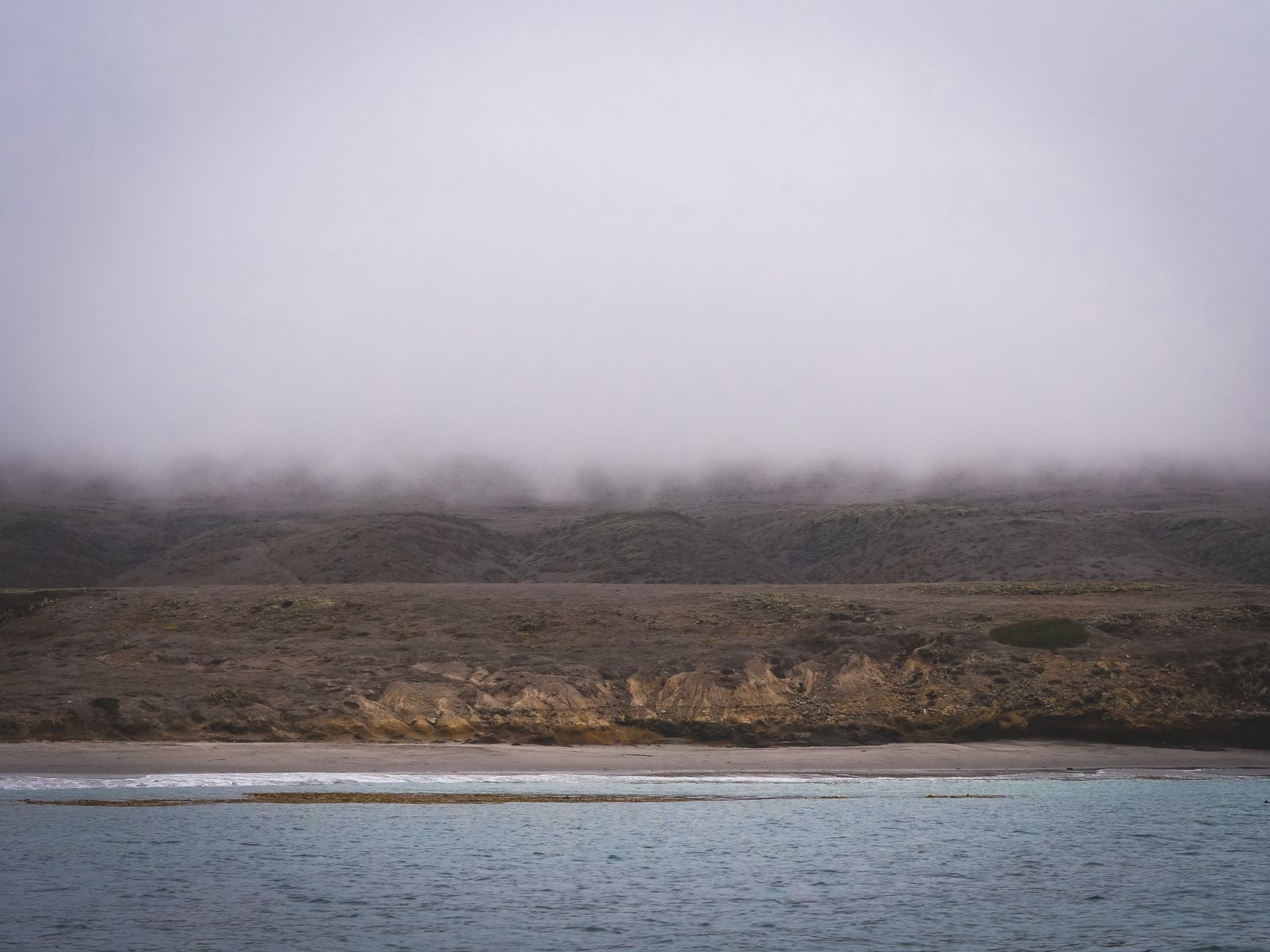
The water comes from the sea. A dense marine fog called the camanchaca rolls in from the cold Humboldt Current, drapes itself across the coastal cliffs, and clings to whatever it touches. It never falls as rain. It settles. On that thin film of condensed cloud, lichens grow that live nowhere else on Earth, cacti hold on to bare rock, and coastal fishing communities have long drawn moisture from the same marine layer that the modern fog-catcher nets now harvest systematically.
Weather stations that record nothing
The Atacama runs about 1,000 kilometres along northern Chile, pinned between two barriers that between them lock out almost every source of moisture. The Andes to the east block the Amazon’s westward-moving humidity. The cold Humboldt Current to the west chills the air above the Pacific so thoroughly that evaporation is suppressed and the atmosphere becomes too stable for clouds to rise, cool further, and release rain.
The result is a desert roughly ten times drier than the Sahara. London gets around 600 millimetres of rain a year. The Sahara averages about 75. The core of the Atacama can go a decade without a single measurable event, and some stations have gone longer than that.
A serially complete daily precipitation dataset for South America, published in Scientific Data, shows how sparse the record becomes across the hyperarid strip: many stations produce long unbroken runs of zeros, and the interpolation methods that work elsewhere on the continent break down when there is simply no signal to smooth.
The town of Yungay, roughly 80 kilometres inland from the port of Antofagasta, has been used by NASA for decades as a Mars analogue. Meteorological stations in the Yungay area and along the Pampa del Tamarugal have gone entire decades without a measurable rainfall event, and the soil there returns negative results for cultivable bacteria on standard assays.
Space Daily has previously covered how the same soils fool life-detection hardware in the same way Mars does, which is why the agency spent four field seasons rehearsing a rover mission on that ground.
The fog has a name
The camanchaca is not weather in the ordinary sense. It is the marine layer made visible. Cold air over the Humboldt Current condenses into low stratus cloud that blows inland, hits the coastal escarpment, and settles between roughly 400 and 1,200 metres of elevation. In Aymara, the word roughly means a darkness that spreads.
It arrives most reliably in the southern hemisphere winter, between May and October, thickening after midnight, peaking near dawn, and burning off by mid-morning when the sun warms the cliff face enough to lift the ceiling back out to sea.
Camilo del Río, director of the Catholic University’s Atacama Desert Center, described the mechanism plainly to Mongabay: clouds are already made of water droplets, already condensed, so whenever a cloud is transported by wind and touches the ground, what is touching the surface is thousands and thousands of litres of water.
The trick is catching it before it lifts.
Lichens that drink air
The coastal cliffs above Paposo and Iquique are painted with lichen. Grey-green crusts. Orange rosettes. Black filamentous species that hang down the rock face like hair. Genera like Roccellinastrum, Santessonia and Follmanniella have been documented on the fog-drenched coastal cordillera of northern Chile and adjacent Peru with distributions that stop where the fog stops. Some species are known from a single cliff.
A lichen is a partnership. The body is built by a fungus, which cannot photosynthesise, so it houses an algal or cyanobacterial partner inside its tissues. The alga makes sugars from sunlight. The fungus provides architecture, mineral scavenging, and defence against drying out. The total number of known lichen species is estimated at 20,000 to 30,000, many still undescribed.
What suits them to the Atacama is that they do not need liquid water in the ordinary sense. A lichen thallus can rehydrate from 90 per cent humidity alone, snap into photosynthetic activity within minutes, fix a little carbon, and then desiccate again when the fog burns off.
Some species do this every single day for decades.
Lichens on north-facing rocks may be photosynthetically active for only two or three hours a day, and only during the winter fog season. For the other nine months of the year, they sit freeze-dried, a bundle of fungal hyphae and green algal cells waiting for the next cloud.
A fishing village that drinks clouds
The idea of catching fog for drinking water is older than the modern instrument record. People in the Canary Islands collected water dripping from juniper and pine trees that functioned like natural fountains. In Oman, cisterns were built beneath branches that formed droplets in the marine layer. Systematic engineering of fog capture is a Chilean development.
In the 1950s, researchers in the Antofagasta region developed nets that intercepted droplets carried on the wind. In 1987, the Chungungo fishing community in northern Chile installed one of the largest projects of its time: 100 fog collectors capable of delivering around 33 litres of clean water per day to roughly 300 residents. Two poles held up mesh sheets, the largest 12 by 4 metres, and the droplets fell from the mesh into a receptacle below.
Orlando Rojas Figueroa, president of the Atacama Fog Catchers Group, and members of the group told Mongabay that when the project started in the 1990s, local communities were skeptical and mocked the idea of harvesting water from clouds. Locals questioned what anyone could possibly do with fog and clouds.
By 2004, harvesting figures had climbed to around 1,000 litres a day. On the best days at the best sites, groups have reached as much as 12,000 litres. The water is used to grow potatoes, lettuce, lemons, peaches, pomegranates and figs. The association bottles some of it in glass.
Coastal settlements like Paposo, a rural town of around 250 people, still rely mostly on water trucked in from other parts of the country. But the underlying arithmetic has not changed since the fishermen of Chungungo first strung mesh between two posts: a single square metre of properly oriented net can wring several litres of water per day out of the camanchaca, according to accounts compiled by Popular Science.
What the fog actually contains
The camanchaca is not distilled water. It picks up salts, trace metals, algal toxins and marine microorganisms as it forms above the ocean surface, and it deposits all of that onto the lichens, the cacti, and the mesh nets when it condenses.
That matters for the lichens as much as for the villages. In a desert with almost no soil chemistry to speak of, the fog is the soil. It delivers iodine, nitrate, sulphate, and traces of whatever the phytoplankton bloomed offshore that week. The organisms are drinking a thin marine soup that happens to arrive as air.
A 2024 paper by Keim-Vera and colleagues in Atmospheric Research catalogued the frequency of different fog types over the Atacama and their collectable water potential, a step toward treating the marine layer as a mappable resource rather than a poetic curiosity.
A 2025 study led by Virginia Carter of the Atacama Desert Center in Frontiers in Environmental Science looked at Alto Hospicio, a city that has historically depended almost entirely on groundwater. Using standard fog collectors and meteorological data on temperature, solar radiation, relative humidity and wind, the team estimated that at sites between 700 and 1,100 metres above sea level, less than a kilometre from the urban edge, the yield could reach 0.2 to 4.9 litres of water per square metre of collecting surface per day.
Roughly 1,000 square metres of collectors, on that estimate, could produce between 200 and 4,900 litres a day. Carter told Mongabay her goal is to strengthen the role of fog collection in water policy and put it on the public agenda in Chile.
Why the desert is not lifeless
The Atacama has been dry for a long time. The extreme aridity in the hyperarid core began roughly 45 million years ago, tens of millions of years before the modern Andes reached their current height. When the first primates were evolving in Africa, this stretch of Chile was already a desert.
And still, biology finds room. An international team led by the University of Cologne recently documented soil nematode communities across six distinct regions of the Atacama, including fog-fed oases where plant life persists against the odds. Life Signs has looked before at how a hidden microbial layer beneath the Atacama’s surface has become one of the closest terrestrial analogues for the search for life on Mars.
Occasionally, the desert also blooms. When a rare weather anomaly pushes even a few millimetres of rain into the hyperarid strip, dormant seeds erupt into the flowering event Chileans call desierto florido. A recent explainer in ZME Science traced how those pulses run on seed banks that have been waiting, in some cases, for decades. And when snow falls on the high plateau, as it has done in unusual quantities in recent years, the disruption is significant enough to force the ALMA observatory into a protective shutdown, as Live Science reported.
The lichens are not waiting on any of that. They are the organisms that never depended on rain in the first place.
Endemism on the fog cliffs is severe. Move ten kilometres inland, past the reach of the marine layer, and the lichens vanish. Move ten kilometres up the coast into a slightly different airshed and the species composition changes. Neighbouring cliffs become, in effect, islands, because lichens disperse slowly and establishment requires a very narrow set of microclimatic conditions.
The Peruvian coast has similar fog oases known as lomas, where the same physics produces the same result, and where the Peruvian government has granted formal conservation status to a 6,449-hectare Lomas y Tillandsiales site that depends entirely on a marine layer that never falls as rain.
Alto Hospicio’s tourism and heritage office started, in 2022, by mapping the Tillandsia plants that absorb water directly from the air. Where the Tillandsia grew, the office reasoned, the fog was reliable enough to harvest. Four fog collectors, each capable of gathering seven to ten litres on a foggy day, were installed with support from the Ministry of the Environment and the Atacama Desert Center.
Nicolás Prado, an anthropologist in that office, told Mongabay that political will is still short and that if the practice grows, it will grow at the community level. Fog collectors, he pointed out, can be built at home with mesh and a couple of posts.
Nobody knows, precisely, what a warmer ocean will do to the camanchaca. The cold currents that produce it are themselves products of atmospheric circulation patterns that climate models struggle to resolve at the coastal scale. Some projections suggest more fog. Some suggest less. Some suggest the same amount, but at different times of year, or at different altitudes on the cliff face.
For a lichen that has spent perhaps hundreds of thousands of years calibrating itself to a fog band between 600 and 900 metres of elevation on a specific stretch of Chilean coast, a shift of a hundred metres up or down the cliff would be catastrophic. There is nowhere else to go. The desert below is too dry. The plateau above is too dry. The cliff is the habitat. Space Daily has written elsewhere about how the Atacama’s salt flats, near-lifeless soils and towering volcanoes make it the closest Mars analogue on the planet, but the fog cliffs are the part of that landscape where Earth is doing something Mars cannot.
Dawn on the escarpment
Stand on the coastal escarpment above Paposo before sunrise. The fog is already there, a wet grey that erases the horizon. Water beads on the underside of every rock overhang. The lichens are open, pale green, faintly glistening. They are doing the only work they will do today — the fungus holding on to the stone, the alga making sugar, the whole organism drinking a cloud that has never once, in the memory of any weather instrument nearby, fallen as rain.
By eleven, the sun will have burned the camanchaca back out to sea. The lichens will shrivel again into their dry-season stillness. Down the coast, the mesh nets will drip into their collecting troughs, filling glass bottles that will be trucked into towns whose taps have never known another source. The rain gauges will register, as they have every day for as long as anyone has been counting, exactly nothing.