
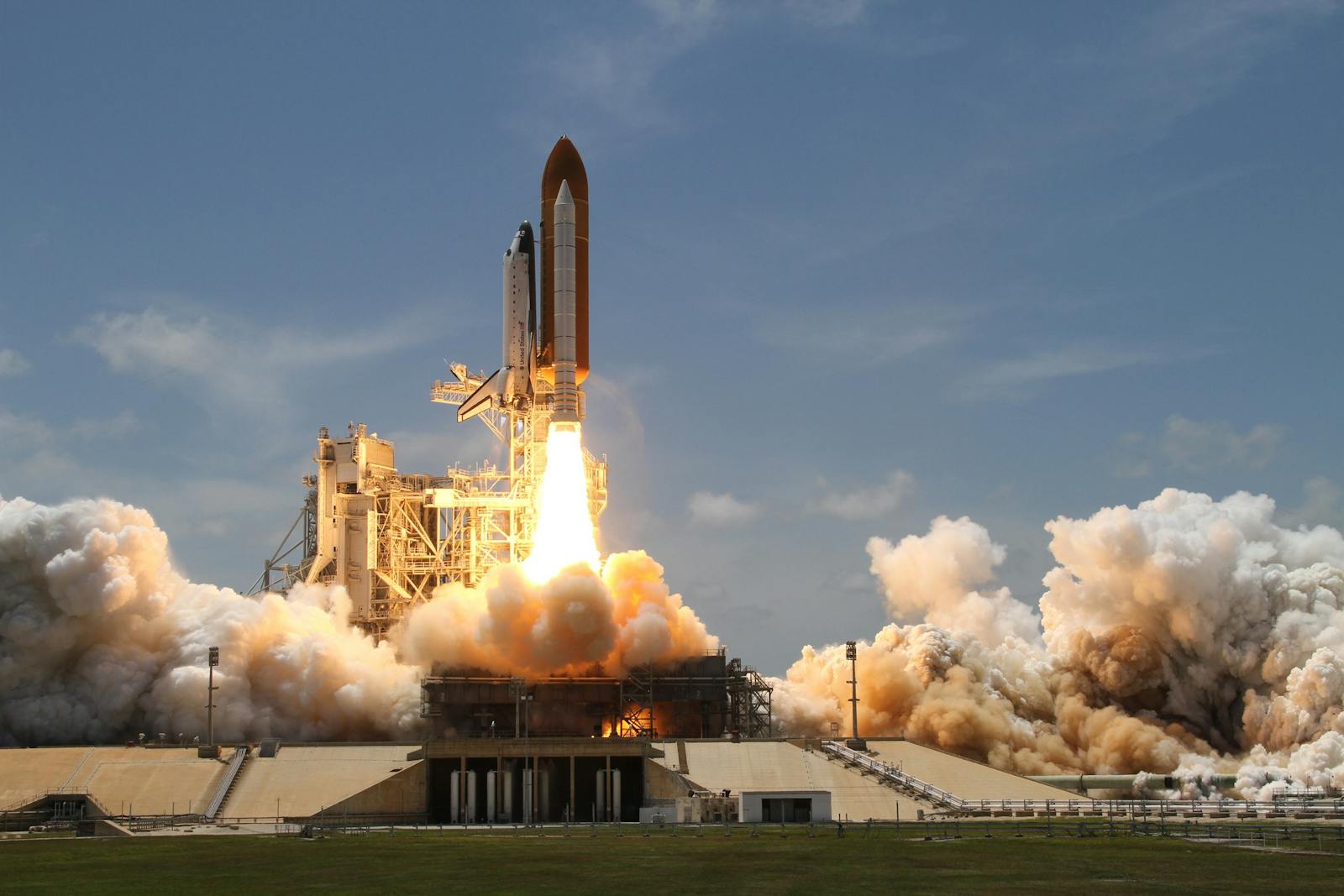
China launched its new Long March 12B rocket for the first time on June 1, 2026, and did something almost no other space program would attempt: it put paying customers on the maiden flight. The rocket flew without the customary public airspace notices and delivered operational satellites for the Qianfan broadband megaconstellation on its very first ride.
The decision says less about confidence in the hardware than it does about how much pressure China’s launch sector is under to move satellites — particularly Qianfan satellites — into orbit faster than its rocket fleet can currently manage.
The rocket lifted off at 0840 UTC from the Dongfeng Commercial Aerospace Innovation Test Zone at Jiuquan Satellite Launch Center, according to SpaceNews, which cited the China Aerospace Science and Technology Corporation (CASC) confirming success within an hour of liftoff. Space journalist Andrew Jones flagged the launch on social media, noting the rocket reached orbit but that no recovery test was attempted. Xinhua confirmed the flight as the 647th mission of the Long March family.
Orbital tracking data published in the days after launch revealed something the initial announcements left out: the rocket deployed just two Qianfan satellites, inserted into polar orbits between roughly 1,020 and 1,048 kilometers — consistent with earlier constellation deployments, per SpaceNews. The upper stage was left in an orbit from which natural decay would take decades at minimum. Two satellites, not the usual batch of 18. The gamble was real, but smaller than it first appeared.
Why launch real satellites on a maiden flight
Western practice typically reserves debut flights for inert payloads or low-value demonstrators. SpaceX flew a wheel of cheese on the first Dragon. Vulcan Centaur carried a lunar lander, but only after extensive review.
China’s decision to put operational Qianfan satellites on the Long March 12B’s first ride is a calculated bet. The vehicle passed a static-fire test in January, and its YF-102 engine family has flown before — three of them powered Space Pioneer’s Tianlong-2 in April 2023, and nine more lifted CAS Space’s Kinetica-2 on its successful debut in March 2026. That heritage was apparently judged strong enough to accept the risk.
Flying only two operational satellites, rather than a full 18-satellite stack, splits the difference between a mass simulator and a revenue flight. CASC risked real hardware, but not a quarter of a year’s production.
It is also a statement about throughput. China conducted 35 orbital launch attempts in the first five months of 2026, with the Long March 12B debut as number 35, following a Long March 2D flight on May 30. To keep that pace and feed two competing megaconstellations, the country cannot afford to fly demonstrator missions that don’t move the deployment counter. The absence of any public airspace or maritime notice — standard safety practice worldwide — only deepens the impression of a launch sector willing to bend its own norms to keep cadence.
Qianfan: 164 satellites and a 15,000-satellite hole to fill
The two new spacecraft bring Qianfan to roughly 164 satellites in orbit, by independent tracking counts. That is meaningful progress, but it remains far behind the constellation’s stated ambitions. Shanghai Spacesail Technologies, the operator behind Qianfan (also called the Spacesail Constellation), plans to deploy more than 15,000 satellites, according to China Daily.
The constellation has already begun moving into commercial service abroad. Brazil’s telecom regulator Anatel authorized Spacesail in February to begin commercial communication services, with an initial allowance of up to 324 satellites over Brazil — building on a November 2024 memorandum with state-owned Telebras focused on broadband for remote schools and hospitals.
Spacesail’s chief technical officer Li Guotong has said the system has been tested in Malaysia, Mongolia, and Kazakhstan.
Commercial traction is one thing. Deployment cadence is another. Independent analysts have flagged that Qianfan and the state-led Guowang constellation are both running well behind their original schedules, with rocket capacity identified as a persistent bottleneck. That context matters when interpreting why a brand-new vehicle would carry operational satellites on its first flight rather than a mass simulator.
The rocket, and the recovery problem it didn’t try to solve
The Long March 12B is a two-stage kerosene-liquid oxygen vehicle with a 4.37-meter-diameter core and an overall length of roughly 72 meters. Its first stage uses nine YF-102R engines, with a single vacuum-optimized variant on the upper stage.
CASC lists low Earth orbit payload capacity at approximately 20,000 kilograms in expendable configuration — Falcon 9 territory on paper, and within striking distance of the Long March 5’s 25,000 kg to LEO.
CASC confirmed that although the 12B is designed for first stage recovery, the maiden mission flew in expendable mode, with a recovery attempt deferred to a later flight. China has been here before. Both the Long March 12A in December 2025 and Landspace’s Zhuque-3, which flew on December 3 of that year, reached orbit on their first attempts — but both first-stage recovery tests failed during descent.
Reaching orbit is no longer the hard part for Chinese launch vehicles. Recovering a first stage intact is. Until one Chinese vehicle actually lands and is reflown, the cost reductions implied by reusability remain theoretical.
The recovery problem is also driving a pad-building boom on the coast. At Wenchang on Hainan island, the Hainan International Commercial Aerospace Launch Company plans to double its launch pads from two to four by the end of 2026. Company chairman Yang Tianliang has said the expanded facility will be able to handle more than 60 launches annually, with each pad supporting missions every 10 days or even weekly.
Yang has pointed to economics as the driver behind the recovery push: with first-stage manufacturing accounting for more than 70 percent of launch costs, the company is building a sea-recovery vessel to support a launch-recover-reuse model for domestic rocket makers. Minsheng Securities has called 2026 a critical year for the debut and validation of new-generation reusable rockets in China.
What happens on the next debut
The next several months are likely to bring additional Chinese reusable rocket debuts and renewed recovery attempts from CASC, Landspace, Space Pioneer, and others. For readers tracking how China’s space program connects to broader scientific cooperation, the country continues to fly missions with international partners even as its commercial launch sector races ahead — including the European-Chinese SMILE spacecraft launched May 19 to image Earth’s magnetosphere.
But the real test of the strategy on display June 1 is what happens the next time a Chinese provider rolls out a brand-new vehicle. If the Long March 12B’s recovery test succeeds and the Qianfan satellites it just delivered enter service on schedule, China will have proven that flying paying customers on maiden flights is a viable shortcut — one that lets it close the cadence gap with SpaceX without waiting for the years of demonstrator missions Western programs have traditionally required. The commercial pressure on every other Chinese launch provider to do the same will be enormous.
If it fails — if a future debut loses an operational batch of broadband satellites, or worse, scatters debris without prior airspace notice — the damage will land in two places at once. Spacesail and Guowang would lose hardware they cannot easily replace at current production rates, pushing their already-slipping schedules further out. And foreign customers in Brazil, Malaysia, and the other markets Qianfan is courting would have to weigh whether a constellation built on maiden-flight gambles is the broadband partner they want.
Beijing’s bet is that the math works out before the luck runs out. The Long March 12B just made that bet visible.
