

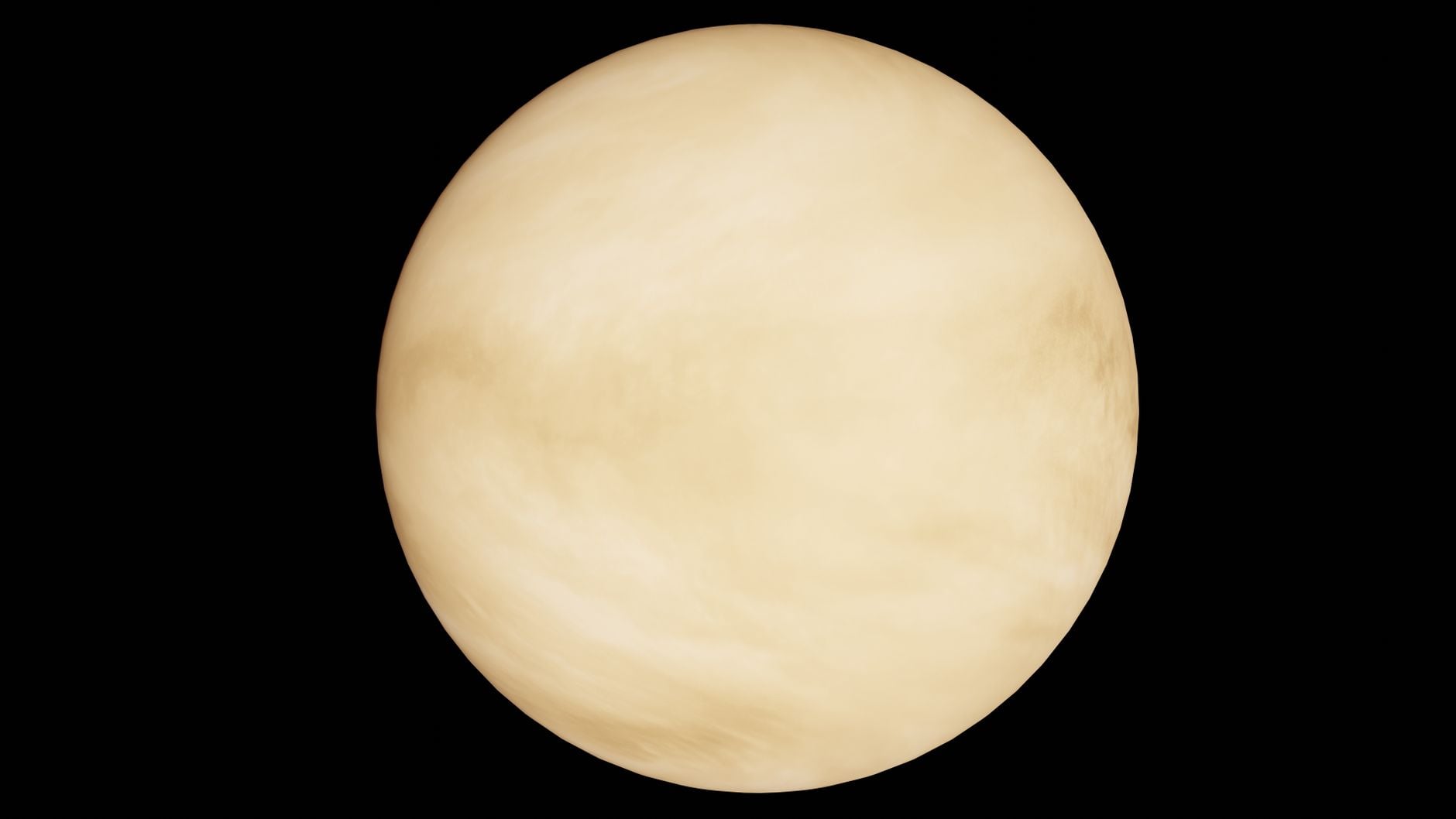
Venera 7’s radio signal appeared to end when the Soviet capsule reached Venus on 15 December 1970. The strong descent transmission dropped at impact, leaving what ground stations initially treated as unintelligible noise.
The recording had not ended with the apparent failure. Computer processing later separated a much weaker trace from the background and recovered 22 minutes 58 seconds of post-impact data. Rounded to 23 minutes in mission histories, it was the first transmission received from the surface of another planet.
Venera 7 did not wake up and call Earth again. Its transmitter continued operating, but the signal became so faint at touchdown that its survival could only be established by returning to the recorded radio data.
Earlier Venera capsules had not reached the ground alive
Venus had already defeated several Soviet probes. Venera 3 struck the planet in 1966 without returning data. Venera 4 entered the atmosphere in 1967 and transmitted measurements before pressure destroyed its descent capsule. Venera 5 and 6 travelled deeper in 1969 but also stopped transmitting roughly 20 kilometres above the mean surface level.
Those failures were scientifically useful. Measurements from Venera 5 and 6 allowed Soviet engineers to estimate that conditions at the ground could approach 500 degrees Celsius and 100 times Earth’s sea-level atmospheric pressure.
The V-70 capsule built for Venera 7 was therefore a substantial redesign. According to the mission history published by NPO Lavochkin, which developed the spacecraft, the design requirement rose to 150 atmospheres and 540 degrees Celsius. Its titanium shell was tested to a destructive pressure of 180 atmospheres.
The spherical lander weighed about 490 kilograms. Engineers fitted shock absorption around the capsule and used glass-based insulation in its hemispheres. They also replaced the earlier two-stage parachute arrangement with a smaller single-stage system intended to move the vehicle through the lower atmosphere more quickly.
Survival on the surface was part of the design requirement, not an accidental bonus.
Venera 7 reached Venus after a four-month flight
The Soviet Union launched Venera 7 from Baikonur on 17 August 1970. A second spacecraft of the same design followed five days later but remained trapped in Earth orbit and was named Kosmos 359.
Venera 7 made two course corrections during its flight. Before arrival, the spacecraft charged the lander’s batteries from the cruise stage’s solar panels and reduced its internal temperature, giving the electronics a larger thermal margin for descent.
NASA historian Asif Siddiqi’s mission chronology places atmospheric entry at 04:58:38 Universal Time on 15 December. The capsule entered at an altitude of 135 kilometres and a speed of 11.5 kilometres per second.
Aerodynamic drag slowed it to 200 metres per second by an altitude of 60 kilometres. The parachute system deployed at 04:59:10, and the radio continued carrying measurements as the capsule descended through increasingly dense and hot carbon dioxide.
The descent through the atmosphere lasted about 35 minutes.
The parachute probably failed before impact
The final descent did not follow its intended profile. Siddiqi’s account says the parachute may have torn and ultimately collapsed. Other reconstructions describe the parachute as having been lost close to the surface. No camera watched the event, so the precise failure sequence is reconstructed rather than directly observed.
The capsule hit the nightside of Venus at 05:34:10 Universal Time. Its estimated impact velocity was 17 metres per second, or about 61 kilometres per hour. That is a hard arrival for a vehicle commonly credited with the first soft landing on another planet, but “soft” in this context distinguishes a controlled, survivable landing from a destructive impact.
At that moment, the strong radio signal disappeared. The usual explanation is that Venera 7 tipped or bounced onto its side, leaving the antenna poorly oriented towards Earth. NASA’s chronology calls that scenario quite likely, not certain.
Whatever its final posture, the pressure vessel survived and the transmitter remained active.
Signal processing recovered almost 23 minutes
Soviet tracking stations preserved the radio recording even though the post-impact portion did not initially look intelligible. When the data was processed again, a signal could be distinguished below the level of the earlier descent transmission.
The recovered interval lasted 22 minutes 58 seconds. Its continuity after the known impact time established that the capsule was operating on the surface rather than merely transmitting somewhere in the lower atmosphere.
This is why “buried in the recording” is more exact than saying the probe sent a second message. The carrier and telemetry had been captured the first time. What changed was the ability to separate them from the background and recognise that they continued beyond touchdown.
The mission values reported in NASA’s historical record were a surface temperature of 475 plus or minus 20 degrees Celsius and a pressure of 90 plus or minus 15 atmospheres. The broad pressure uncertainty matters. Venera 7 confirmed the physical regime at the ground, but later Soviet landers returned cleaner and more varied measurements.
The first from a planet was not the first from another world
By 1970, machines had already transmitted from the Moon. The Soviet Luna 9 lander survived on the lunar surface in 1966, and the United States followed with Surveyor missions. The Moon is another world, but it is Earth’s natural satellite rather than another planet.
Venera 7 crossed that narrower historical threshold. NASA’s catalogue of robotic firsts lists it as the first transmission from the surface of another planet and dates the event to 15 December 1970.
Venera 3 had already become the first spacecraft to impact another planet, while Venera 4 had completed the first successful entry into Venus’s atmosphere. Neither returned information from the ground. Venera 7 was the first whose signal could be shown to continue after arrival.
It sent no pictures.
The first photographs from another planet’s surface would come from the later Venera 9 and 10 landers in 1975.
The weak signal changed the mission’s result
A landing can be mechanically successful while looking like a communications failure. Venera 7 had survived the atmosphere and impact, yet the achievement remained hidden until the radio record was examined below the level that had been useful during descent.
The recovered minutes did not turn the capsule into a long-lived Venus observatory. They established that its pressure vessel, insulation, power supply, instruments and transmitter functioned together at the surface for almost 23 minutes.
Venera 8 returned surface data for longer in 1972. The heavier Venera 9 and 10 missions added orbiters and cameras in 1975. Those later successes followed from knowing that a survivable landing was possible and that the conditions inferred from Venera 7 were close enough to design around.
For Venera 7, the mission result was decided after the apparent ending. The first radio transmission from another planet’s surface was already on the recording; it had simply arrived too faintly to be recognised in real time.