
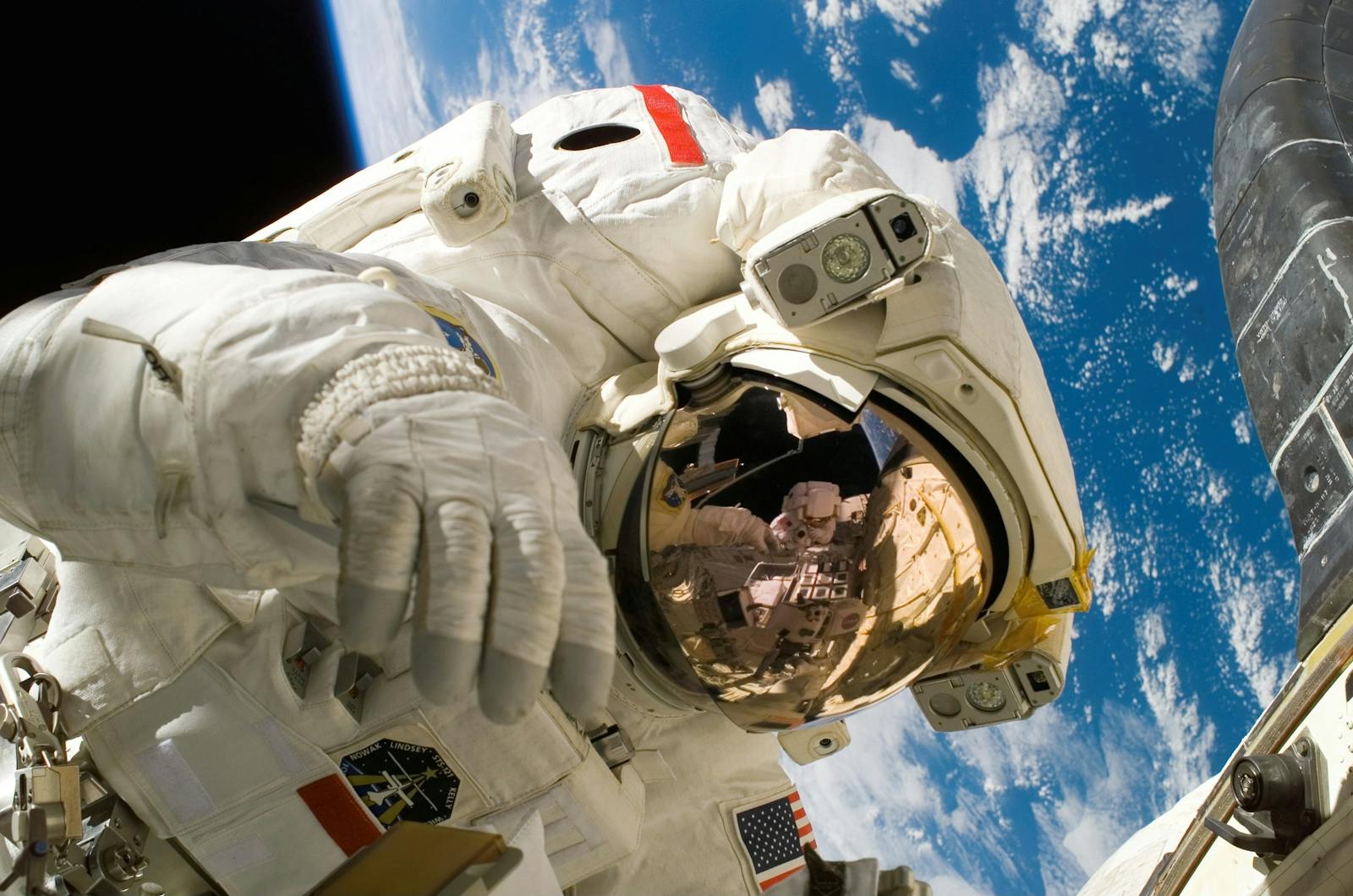
Thomas Pesquet has spent close to 400 days in space across two missions, run the International Space Station as its commander, and logged more spacewalk time than any other European. In 2027 he is set to go back — not on a NASA rotation or an ESA barter flight, but at the helm of a private mission sold to the French government by a startup in Long Beach, California, that has never yet put a space station in orbit.
The deal was announced on June 1, 2026, at the Choose France Summit hosted by President Emmanuel Macron, and confirmed the same day by Vast, the company behind it. France has secured two flights: Pesquet will command a Vast private astronaut mission to the ISS, and reserve astronaut Arnaud Prost will serve as flight test engineer on the first crewed flight to Haven-1, the single-module station Vast intends to launch as the world’s first commercial outpost. According to SpaceNews, both missions are planned for 2027, will last roughly two weeks each, and will ride SpaceX Crew Dragon capsules launched on Falcon 9 rockets.
None of it would be possible without a rule NASA loosened in 2025, with little ceremony and enormous consequences. For the first time, the person in command of a private mission docking at the station does not have to be one of NASA’s own.
A rule written in 2022 and unwritten in 2025
The commander requirement is younger than it sounds. When Axiom Space flew the first private astronaut mission, Ax-1, in April 2022, former NASA astronaut Michael López-Alegría led three paying customers to the station. Afterward, NASA folded the arrangement into policy: future private missions would be commanded by a former NASA astronaut with flight experience, a chaperone linking the visitors to the professional expedition crew living on board.
Every private mission since has followed the pattern. López-Alegría commanded Ax-1 and Ax-3; Peggy Whitson, NASA’s most experienced astronaut before she joined Axiom, commanded Ax-2 and Ax-4 in June 2025, flying with crew members from India, Poland, and Hungary. Four missions, two commanders, both wearing résumés stamped in Houston.
Then, in its April 2025 solicitation for the fifth and sixth private astronaut missions, NASA cracked the door open. Bidders could propose an alternate commander drawn from the ranks of Canadian, European, or Japanese space agency veterans with long-duration experience on the station’s US segment, while the agency weighed making the broader rule permanent. On paper it read like procurement housekeeping. In practice it ended a NASA monopoly on the left-hand seat that had governed every commercial crew to visit the station it built.
The Vast-France agreement is the first concrete demonstration of where that opening leads. Subject to review by the station’s Multilateral Crew Operations Panel — the body where NASA, ESA, Roscosmos, JAXA, and the Canadian Space Agency decide crew matters by consensus — Pesquet will become the first commander of a private ISS mission who never flew as a NASA astronaut.
The man who has already run the station
Pesquet clears the experience bar by a wide margin. Selected by ESA in 2009 after careers as a satellite dynamics engineer and an Air France pilot, he first reached the station in 2016 on the Proxima mission, spending 197 days in orbit and performing two spacewalks.
He went back in April 2021 aboard a SpaceX Dragon on NASA’s Crew-2, and that autumn took command of Expedition 65 — the first French astronaut to run the orbiting laboratory. Four more spacewalks and 200 days later, he came home holding the European records for cumulative time in space and time spent outside a spacecraft.
He also came home with several hundred thousand photographs and a public profile few astronauts match, channeled into books and a sustained plea for the planet he watched burn through the station’s cupola windows. Since Alpha he has flown as a test pilot at Airbus and become CEO of Novespace, the company that operates Europe’s parabolic-flight aircraft. He never stopped being operational.
His next flight will be the sixth private astronaut mission to the ISS — CNES, the French space agency, already calls it PAM-6 — and Vast says it will launch no earlier than the summer of 2027. The remaining crew seats are expected to go to professional astronauts from countries with diplomatic ties to France, with names promised at an International Space Summit Macron has called for September 9 and 10 in Paris.
A test pilot’s first ride
The second French seat belongs to a man who has never flown in space at all. Arnaud Prost, a graduate of École Polytechnique, worked as a test diver for COMEX on an underwater training spacesuit before becoming a fighter pilot in the French Air and Space Force. From 2020 he served as a flight test engineer on the Rafale at the DGA flight test centre in Istres, and since 2023 he has commanded E-3F AWACS aircraft for the 36th Airborne Command and Control Wing.
ESA selected him for its astronaut reserve in November 2022 — the bench of trained candidates who fly short missions without joining the permanent corps. He completed the agency’s PANGAEA geology training in 2024 and 2025 and finished basic reserve training in May 2026, one month before his name was read out at the Élysée Palace.
Prost’s assignment is the more experimental of the two. He will fly as flight test engineer on the crewed acceptance flight of Haven-1 itself — the shakedown cruise of a station that, as of this writing, is still being assembled in Long Beach. CNES describes a national astronaut mission to a private station as a world first, and it is: no government has ever sent one of its people to live aboard orbital hardware it neither built nor co-owns.
Haven-1 is a single-module station designed for four crew, launching on a Falcon 9 with crews arriving by Dragon a few weeks after the module reaches orbit. Vast has been buying down risk piece by piece — contracting Impulse Space for the propulsion system back in 2023, flying its Haven Demo pathfinder spacecraft in 2025, and testing the station’s air-scrubbing system at NASA’s Marshall Space Flight Center under a reimbursable Space Act Agreement. The Impulse deal originally targeted an August 2025 launch. The station is now scheduled for 2027.
Prost’s path also has precedent. Sweden’s Marcus Wandt and Poland’s Sławosz Uznański-Wiśniewski, both ESA reserves, flew on Axiom’s Ax-3 and Ax-4 missions with their governments footing the bill. The reserve corps, conceived as a bench, is quietly becoming an active flight roster funded by national checks written to American companies.
What France is buying
For Paris, the agreement is a hedge against a future ESA cannot deliver alone. The traditional European route to orbit — ISS access bartered against hardware contributions like the Columbus module and ATV cargo ships — winds down with the station’s planned retirement around 2030, and no European-built crewed successor exists. Buying seats is how France keeps flying its citizens, and a fourth French astronaut, Sophie Adenot, is aboard the ISS right now on a conventional ESA rotation even as the commercial deals are signed beneath her.
The agreement also moves a piece of Vast onto French soil. The company committed to establishing its European headquarters in Paris, led by former Italian Space Agency president Giorgio Saccoccia, aligning its commercial interests with the political weight France carries in European space policy. Rather than building a sovereign station, France is anchoring an American operator next door and treating that as a form of strategic position.
Vast’s chief executive Max Haot said the agreement “reinforces Vast’s commitment to launch and operate the world’s first commercial space station,” adding: “We are honored that France selected Vast for these historic missions.” For a company racing Axiom, the Voyager-and-Airbus-backed Starlab, and Blue Origin and Sierra Space’s Orbital Reef to operate the first private station, a French flag on the manifest is both revenue and proof that a major government has staked credibility on the hardware.
Two capitals in one week
The French announcement did not land alone. On June 2, 2026 — the very next day — the UK Space Agency signed a memorandum of understanding with Vast that could send British astronaut John McFall to Haven-1 as early as 2027, with the UK government supporting Vast in securing corporate sponsorships to fund the flight.
McFall, an NHS surgeon who lost his right leg in a motorcycle accident at 19 and went on to win bronze in the 100 metres at the 2008 Beijing Paralympic Games, was selected by ESA in 2022 for its Fly! project and last year became the first person with a physical disability to be medically cleared for a long-duration mission. If the sponsorship comes together, he would become the first person with a physical disability to live in orbit, conducting research on human physiology and prosthetics in microgravity. “Signing this agreement with Vast is incredibly exciting,” he said.
Two European governments signing with the same commercial provider within 24 hours is not coincidence. It is what an order book looks like. Station operators are now courting national space agencies the way satellite builders once courted telecom carriers, and the agencies — facing a post-ISS decade with no government station of their own — are buying.
What 2027 will measure
The schedule is aggressive on every front. Haven-1 has not yet launched, and Prost’s mission cannot fly until the module is in orbit and checked out. Pesquet’s ISS flight depends on Multilateral Crew Operations Panel approval, on NASA’s continued hosting of private missions during the station’s crowded final years, and on Crew Dragon availability against SpaceX’s own crew-rotation cadence. The contracts, as so often in this market, have been signed faster than the hardware has flown.
If both missions hold their dates, 2027 becomes the year a non-NASA commander led a private crew to the ISS, the year a national astronaut moved into a privately owned station, and the year a sixty-year assumption — that humans reach orbit as guests of governments — formally expired. If the dates slip, they will slip the way space station dates always have, one quarter at a time.
Either way, the station Pesquet commanded still crosses the evening sky over Normandy a few times a month, a bright point sliding west to east in about six minutes. He photographed France from its cupola hundreds of times during his 397 days aboard. When he looks up at it now, he is looking at an outpost entering its final years — and at the place where, sometime in 2027, a Dragon with a French commander in the left seat is scheduled to knock on the airlock one more time before the lights go out for good.
