
Roughly 150 kilometres northwest of Sydney, in a sandstone canyon whose coordinates the New South Wales government treats as a state secret, fewer than 90 wild Wollemi pines are still standing. Their bark looks like knobbly chocolate bubbles. Their leaves match the imprints in rock beds laid down when Tyrannosaurus rex was still a going concern. And the only reason anyone knows they exist is because an off-duty park ranger named David Noble abseiled into the wrong slot canyon on a weekend in September 1994, snapped a frond off a tree he didn’t recognise, and took it home.
The species had been presumed extinct for roughly two million years.
The canyon nobody was supposed to be in
Noble was a fit young ranger with the NSW National Parks and Wildlife Service, canyoning on his days off in the sandstone gorges of Wollemi National Park — a wilderness of some 500,000 hectares that sits close enough to Sydney to see the city’s glow, but rugged enough that satellite imagery still shows blank pockets where nobody has walked. He roped down into a narrow gorge and noticed a stand of tall trees he could not place. He was familiar with the flora of the Blue Mountains. These were not it.
He kept a frond. Back in Katoomba, he showed it to botanist Wyn Jones. According to ABC News accounts, botanist Wyn Jones immediately recognized the frond as potentially belonging to a new species when shown the sample.
It was not a new species. It was a very, very old one.
Ninety million years, frozen in bark
The genus Wollemia belongs to the Araucariaceae, an ancient conifer family that dominated the southern supercontinent of Gondwana during the Jurassic and Cretaceous. Fossilised pollen and leaf impressions matching the newly-found tree date back roughly 90 million years — a period when the ancestors of modern flowering plants were still a botanical minority, and when the sturgeons recently excavated from the Tanis fossil bed in North Dakota were swimming in rivers that fed the Western Interior Seaway.
To put the timescale in perspective: the last common ancestor of humans and chimpanzees lived about seven million years ago. The Wollemi pine lineage has been recognisably itself for more than ten times that span. It watched the Chicxulub asteroid strike, watched the non-avian dinosaurs die out, watched Australia break away from Antarctica, watched the continent dry into eucalypt scrubland — and kept growing, in one canyon, essentially unchanged.
Botanists sometimes reach for the phrase “living fossil.” It is imprecise but useful. The tree Noble found in 1994 looks like the fossils. Not similar. The same.
What the tree actually looks like
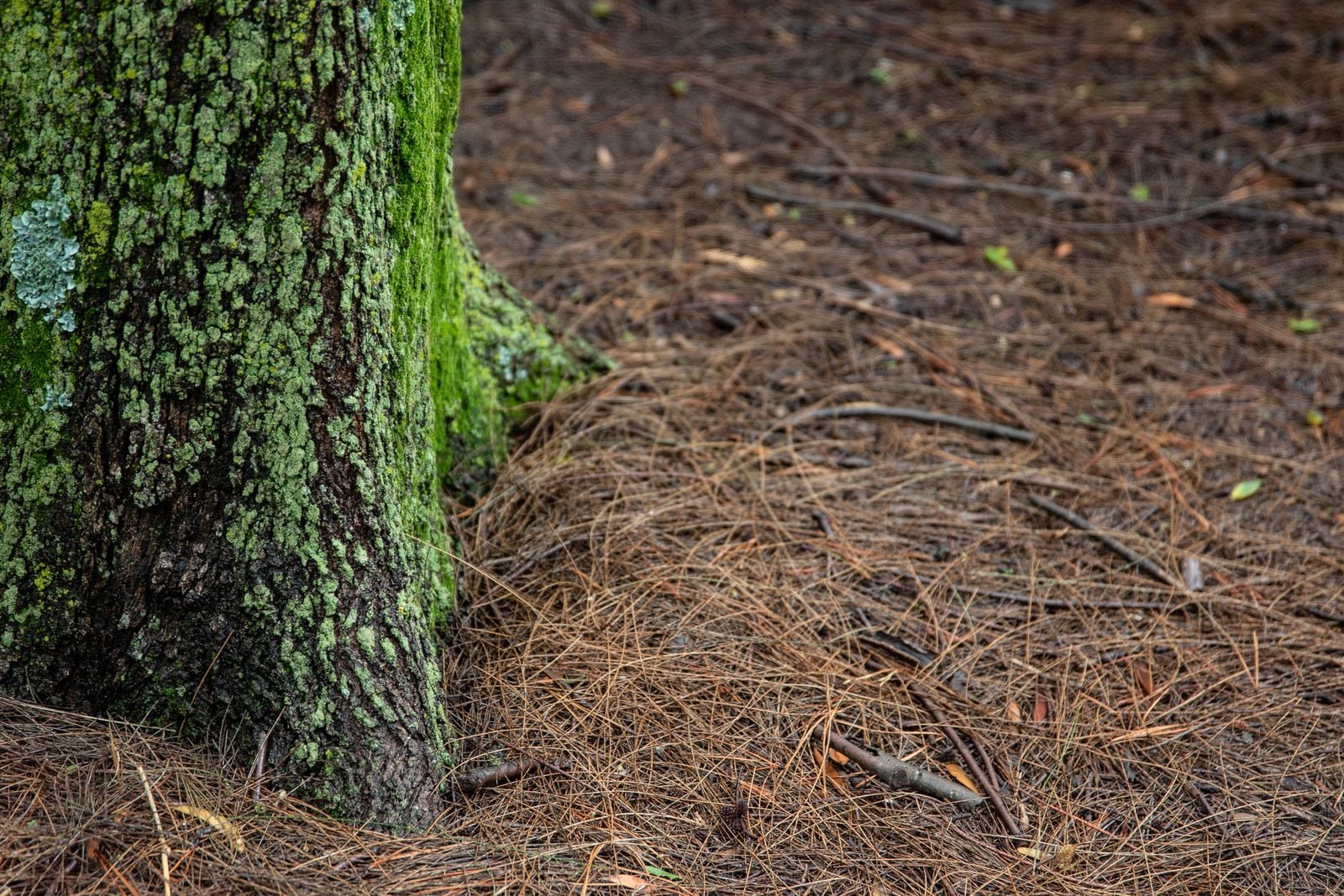
A mature Wollemi pine grows to about 40 metres — roughly the height of a 12-storey building. Its trunk is coated in what botanists call “bubbly” bark, dark brown nodules that give the tree the appearance of being dipped in Coco Pops. The leaves are flat, ferny, arranged in two ranks along the stem, and a curious blue-green colour that shifts toward bronze in the crown.
Individual trees produce both male and female cones, and — here is the strangeness — the entire wild population is essentially genetically identical. As researchers reported in the Sydney Morning Herald, early studies found so little genetic variation between individuals that the grove behaves almost like a single clonal organism. This is what happens when a species passes through a bottleneck so tight that only a handful of individuals make it to the other side.
The trees also “coppice” — a single root system can send up multiple trunks. Some of the trunks growing today may be sprouts from root systems thousands of years old, meaning the individual organism you are looking at might, in a biological sense, predate the pyramids.

Why the coordinates are classified
The exact location of the wild grove is one of the more strictly enforced secrets in Australian conservation. Journalists who have been permitted to visit — including the ABC team who filmed the site in 2024 — are flown in by helicopter with the windows effectively curtained, sworn to secrecy, and required to soak their boots in methylated spirits before walking anywhere near the trees. Cameras have their GPS tags stripped. Notebooks are checked.
The paranoia is not theatrical. It is a response to a specific microscopic threat called Phytophthora cinnamomi, a soil-borne water mould responsible for root rot in thousands of Australian plant species. According to the researchers featured in the ABC’s site visit, it takes just one gram of infected soil, tracked in on a boot sole, to introduce the pathogen. There is no cure. And phytophthora has already been detected in parts of the original grove, almost certainly carried in by an unauthorised visitor who found the site and could not resist walking to it.
The other threat is fire. In the catastrophic 2019–2020 bushfire season, flames swept through Wollemi National Park and came within metres of the grove. In an operation that briefly captured global attention, remote area firefighters were winched into the canyon to rig sprinkler systems and lay water bombing runs directly on the trees. They saved most of the wild population. They lost almost every sapling at a nearby translocation site.
Between fire and rot, the entire species — a lineage older than the Rocky Mountains — hangs on the discipline of a small team who inspect the trees only when they must, and who understand that the grove’s greatest defence is that almost nobody knows where it is.
The insurance populations
The response to a species that survives in one location, in one canyon, with one pathogen already circulating, is to build backups. Since 2019, NSW National Parks and Wildlife has established translocation sites — secret plantings elsewhere in the wilderness where saplings raised from the original grove are being reintroduced into habitat that matches the sandstone-slot microclimate of the source canyon.
Growth is glacial. Seedlings put on less than a centimetre a year until they can push a crown into the rainforest canopy at 20 to 30 metres. That is a wait of decades. A tree planted at a translocation site today may not cone until the middle of the next century.
The commercial arm of the strategy has been almost equally strange. Beginning in the early 2000s, the Australian government authorised licensed nurseries to propagate Wollemi pines from cuttings and sell them to gardeners worldwide. The logic: if the species exists in tens of thousands of gardens on six continents, it can never truly go extinct. As Country Life reported, British estates and botanic gardens now grow mature specimens that have already outperformed expectations in a range of climates. Kew Gardens has one. So does the Royal Botanic Garden in Sydney. A sapling now sits in a courtyard at the Vatican.
In September 2024, on the 30th anniversary of Noble’s discovery, a batch of rare direct-lineage saplings was auctioned to fund ongoing conservation. The proceeds go back into the recovery programme.
What survives, and what almost didn’t
The pattern the Wollemi pine sits inside is worth naming. Species presumed extinct that turn out to be quietly holding on in some overlooked pocket are called Lazarus taxa. The coelacanth is the famous marine example — a lobe-finned fish thought to have vanished with the dinosaurs, found alive off South Africa in 1938. The Wollemi is the botanical version, and arguably more spectacular because there is no ocean to hide in. It survived in one canyon, in one country, at a distance from a major city about equal to the drive from London to Birmingham.
Space Daily has written before about the psychology of finding what was thought to be gone — the astronomers who spent decades searching for Planet X, the physicists who mistook the cosmic microwave background for pigeon droppings. The Wollemi discovery sits in the same tradition: a person doing their normal work, noticing an anomaly, and being right about it.
Noble was not looking for a new species. He was canyoning on his day off.
The threat that is still coming
Climate models suggest the sandstone canyons of the Blue Mountains will grow hotter and drier through the century, and the fire seasons that came within metres of the grove in 2019–2020 will get worse. The Revelator has documented how the grove’s microclimate — deep shade, cool air pooling at the canyon floor, permanent seepage from the sandstone walls — has been the species’ refuge for millions of years, and how that refuge is not guaranteed for the next few decades.
The recovery programme has been treated as a template for other critically endangered plants: secret location, quarantine protocols, translocation sites, commercial propagation, active fire defence. It is expensive, labour-intensive, and dependent on the discipline of a small workforce. It is also working. Thirty-two years after Noble roped into the wrong canyon, the wild population is stable, the insurance populations are growing, and the species is on almost every continent as a garden ornamental.
What the bark remembers
Stand at the base of a mature Wollemi pine — or one of the domesticated cousins in a botanic garden, since the wild ones are off-limits — and press a palm against the bark. The bubbly texture is not decorative. It is the structural signature of a genus that split off from other conifers before the flowers evolved, before grass evolved, before the continents took the shape you would recognise on a globe.
The tree does not know any of this. It does not know that a ranger found it in 1994, or that its coordinates are held in a locked file in a government office in Sydney, or that a version of itself now grows in a courtyard in Rome. It puts on less than a centimetre a year and waits for a gap in the canopy.
Ninety million years is a long time to wait. It has waited longer.
