
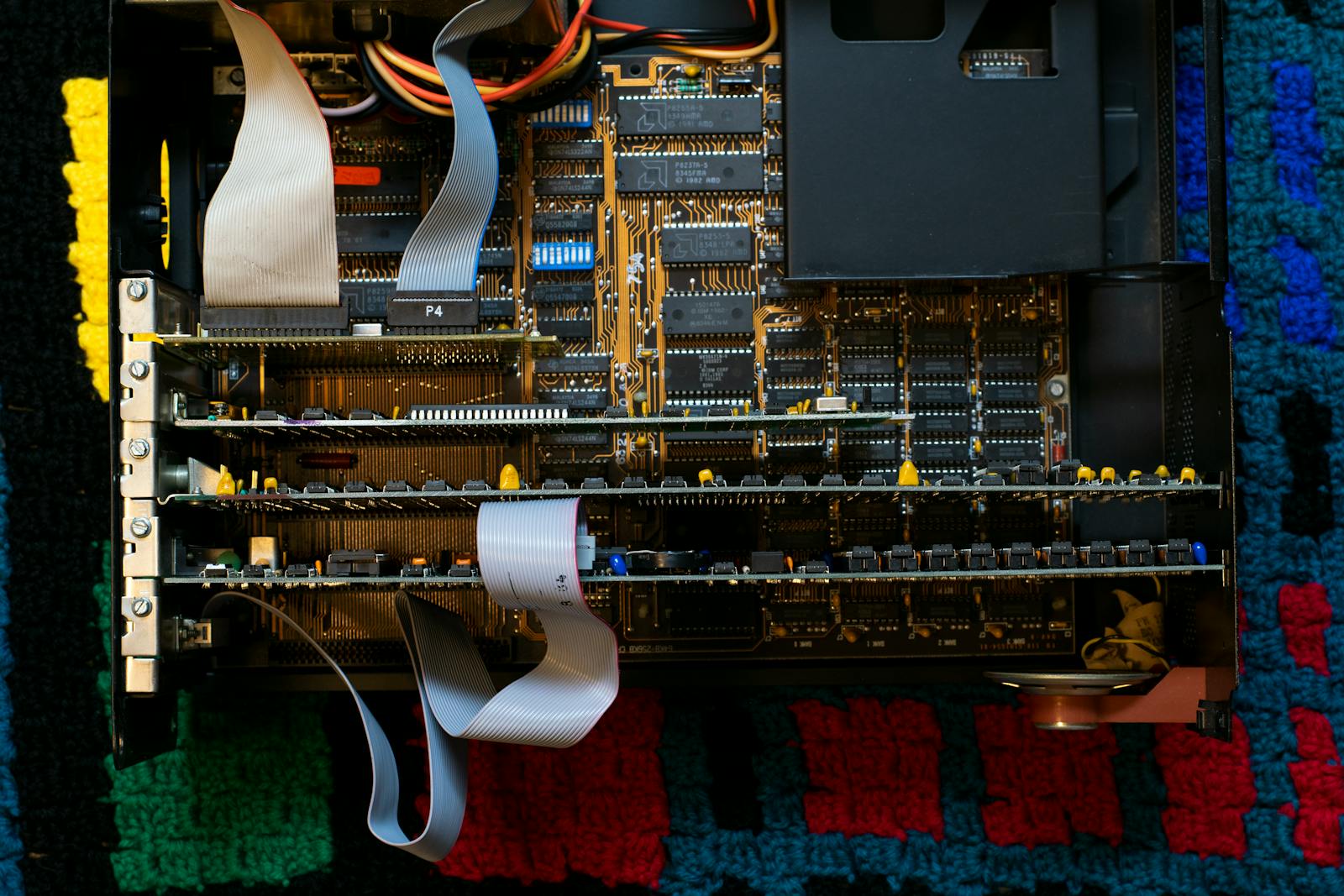
Every Apollo Guidance Computer that flew to the Moon carried software that had been stitched together by hand, one copper wire at a time, by women working at a Raytheon factory in Waltham, Massachusetts. The program was not loaded. It was not written to a disk. It was physically threaded — wire going through a tiny iron ring for a 1, wire going around it for a 0 — until the entire flight program for Apollo 11 existed as a woven object, dense as a brick, about the size of a paperback novel.
The factory floor had a name for the women doing the stitching. They were called the Little Old Ladies. The acronym, half-affectionate and half-condescending, was LOL.
They were holding the only copy of the code that would land a man on the Moon.
How you weave a computer program
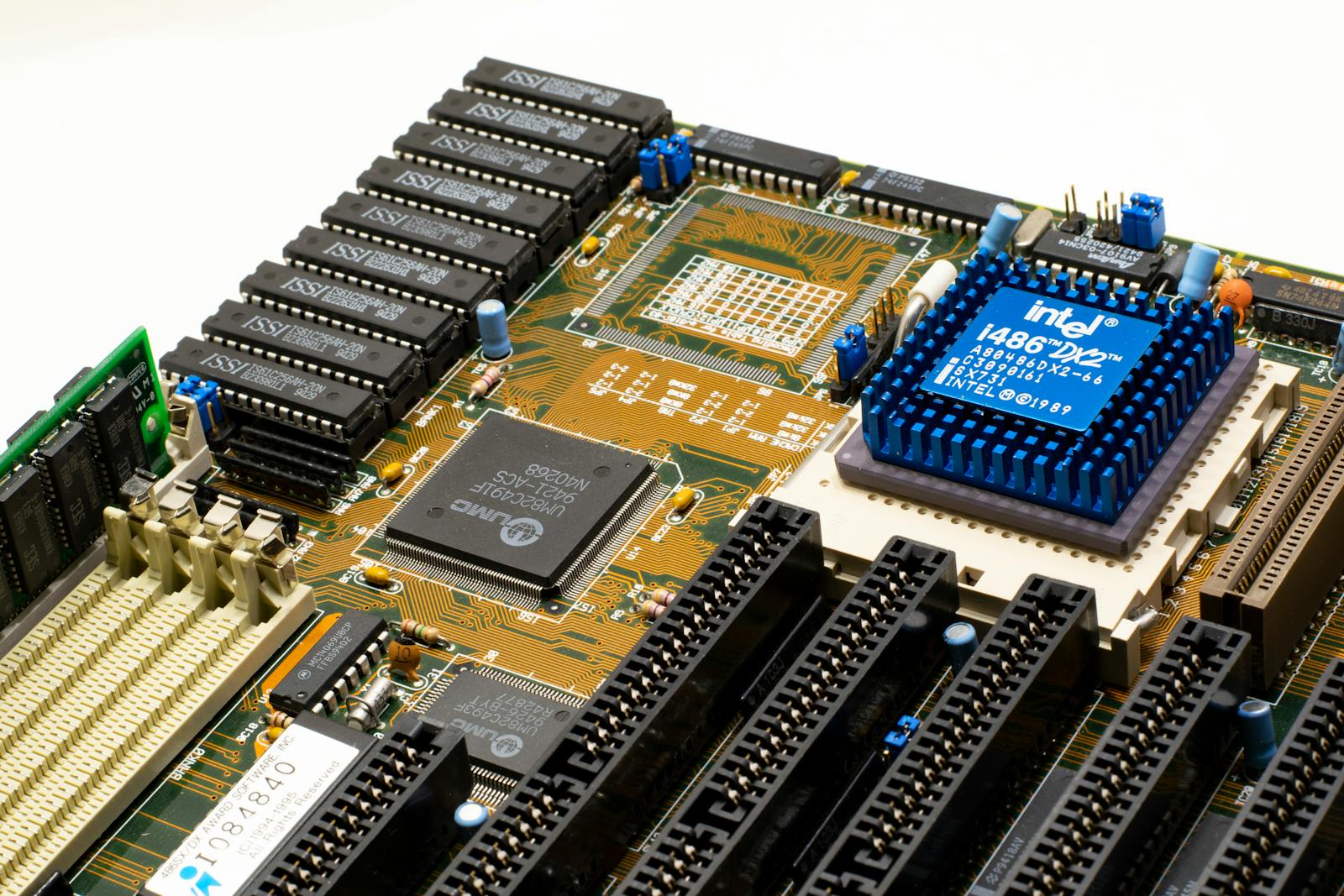
The Apollo Guidance Computer, designed at the MIT Instrumentation Laboratory under Charles Stark Draper, had two kinds of memory. There was a small amount of erasable magnetic-core RAM for variables and scratch work. And there was the read-only memory that held the flight program itself, which engineers called core rope.
Core rope was a strange invention. Each module contained 512 tiny ferrite rings, each smaller than a grain of rice. A wire threaded through a ring encoded a 1. A wire routed around the outside of that same ring encoded a 0. Each wire passed through dozens of rings on its way across the module, picking up a binary digit at every ring it pierced or bypassed.
The density was extraordinary for the era. A single module could hold roughly 98,000 bits — 6,144 sixteen-bit words — in a package small enough to hold in one hand. The trade-off was that once a wire was woven, the program was permanent. There was no rewriting. If the code changed, the module had to be unwoven and re-woven from scratch.
That permanence is why the engineers called it “LOL memory” in their jokes — Little Old Lady memory. The wiring diagrams were translated into long sequences of instructions on punched tape, and the women at Raytheon followed the tape, ring by ring, pushing the long needle through or around. A single mistake corrupted the program. There was no debugging at that stage. There was only re-threading.
The women at the bench
The Raytheon plant in Waltham, just outside Boston, employed skilled textile workers — many of them experienced seamstresses and weavers — because the work required exactly the kind of patience, dexterity, and pattern recognition that decades at a sewing machine builds. Hackaday’s retrospective on restoring an Apollo Guidance Computer describes the modules as woven artifacts in the most literal sense, with a programmer reading bit values from a printout while the weaver advanced the needle.
Two women would often work as a pair, one on each side of the module, passing the long needle back and forth like a shuttle on a loom. A single module could take eight weeks to complete. The full set of fixed memory modules for one Apollo Guidance Computer represented months of continuous human labor.
Science News, in its account of the workers behind the program, noted that core memory weavers were part of a broader, largely uncredited pipeline of women — including the Navajo workers at the Fairchild plant in Shiprock, New Mexico, who assembled integrated circuits for the same generation of aerospace electronics. The hands that built the space age were, in large part, female and invisible.
The code came from a woman too
The program being threaded into those rings was the work of a team led by Margaret Hamilton, then in her early thirties, who ran the software engineering group at the MIT Instrumentation Laboratory. Hamilton coined the phrase “software engineering” in part to push back against the idea that what her team did was peripheral to the hardware. As Vox documented in its profile of Hamilton, the asynchronous priority-scheduling system she helped design is the reason Apollo 11 landed at all.
Roughly seven minutes before touchdown, the AGC began throwing 1202 alarms — the rendezvous radar was flooding the processor with interrupts it had not been asked for. A 1201 followed a few minutes later. Hamilton’s scheduler shed the lower-priority tasks and kept the landing program running. Neil Armstrong landed with seconds of fuel remaining and the computer still working because of code that had been written, tested, and then physically sewn into the spacecraft.
A famous photograph from 1969 shows Hamilton standing next to a stack of printed Apollo source code that is taller than she is. The Smithsonian’s account of her work on the Apollo software team notes that her group’s listings, taken together, ran to thousands of pages — every one of which had to be translated into a routing diagram for the weavers.
Why the joke was barbed
“LOL memory” was the kind of nickname that sounds friendly until you look at the room it was spoken in. The men who designed the modules were engineers with MIT degrees. The women who built them were paid hourly and were rarely named in technical documentation. The acronym did the cultural work of separating the thinkers from the hands, even though the hands were the only reason the thinkers’ work ever flew.
The pattern was not unique to Raytheon. At the Playtex factory in Delaware, a separate team of seamstresses was hand-stitching the Apollo spacesuits to a tolerance of one sixty-fourth of an inch, as Space Daily has previously reported. Two of the most safety-critical components of the Moon landing — the program and the pressure suit — were both produced by women whose names did not appear on the engineering drawings.
Ahead of the 50th anniversary of Apollo 11, Caroline Kennedy tried to track down five of the surviving Raytheon weavers — Vernell Norman, Caroline Butler, Helen Lennon, Edna Walcott, and Mary Julian — after seeing them in a black-and-white photo from a Raytheon newsletter dated February 1969. The Boston Globe documented her search, as did IrishCentral; only one of the five women, Mary Julian, was ever positively identified, through her son Jim, after the photo was published. The other four are still unaccounted for. Nearly all of the original weavers, if they are alive at all, are now in their eighties or nineties.
The physical object that flew
Picture what was actually bolted into the Command Module and the Lunar Module. The Block II Apollo Guidance Computer weighed about 70 pounds and drew roughly 55 watts — less than a modern desk lamp. Inside it sat six core rope modules. Each module was a sealed potted block of epoxy with the woven mesh of rings and wires entombed inside, totally inaccessible once the resin cured.
The program could not be patched in flight. Whatever was woven was what flew. If a bug had been discovered the week before launch, the only fix would have been weeks of re-threading by hand. This is why the verification process at MIT was so brutal, and why Hamilton’s team ran simulation after simulation. The cost of being wrong was measured in months of women’s labor and, eventually, in astronaut lives.
The block II design had a quirk that the modern restorers only rediscovered in 2023. To select an individual core for reading, multiple inhibit wires had to be set to half-current. The half-current trick did not quite work as intended — it partially selected unrelated cores on the other half of the module. When Mike Stewart built a modern core rope reader from scratch to recover lost Apollo software, his FPGA-based reader had to be deliberately rewritten to reproduce the original 1960s bug. The flight code expected the hardware to misbehave in exactly that way.
What got recovered, and what didn’t
For decades, the full source listings of Apollo flight software were scattered, partial, or lost. Some modules survived in museums and private collections. Others existed only as physical objects whose contents nobody had read in fifty years. The restoration effort led by Marc Verdiell — “CuriousMarc” on YouTube — and Stewart involved getting a real AGC running again and then, when the computer had to be returned to its owner, building a standalone reader so the remaining modules could still be decoded.
Every recovered bit is, in a sense, a recovered hand motion. Somewhere in 1968, a woman pushed a needle through a ring, or around it, and that decision is now sitting in a GitHub repository as a 1 or a 0. The act of reading the modules is also the act of recovering the labor.
The legacy in the lunar data
The work those women did is still producing science. The Apollo seismometers ran nearly continuously from 1969 through 1977, and their data is still being mined. In 2024, Keisuke Onodera of the University of Tokyo went back through the short-period seismometer records — by eye, classifying waveforms one at a time — and found 22,000 previously unrecognized moonquakes, bringing the known total to about 35,000.
The instruments that captured those signals were placed on the lunar surface by missions whose navigation depended on woven memory. The data they returned is now being used to plan the next generation of lunar habitats, including NASA’s Artemis landing sites and the Chinese Chang’e 7 mission to the south pole. Every Apollo science result, sixty years on, traces back through a thread.
What sits in museums now
An original core rope module today is a museum piece roughly the size of a hardback book. It is heavy. It is sealed. You cannot see the rings or the wires through the epoxy — they are entombed, the way a fossil is entombed in stone. The only way to know what is inside is to power it up and listen to it speak, bit by bit, in the language the weavers gave it.
The Apollo 11 Command Module guidance computer is still bolted inside Columbia at the Smithsonian National Air and Space Museum, the rope memory modules sealed in their epoxy exactly as they were when Michael Collins flew with them around the Moon and brought them home. You can stand next to it and read the labels. The 1s and 0s are still in there.
The other AGC that flew Apollo 11 — the one in the Lunar Module — is gone. The LM’s guidance computer sat in the ascent stage, in an equipment bay behind the crew cabin, and the ascent stage was jettisoned in lunar orbit shortly after Armstrong and Aldrin had transferred back to Columbia. NASA assumed for decades that the orbit had decayed and the ascent stage had crashed somewhere on the Moon within a few months; a 2021 study using long-term orbital simulations suggested it might in fact still be circling overhead. Either way, nobody has ever recovered it.
The ascent stages of Apollo 12 through 17 are easier to account for. NASA deliberately crashed most of them into the lunar surface after rendezvous, to produce calibrated seismic signals for the instruments below — the very instruments whose data Onodera would later go back through, ring by ring. Each impact buried a stack of woven core rope modules somewhere in lunar regolith, at coordinates carefully logged.
The descent stages — the four-legged platforms the ascent engines lifted off from — are still on the Moon, sitting exactly where the astronauts left them. Eagle’s descent stage is at the Sea of Tranquility. Around the later ones, the artifacts the crews left intact remain in place: the flags, the experiments, the small aluminum figurine of the Fallen Astronaut placed by the Apollo 15 crew. None of them contains a guidance computer. The AGCs all went up with the ascent stages, and then came down hard.
The vacuum will not corrupt them. The temperature swings will not unweave them. The 1s and 0s the Little Old Ladies threaded in a factory outside Boston in 1968 are still in the order the women put them — some sealed in a glass case in Washington, some scattered across the lunar regolith at the bottom of small craters whose coordinates were carefully logged.
