
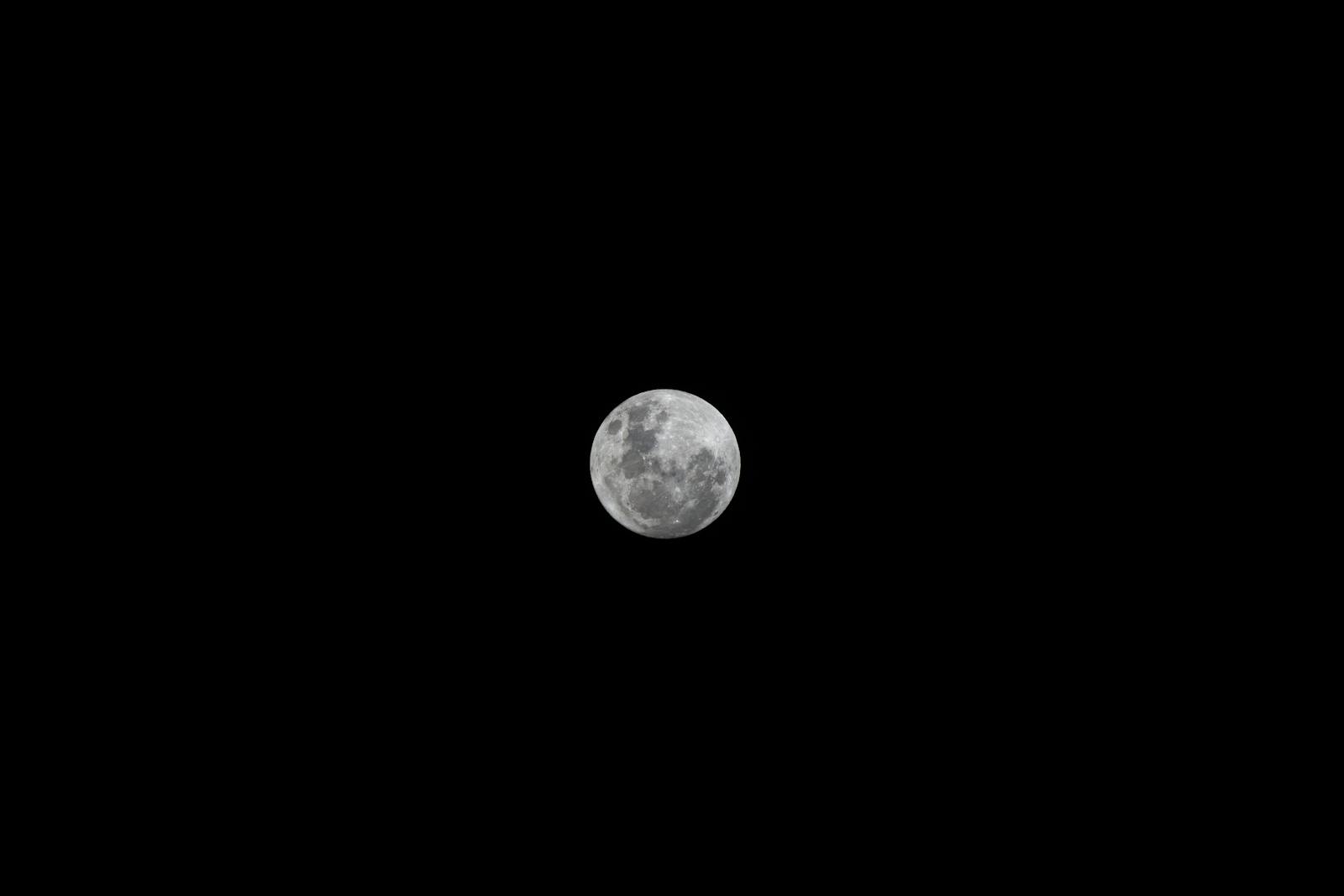
On 7 October 1959, a Soviet probe the size of a small water heater swung around the back of the Moon, opened a camera port on its sunlit side, and began photographing a hemisphere no human had ever seen. The spacecraft was called Luna 3. It carried two lenses, a roll of film, a miniature chemical processor, and a scanner that could turn developed negatives into radio signals. Over the next several days, as it coasted back toward Earth on a long looping trajectory, it transmitted a set of first views of the lunar far side — blurry, low-contrast, and historically irreversible.
Those images ended a question humans had been asking for as long as they had looked up. The Moon is tidally locked to Earth, so one face is always turned roughly toward us. Libration lets observers glimpse a little beyond the edge, but until Luna 3, the far side itself remained a blank place on maps.
A camera system sealed inside a spinning spacecraft
Luna 3 had a launch mass of about 278 kilograms. Most of that mass was spacecraft: structure, power, radio equipment, attitude control, and the temperature-management system needed to keep its film and chemistry within workable limits. The imaging payload was the Yenisey-2 system, built around a dual-lens AFA-E1 camera, an automatic film processor, and a scanner.
The film was the strange part. The camera carried temperature-resistant, radiation-resistant 35 mm film, and the widely repeated history is that Soviet engineers used American film recovered from Genetrix reconnaissance balloons that had drifted into Soviet territory in the 1950s. A Cold War spy program, in a small sideways way, helped make the first map of the Moon’s hidden face.
The spacecraft was spin-stabilised for much of its flight, then oriented itself for photography using the Sun and a photoelectric sensor that detected the Moon. Once the disk was in position, the camera cover opened and the imaging sequence began. Luna 3 took 29 photographs over roughly 40 minutes, from about 63,500 to 66,700 kilometres above the lunar surface.
An automated darkroom in deep space
Here is where the engineering becomes almost theatrical. Luna 3 did not transmit raw digital camera data. There were no CCDs in 1959, and no modern image sensor waiting behind the lens. What Luna 3 had was film, and film needed to be developed.
After the exposures were taken, motors moved the film through the onboard processing system, where it was developed, fixed, and dried. The whole process had to work inside a sealed spacecraft crossing hundreds of thousands of kilometres of space, without a technician, without a second attempt, and without any way to repair a jammed transport or failed chemical step.
The result was not a print, but a strip of processed photographic film inside a spacecraft now falling back toward Earth at several kilometres per second. The negatives were the record. The scanner’s job was to read them line by line and turn their brightness into an electrical signal.
How you radio a photograph in 1959
To send the pictures home, Luna 3 used a slow scanning system that belonged to the same technological family as facsimile and wirephoto transmission. A light spot passed through the developed film. A photomultiplier read the varying brightness. That analog signal modulated the spacecraft’s radio transmitter.
Accounts of the scanner describe a flying-spot arrangement, with a cathode-ray tube producing the moving spot of light that was projected through the film onto the photomultiplier. The important correction is that the spacecraft was not scanning paper prints. It was scanning the developed onboard film.
Early transmission attempts were weak. As Luna 3 moved closer to Earth, the signal improved enough for Soviet ground stations to recover usable images. NASA’s summary says the first photograph was taken at 03:30 UT on 7 October 1959, the last came about 40 minutes later, and 29 photographs covered about 70 percent of the far side. Seventeen frames are commonly cited as successfully transmitted, though not all were published at the time.
What the pictures showed
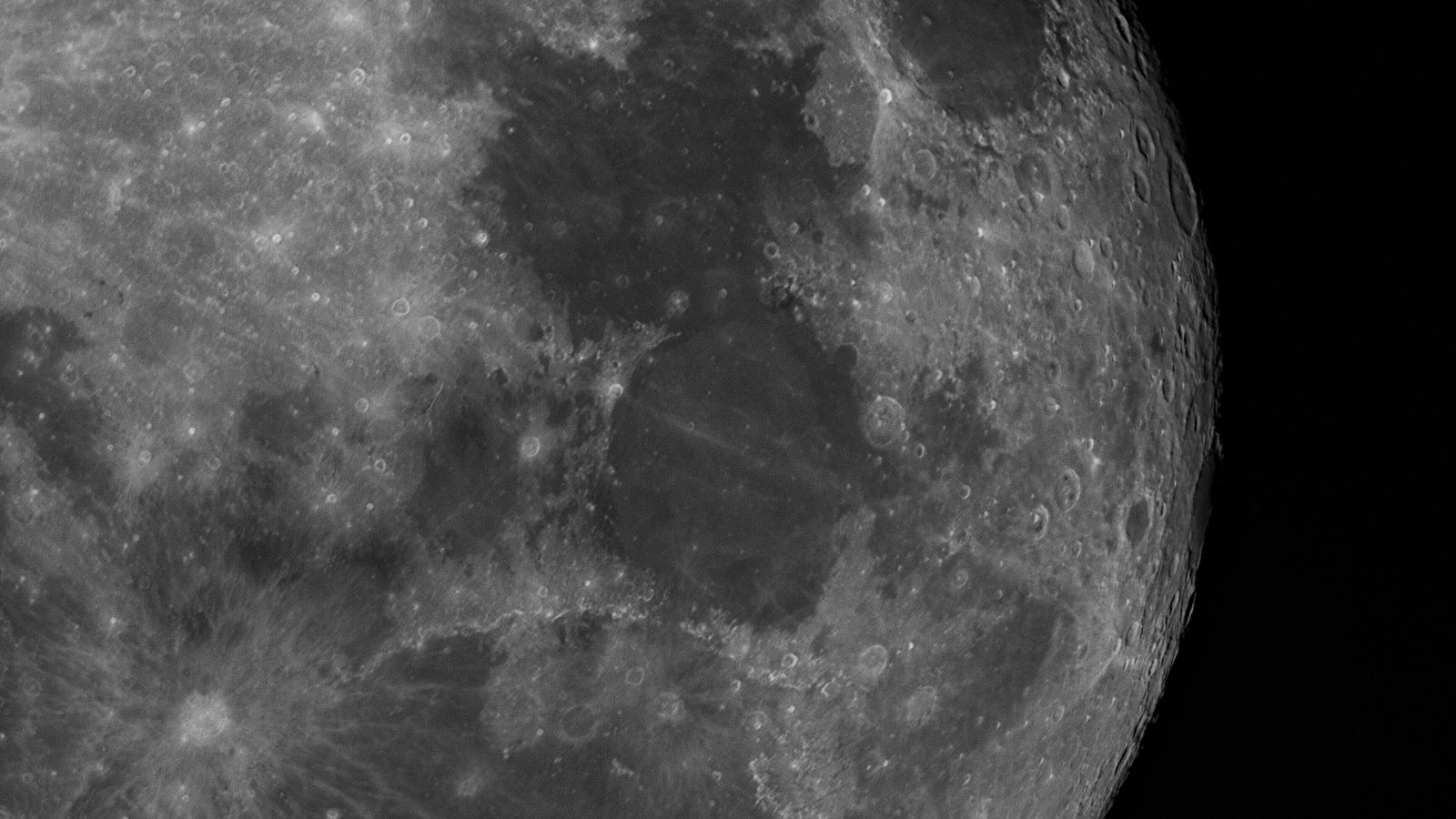
The images were terrible by any modern standard. They were noisy, low-resolution, and soft at the edges. The far side arrived not as a clean map, but as a gray disk with streaks, blotches, and features that had to be separated from defects in film, scanning, and transmission.
Still, the main fact was visible. The far side looked different. The familiar near side is marked by large dark basaltic plains called maria, the ancient volcanic surfaces that form the face people have imagined as the Man in the Moon. Luna 3 showed that the far side had far fewer of them. It was brighter, rougher, more heavily cratered, and geologically unlike the hemisphere humans had been staring at for millennia.
The Soviet team built an atlas from the new images. Mare Moscoviense, the Sea of Moscow, was among the features identified and named. So was Tsiolkovskiy crater, named for Konstantin Tsiolkovsky, the Russian rocketry theorist. Those names survived the first blurry data. They are still part of lunar cartography.
Why the engineering still impresses
Strip away the propaganda framing of the early space race and Luna 3 remains a chain of improbable mechanical successes. Each link had to work in sequence. There was no recovery mode that could send a person to open a stuck cover, warm a frozen valve, or reload a strip of film.
The spacecraft had to survive launch. Its attitude-control system had to find the Moon and point the cameras. Its thermal system had to keep the photographic chemistry within a usable range. The film transport had to advance in microgravity. The processing unit had to develop and dry the film without ruining it. The scanner had to read the negatives. The transmitter had to push the signal across nearly 300,000 miles of space. Ground stations had to pull those faint lines out of noise.
Any one of those steps failing would have produced silence. None of them failed completely. Luna 3 lost contact later in October 1959, and its final fate is uncertain, but the images had already crossed the distance.
The long shadow of 17 grainy frames
Every later far-side mission inherits something from Luna 3. NASA’s Lunar Orbiter spacecraft mapped the Moon in far sharper detail in the 1960s. Apollo 8 carried Frank Borman, James Lovell, and William Anders around the Moon in December 1968, making them the first humans to see the far side directly. The Lunar Reconnaissance Orbiter later turned the hidden hemisphere into a high-resolution landscape rather than a mystery.
The line continued into the Chinese lunar program. Chang’e 4 made the first soft landing on the far side in January 2019, using the Queqiao relay satellite to solve the communications problem that had always made far-side operations difficult. Chang’e 6 returned the first samples from the far side in 2024, from the South Pole-Aitken basin, giving geologists material they could hold instead of only images they could interpret.
The asymmetry Luna 3 first exposed is still a live scientific question. The near side and far side differ in crustal thickness, topography, volcanic history, and distribution of heat-producing elements. NASA’s current Moon composition material describes the crust as thicker on the side farthest from Earth and thinner on the near side, a structural difference that helps explain why basaltic maria are so much more common on the face we see.
Space Daily has covered that later lunar story from several angles, including China’s rapid run from far-side landing to sample return, the communications problem behind lunar trajectories, and new simulations of the South Pole-Aitken basin. Luna 3 sits at the start of that chain: not as a complete map, but as the first proof that the chain existed.
What it cost, and what it bought
The total mass of useful image data Luna 3 returned was tiny by modern standards. A single smartphone photograph contains more recoverable detail than the whole first far-side image set. But those frames changed the scale of human sight.
They proved that an automated machine could leave Earth, pass behind the Moon, perform timed photography, process chemical film, scan it, and report back from a place no human could see directly. That template runs through Mariner, Viking, Voyager, the Mars rovers, and the probes that have since visited every planet in the solar system.
The Soviet engineers who built Luna 3 worked with slide rules, analog electronics, hand-built mechanisms, and sealed chemical systems. Some components were assembled by people who may not have been told the full mission. The film may have begun as material intended for American reconnaissance. The spacecraft turned it into the first visible evidence of another world’s hidden hemisphere.
What came back was not just a photograph. It was a place: hills, craters, pale highlands, and the long shadows of a lunar morning on terrain that had existed for human beings only as geometry. Tonight, the far side is still turned away. The reason anyone knows its shape begins with those damaged gray frames, scanned inside Luna 3 and sent home through the dark.
Sources and verification
NASA’s history of the early Luna missions records that Luna 3 took 29 photographs over roughly 40 minutes and developed and scanned the film onboard. NASA also maintains a reconstruction and explanation of the first far-side image.
Editor’s note: Sources were added on September 14, 2026, to support the mission chronology and imaging process.
