

The Greek government’s salvage of the Antikythera wreck ran for roughly ten months across 1900 and 1901, and it cost one diver his life. The official roster of the operation, maintained by the modern research project working the same site, lists him as Georgios Kritikos, also called Tourkokritikos, a Cretan of Turkish descent, who lost his life during the operations. Two other men on the crew were left paralysed. The Woods Hole Oceanographic Institution, which has been diving the wreck since 2012, puts the site at 55 metres and notes that the casualties are what forced the first salvage to stop.
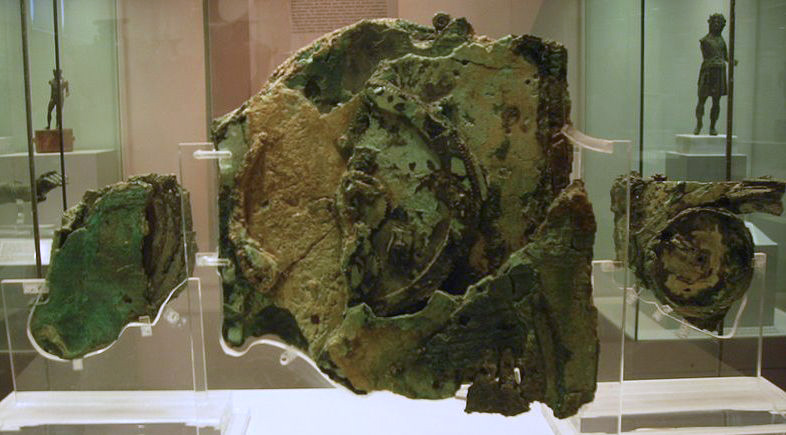
What those men brought up before the operation ended included bronze and marble statues, glassware, jewellery, furniture, coins and a corroded lump about the size of a shoebox that nobody catalogued as interesting. That lump turned out to be a geared astronomical calculator. It has since absorbed most of the attention the wreck receives.
The wreck itself is the larger object. It is still there, still being excavated, and it is still producing human remains.
The storm that put them there
In the spring of 1900, a crew of sponge divers from the island of Symi was sailing home from the sponge beds off North Africa when weather forced them to shelter behind Antikythera, a bare rock between Crete and the Peloponnese. They waited. When the sea dropped, they went down to see whether the sponging was worth anything.
Elias Stadiatis went first. He wore the equipment that had transformed the industry a few years earlier and was killing men across the Aegean: a heavy canvas suit, a bolted copper helmet, air fed down a hose from a hand-cranked pump on the deck. He reached the bottom at roughly 50 metres, signalled almost immediately, and came up shaking. What he described was a field of human bodies and dead horses lying on the seabed.
The crew assumed he was narcotised. Captain Dimitrios Kontos went down himself to check. He surfaced holding the bronze arm of a statue.
Greece had recently come out of a bruising war with the Ottomans and the government was in the market for national prestige. It hired Kontos and his crew, backed by the Hellenic Navy, to strip the site.
What ten months on the bottom cost
Nobody involved understood decompression. The physiology of dissolved nitrogen was known in outline by 1900 but staged ascent was not standard practice among Aegean sponge crews, and the economics of the work pushed against caution. A diver on the bottom was earning. A diver hanging on a rope at ten metres for twenty minutes was not.
The site made this worse. At 50 to 55 metres, useful bottom time is measured in minutes and the decompression obligation stacks up fast. The crew were doing repeated deep dives, day after day, hauling marble.
Kritikos died. Two others were crippled. The roster that names him also names the men he worked alongside — Kyriakos and Georgios Mountiadis, Ioannis Piliou, Vasilios Katsaras, Konstantinos Kalafatis, Vasilios Zouroudis, and Merkouris Karayanis, the rope-holder — which is more than most salvage crews of the period get.
The operation stopped. Whether it stopped because of the deaths or because the visible cargo had been cleared is not entirely settled, but the effect was the same: after 1901 the wreck was left alone.
By then the haul was extraordinary. Marble sculpture, bronze figures including the Antikythera youth, a headless Herakles, luxury glassware, gold jewellery, coins. The project’s own account of the 1901 recovery notes four giant marble horses, possibly part of a chariot group with a warrior. Space Daily has covered the one object from that haul that rewrote the history of engineering, and separately the reconstruction of its gear train.
The site nobody could reach for a century
Depth is why the wreck sat untouched. Recreational scuba does not safely reach 50 metres, and for most of the twentieth century the site was effectively out of range for the sustained, careful work archaeology requires. The sponge divers had been able to get there only because they were willing to be injured.
Jacques-Yves Cousteau visited briefly in the 1950s and returned in 1976 with Calypso, recovering close to 300 further objects, including human skeletal material. Then the site went quiet again for more than three decades.
Systematic excavation resumed in 2012. The difference was rebreather technology — closed-circuit systems that scrub carbon dioxide and recirculate oxygen, extending safe bottom time from minutes to hours. The 2014 team reported working the site for up to three hours per dive, which is not comparable to anything available to Kontos.
That 2014 season also mapped the wreck in three dimensions using stereo cameras on an autonomous underwater vehicle, and brought in the Nuytco Research Exosuit, an armoured one-atmosphere suit rated to 150 metres, to extend the team’s reach past the site’s lower edge.
What the mapping established is that the ship was much bigger than anyone had assumed. Hull planking and anchor dimensions point to a vessel perhaps 50 metres long, which led Brendan Foley of Woods Hole to describe it as the largest ancient shipwreck yet found. It went down between roughly 70 and 60 BCE, most likely driven onto Antikythera’s cliffs by a storm while carrying Greek luxury cargo west from Asia Minor toward Rome.
What has come up since
The 2016 season recovered around 60 artefacts in a few weeks: gold jewellery, luxury glassware, a bronze spear from a statue, marble fragments, resin and incense, ceramic decanters, and an object the team suspected was defensive equipment against pirates.
That same season confirmed the wreck of a second ancient cargo ship close by, a question that had been open since exploratory dives in 2012.
Since 2021 the work has run under a five-year programme led by the Swiss School of Archaeology in Greece, directed by Angeliki Simosi of the Ephorate of Antiquities of Euboea and Lorenz Baumer of the University of Geneva, under the supervision of the Ephorate of Underwater Antiquities.
Their first serious obstacle was geological. Boulders weighing up to eight and a half tonnes had fallen from the island’s cliffs and settled over the wreck, possibly dislodged by an earthquake centuries after the sinking. They had protected what lay beneath and also made it unreachable. Lifting them, at 50 metres, in thirty-minute working windows, took seasons.
Under one of them, in 2022, was a marble head. Bearded, larger than life-size, Farnese-type Herakles. The project’s announcement identifies it as most probably belonging to the headless Herakles of Antikythera, inventory number 5742 at the National Archaeological Museum — the statue Kontos’s crew pulled up in 1900. The head and the body had been separated for 2,000 years and apart in the same institution’s care for 120. Baumer told reporters he considered the identification near-certain.
The 2024 season, running from 17 May to 20 June, produced around 300 objects including 18 marble statue fragments and a substantial section of the ship’s hull. It also recovered the remains of a second wooden vessel beneath a separate cargo concentration, in an area roughly 200 metres from the main site.
The people on board
In 2016, three minutes into the first dive of the season, Foley’s colleagues found bone. What came up was a partial skeleton — a nearly complete skull, two arm bones, ribs, two femurs — from a young man, recovered by an expedition co-directed by Foley and Theotokis Theodoulou of the Greek Ephorate of Underwater Antiquities. They nicknamed him Pamphilos, after a name inscribed on a drinking cup found at the site in an earlier season. There is no evidence the cup was his.
He is not the only one. Skeletal material from Cousteau’s 1976 dives was examined by the osteoarchaeologist Argyro Nafplioti, who concluded it represented at least four individuals: a young man, a woman, and a teenager of undetermined sex, plus one more.
The 2022 season added two human teeth, found locked in a concretion of marine deposit alongside copper fragments and wood. Genetic and isotopic analysis of tooth enamel can indicate where a person grew up. If those teeth yield anything, they will say something about who was on a Roman-bound luxury freighter in 60 BCE — crew, passengers, or cargo in the other sense.
Foley, speaking to AFP before the 2014 season, predicted the team would find monumental statues that the 1901 divers had passed over “in the mistaken belief that they were rocks.” He was describing marble. The sentence turned out to describe the site’s whole history.
Divers still work the wreck in thirty-minute windows, breathing recirculated gas, moving stone that fell from the cliffs a thousand years after the ship hit them. Below the boulders are the bones of people who drowned in the reign of Julius Caesar’s contemporaries, and above them, somewhere in the water column between the seabed and the deck of a Hellenic Navy vessel, is where Georgios Kritikos came up too fast in 1901. The site has taken lives twice, two thousand years apart, and it is not finished handing things back.