
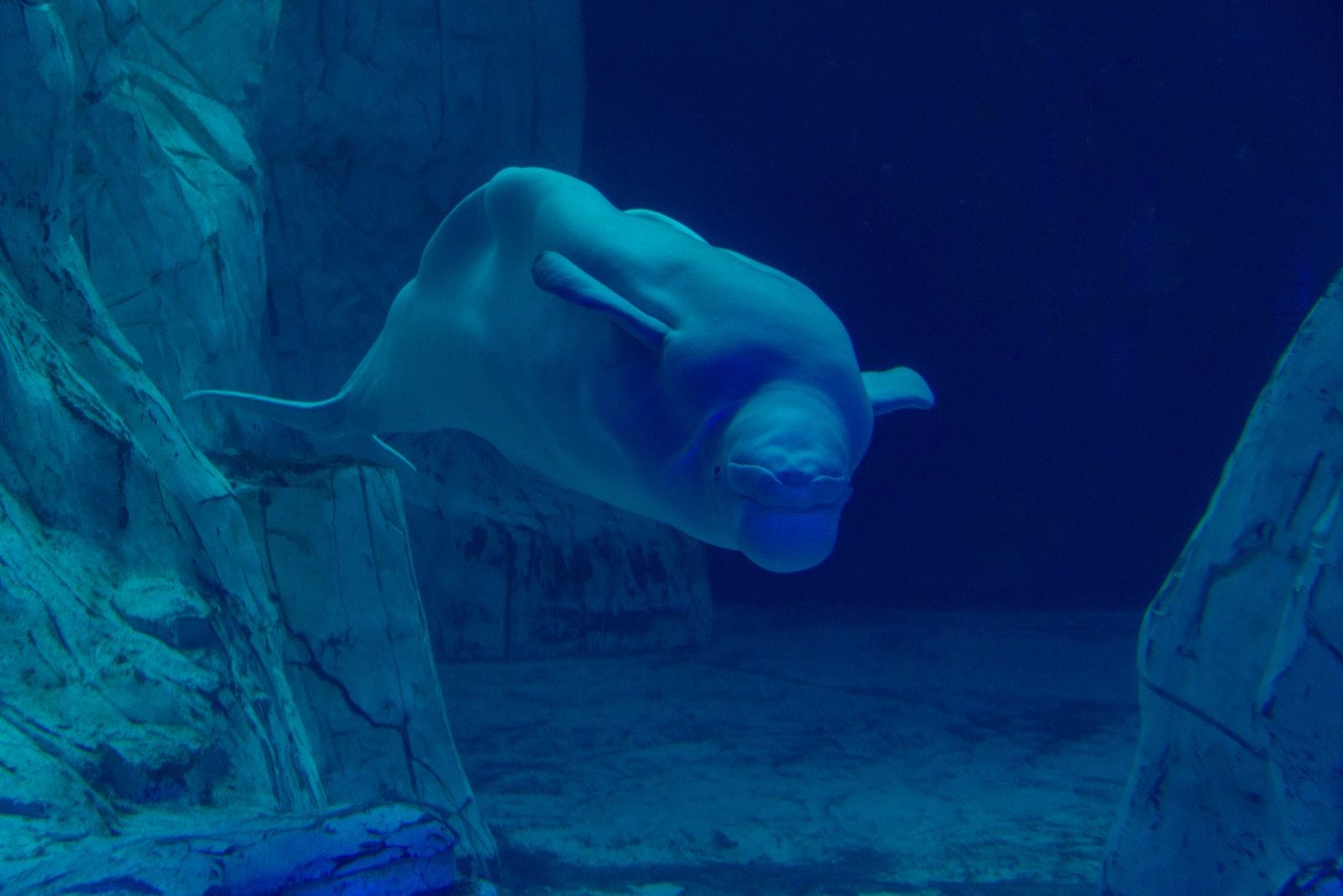
A beluga whale slipping under the winter pack ice off western Greenland can descend to great depths, hold its breath for extended periods, and surface at a crack in the ice barely wider than its own body — all on a single lungful of air squeezed to a tiny fraction of the volume it had at the surface. The physics of that dive would kill a human diver several times over. The beluga does it before breakfast.
Belugas are among the least-observed large mammals on Earth. Most of their year is spent under sea ice, in water so cold and dark that direct study is nearly impossible. What is known about their diving comes from satellite tags, tissue biopsies, and the patient work of researchers who have followed the same populations for decades.
The dive profile of an Arctic ghost
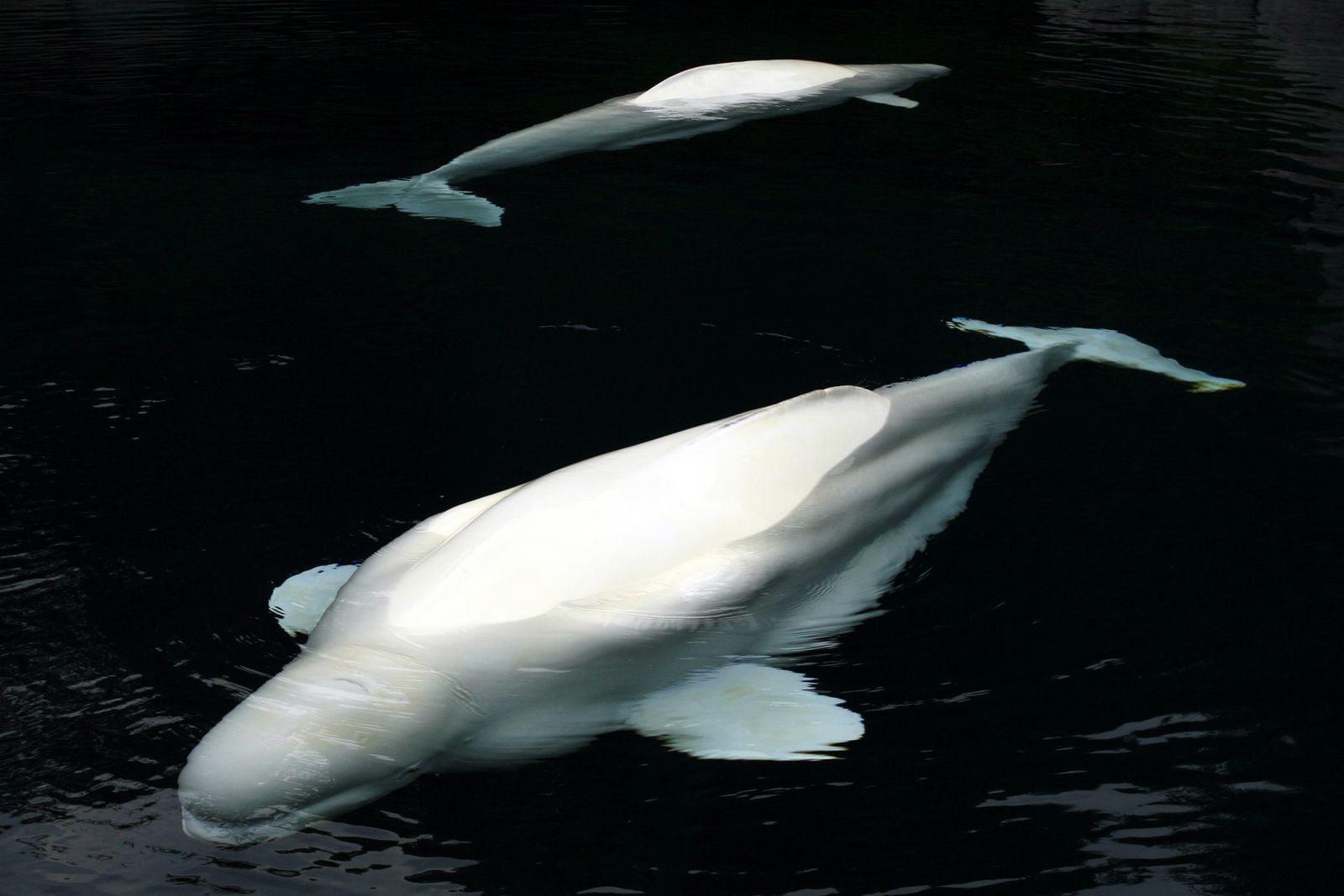
Belugas in the Canadian High Arctic and off West Greenland routinely make foraging dives to considerable depths, chasing Greenland halibut and Arctic cod along the continental slope. Deep dives can reach extreme depths. A typical foraging bout lasts many minutes, with the longest submergences extending before the animal returns to the surface for a rapid series of breaths.
To picture such depths: stack the Eiffel Tower twice, then add another 100 metres. That is the water column above a beluga at the bottom of its dive. The pressure there is roughly 71 atmospheres — 71 times what a human feels at sea level.
What is astonishing is how ordinary this is for the whale. It happens dozens of times a day, every day, for a life that can stretch many decades.
A lung that collapses on purpose
The lungs of a diving cetacean do something a human lung cannot. As pressure builds on descent, the beluga’s chest wall and diaphragm allow the lungs to compress — not passively resist, but fold. Air is pushed out of the delicate alveoli, where gas exchange happens, and into the reinforced upper airways, where nitrogen cannot dissolve into the bloodstream. The lung volume at depth shrinks to a small fraction of its surface size.
The Natural History Museum in London has described how the deepest-diving whales survive pressures that would crush terrestrial mammals by allowing their lungs to collapse in a controlled way rather than fighting the squeeze. The trick is that gas exchange effectively stops partway down the dive. The whale is no longer breathing from its lungs. It is running on what it stored before it left the surface.
Muscle as an oxygen tank
The other half of the story is chemistry. Beluga muscle carries an extraordinary concentration of myoglobin, the iron-bearing protein that binds oxygen inside muscle cells. The muscle of a deep-diving whale is densely saturated with myoglobin — the same pigment that gives the tissue its characteristic dark coloration.
That oxygen reservoir is what powers the tail, the flippers, and the hunting brain while the lungs sit collapsed and useless. A beluga at depth is, in a sense, running on batteries. The blood carries oxygen to the vital organs; the muscle carries its own supply and burns through it locally. When the animal surfaces, the whole system re-oxygenates in a matter of breaths.
Dolphins, which face the same physiological problem on shallower dives, manage the risk of decompression sickness by careful control of when and where gas exchange happens. A report on how dolphins handle the bends describes the same basic architecture — collapsing lungs, shunted blood flow, and a nervous system that regulates dive tempo to keep nitrogen out of the tissues where it would form bubbles on ascent.
Staying warm at depth
Deep Arctic water sits close to freezing. A beluga descending into pitch-black water is losing heat continuously through skin that has no fur. What it has instead is blubber — a substantial layer of insulating fat — and a circulatory system tuned to keep warm blood close to the core.
Counter-current heat exchangers in the flippers and flukes work as follows: arteries carrying warm blood outward run alongside veins returning cold blood inward, so the heat is captured before it reaches the extremities. The whale is essentially wearing a radiator it can switch off. On a long dive, blood flow to the skin drops to almost nothing. The animal cools its own surface deliberately to reduce heat loss, then re-warms at the surface.
Who this particular whale is
The belugas that dive deepest are usually adults from the Cumberland Sound, Somerset Island, or West Greenland stocks — populations that overwinter along ice edges where the seabed drops steeply into deep basins. In summer, other populations behave very differently. The belugas of Bristol Bay, Alaska, spend much of their year in shallow estuarine water, feeding on salmon runs and rarely diving to extreme depths.
A 13-year genetic study of that Bristol Bay population, published in Frontiers in Marine Science and summarised by ScienceDaily in June 2026, gives some sense of how hard belugas are to study at all. Researchers led by Greg O’Corry-Crowe at Florida Atlantic University’s Harbor Branch Oceanographic Institute collected tissue samples from 623 individuals across more than a decade to reconstruct the mating system, because direct observation of what belugas do underwater is almost impossible. According to the release, O’Corry-Crowe noted the challenges of studying beluga whales, which live beneath the waves in the frozen north and are difficult to observe directly despite significant public interest in the species.
The accompanying release from EurekAlert notes that belugas can live perhaps 100 years or more, and that both males and females switch mates across breeding seasons in what the researchers describe as a polygynandrous system. The dive physiology, in other words, is the shell around a very long life.
What the physiology buys the animal
The reason for all this engineering is food. At significant depths, Arctic cod and Greenland halibut concentrate in dense schools that no surface predator can reach. A beluga that can drop to great depths, hunt in complete darkness using echolocation, and return to a hole in the ice a few kilometres away has access to a food column that most marine mammals cannot touch. The Weddell seal does something similar in Antarctic waters. The narwhal, the beluga’s closest relative, dives even deeper — chasing halibut off the Greenland shelf.
Narwhals have been observed interacting with acoustic monitoring equipment moored on the seafloor, complicating the assumption that passive listening devices are invisible to the animals they are meant to record.
The comparison with human diving
A trained human free-diver can reach considerable depths on a single breath. The deepest free dives, achieved with the aid of weighted sleds, push the limits of human physiology. Beyond certain depths, the human chest cavity begins to buckle in ways that cause bleeding into the lungs. A beluga at that depth is barely partway to its foraging ground.
Recreational scuba divers using compressed air face nitrogen narcosis at depths beyond safe recreational limits, and any ascent from meaningful depth requires slow decompression stops to prevent the bends. The beluga’s collapsing lung sidesteps the problem entirely by ensuring nitrogen never enters the bloodstream in the first place.
An animal built for a vanishing world
Belugas evolved for an ocean covered by ice. Their skulls are unfused, allowing the head to turn independently of the body — useful for navigating floes. Their echolocation is precise enough to distinguish a breathing hole from a shadow. Their skin thickens in winter and moults every summer against gravel bottoms, one of the few marine mammals to shed skin that way.
What that lineage did not evolve for is an ice-free Arctic. As sea ice retreats, the geography of beluga foraging is shifting. Populations that once wintered along stable ice edges now face open water, increased predation from killer whales that previously could not access the region, and competition from commercial fisheries following the same halibut schools into deeper water. The physiology that lets a beluga dive to great depths does not help it against a boat.
Space Daily has written before about the culture-wide song revolutions of humpback whales in the South Pacific, and the way whole populations can adopt a new song in a single season. Belugas are equally vocal — they are called sea canaries for a reason — and their calls, like the humpbacks’, shift across generations. What the beluga has that the humpback does not is the depth. The song lives at the surface. The animal itself lives most of its life in the dark.
What a long dive looks like from below
Imagine the last few seconds of a dive. The whale has been at great depth for many minutes. Its heart rate has dropped from around 100 beats per minute at the surface to fewer than 20. Blood has been pulled away from the skin, the flippers, the digestive tract. The muscles are still burning through the myoglobin reserve. The lungs are collapsed almost flat against the ribcage, holding a slug of compressed air near the throat.
The animal turns upward. In the last hundred metres of ascent, the lungs begin to re-expand as pressure drops. Gas exchange restarts. The whale surfaces through a crack it located by echolocation from more than a kilometre away, exhales explosively — a plume of vapour in the −30 °C air — and takes four or five fast breaths. Blood re-oxygenates. Heart rate climbs back to normal.
Then it dives again.
Off Churchill, Manitoba, in summer, thousands of belugas gather in the estuary of the Churchill River, where the water is warmer and shallow enough for kayakers to paddle alongside them. Those are the same animals that, six months later and 2,000 kilometres north, will be dropping into black water under a metre of ice, running on the oxygen in their muscle, holding a breath compressed to something a physiologist would struggle to model on a whiteboard. The tourists in the kayak see the surface. The whale spends most of its life somewhere else entirely.
