
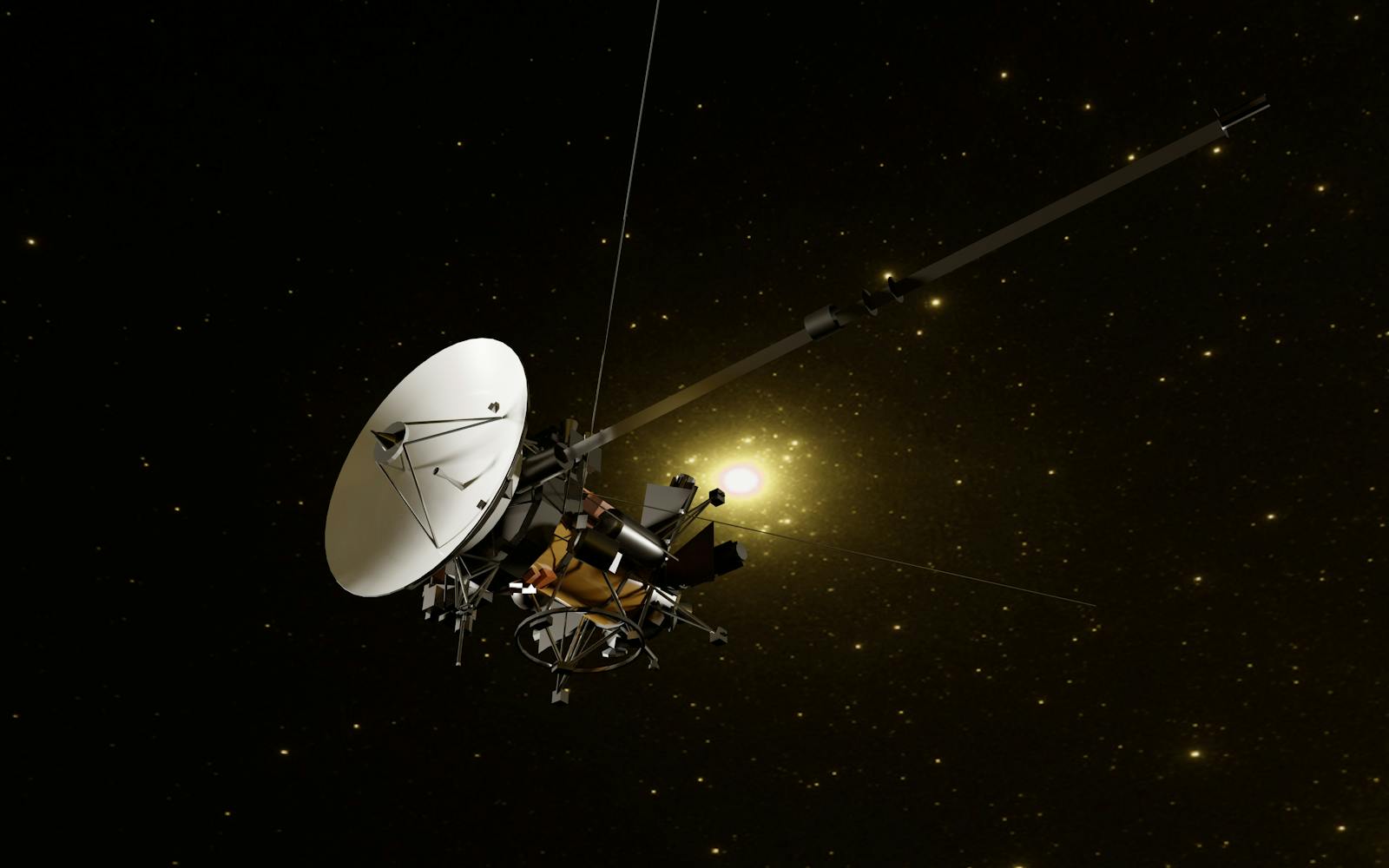
Two Voyager spacecraft, built in the 1970s and launched before personal computers became ordinary household objects, are still returning science data from interstellar space in 2026. On April 17, NASA engineers at the Jet Propulsion Laboratory sent a command to Voyager 1 to shut down one of its science instruments, not because the mission had failed, but because the spacecraft needed the power elsewhere.
That tension, between a mission that has outlasted almost every expectation and a power budget now measured in single watts, is the real story of the Voyager Interstellar Mission nearly 49 years in. The probes are not simply dying. They are being rationed, instrument by instrument, into the late 2020s.
What just happened to Voyager 1
On April 17, 2026, engineers at NASA’s Jet Propulsion Laboratory commanded Voyager 1 to power down its Low-energy Charged Particles experiment, known as LECP. The instrument had operated almost without interruption since Voyager 1 launched in 1977, measuring ions, electrons, and cosmic rays from the solar system and the wider galaxy.
NASA said shutting down LECP was the best available way to extend the life of the spacecraft. Kareem Badaruddin, Voyager mission manager at JPL, said in the agency’s statement that shutting down a science instrument was not anyone’s preference, but that Voyager 1 still had two operating science instruments returning data from a region no other human-made spacecraft has explored.
The reason is power and temperature together. Voyager 1 and Voyager 2 are powered by radioisotope thermoelectric generators, which convert heat from decaying plutonium into electricity. NASA says each spacecraft loses about four watts of power every year. After almost half a century in space, that decline has forced engineers to shut off heaters and instruments while still keeping critical parts of the spacecraft warm enough to function.
That includes fuel lines. If the spacecraft gets too cold, the hydrazine used for attitude-control thrusters can freeze. Without attitude control, the spacecraft cannot keep its high-gain antenna pointed at Earth. Without that antenna pointing home, the mission loses its voice.
Voyager 1 now has two science instruments still operating: one that listens to plasma waves and one that measures magnetic fields. A small motor inside LECP, which spins the instrument’s sensor so it can scan in all directions, was left running because it uses only about half a watt. In theory, that keeps open the possibility that LECP could be revived if engineers later find enough power. NASA has made clear that the safer assumption is continued triage, not a return to abundance.
Why the spacecraft is still teaching engineers
The remarkable part is not only that Voyager is still alive. It is that nobody who designed the spacecraft expected anyone to be operating it in 2026, and the mission has produced operational lessons that no other deep-space program has been in a position to learn.
The first lesson is that conservative engineering choices can buy decades of headroom. Voyager was designed for a grand tour of the outer planets, not for a half-century mission in interstellar space. Yet its redundant systems, radiation-tolerant electronics, careful margins, and relatively robust mechanical design have allowed engineers to keep it running long after its original planetary mission ended.
The second lesson is harder to design for: institutional memory. Many of the engineers who wrote the original code, assembled the hardware, or understood the design tradeoffs firsthand are no longer available to explain them. The current team has had to work from old documentation, archived records, and inherited expertise to understand decisions made before many of today’s operators were born.
That became clear when Voyager 1 began returning unreadable telemetry in late 2023. NASA eventually traced the problem to a damaged portion of memory in the flight data subsystem. The recovery required engineers to divide and relocate affected code into other parts of the spacecraft’s memory and then make it work across hardware that was more than 15 billion miles away. It was the kind of repair no spacecraft manual could fully anticipate.
The distance problem
Voyager 1 is more than 15 billion miles from Earth and moving outward at roughly 11 miles per second. Popular Science reported, based on NASA projections, that the spacecraft is expected to reach one light-day from Earth on November 15, 2026. At that point, a signal traveling at the speed of light would take 24 hours to make the one-way trip.
Even now, the delay is already punishing. A command takes about 23 hours to reach Voyager 1, and a response takes about the same time to come back. Every troubleshooting cycle is a two-day round trip at minimum, and that is before engineers on the ground have had time to analyze what happened and decide what to try next.
Voyager 2, which actually launched first on August 20, 1977, is closer to Earth than Voyager 1 but is also operating in interstellar space. It crossed the heliopause in 2018, six years after Voyager 1 made the crossing in 2012. The two probes remain the only operating spacecraft beyond the heliosphere, the vast bubble shaped by the solar wind and the Sun’s magnetic influence.
The signal coming back is faint almost beyond intuition. Voyager’s transmitter is weak by ordinary terrestrial standards, and the signal spreads across billions of miles before reaching Earth. In 2024, the historic Dwingeloo Radio Telescope in the Netherlands, operated by the CAMRAS foundation, detected Voyager 1’s signal from nearly 25 billion kilometers away. That achievement showed how carefully tuned radio equipment can still pick out the spacecraft’s carrier signal, but actual mission communication still depends on NASA’s Deep Space Network.
The Big Bang power plan
The April shutdown is part of a longer rationing strategy. NASA said engineers are preparing a more ambitious energy-saving fix for both spacecraft called “the Big Bang.” The idea is to swap several powered devices at once, turning some systems off and replacing them with lower-power alternatives while keeping the spacecraft warm enough to continue returning science data.
NASA plans to try the procedure first on Voyager 2, which has slightly more power to spare and is closer to Earth. Tests are scheduled for May and June 2026. If those go well, the team may attempt the same approach on Voyager 1 no earlier than July.
Voyager 2 is the safer test subject because it has more margin and shorter communications delays. That is engineering triage, and it is the kind of decision the original mission designers never had to think about because they did not expect the spacecraft to still be operating when these tradeoffs became urgent.
The pattern over the last decade has been to shut off heaters first, then non-essential systems, then science instruments in an order worked out years in advance by the Voyager science and engineering teams. The cosmic ray subsystem on Voyager 1 was shut down in 2025. LECP was next. Each shutdown can buy precious time, but there are fewer and fewer systems left to sacrifice.
What the probes have actually found out there
The interstellar mission has produced findings that were not part of the original planetary flyby plan, because the Voyagers were not originally built around the expectation of taking measurements beyond the heliopause for decades.
Voyager 1’s plasma wave subsystem has detected oscillations in the interstellar medium that allow scientists to estimate the density of plasma outside the heliosphere. Its magnetometer has measured the local magnetic field in interstellar space, helping researchers understand how the Sun’s protective bubble interacts with the surrounding galactic environment.
Before LECP was switched off, it had spent years measuring charged particles outside the heliosphere. That record helped scientists study the cosmic ray environment beyond the filtering influence of the solar magnetic field. The data matters for models of the heliosphere, the interstellar medium, and the radiation environment future spacecraft may encounter.
None of this was on the original mission objectives sheet in the way it exists now. The Voyagers were built to fly by Jupiter and Saturn. Voyager 2 later continued to Uranus in 1986 and Neptune in 1989 because a rare planetary alignment made the extended tour possible. The interstellar phase was the bonus mission, and it has now lasted far longer than the initial planetary encounters.
The thermal engineering nobody planned to need for this long
One of the more counterintuitive lessons of the Voyager extended mission is that managing a deep-space probe’s temperature becomes harder, not easier, as power drops. Instruments and heaters use electricity, but they also produce warmth. When engineers switch systems off to save power, the spacecraft loses some of the internal heat that helped keep it alive.
For most of the planetary phase, waste heat from active systems helped maintain temperatures. In the interstellar phase, every shutdown changes the thermal balance. Engineers have had to think carefully about how heat moves through a spacecraft assembled in another technological era, and how cold different components can get before performance or survival is at risk.
This kind of slow-failure thermal management has relevance for any future deep-space mission expected to operate for decades. New Horizons, which flew past Pluto in 2015 and is now traveling through the Kuiper Belt, faces its own long-duration power and thermal tradeoffs. Future interstellar-probe concepts will inherit lessons from Voyager not because Voyager was designed as a training program, but because no other spacecraft has lived long enough to become one.
The golden record question
Both Voyager probes carry a 12-inch gold-plated copper phonograph record selected by a committee chaired by Carl Sagan. The records include greetings in 55 languages, music from many cultures, natural sounds, and images encoded in analog form. The cover includes information intended to show how the record can be played and where it came from.
The records will outlast the spacecraft’s transmitters by an almost unimaginable margin. Voyager 1’s radio will eventually go silent, but the golden records will continue outward through interstellar space. Whether anything ever finds them is a different question. As engineering objects, they are passive archives: no power, no maintenance, no moving parts, just a message attached to a machine that will keep traveling long after contact ends.
What ends, and what does not
The Voyager program will probably not end with a dramatic explosion or a final image. It will end with a command sequence that receives no acknowledgement, a signal too weak to recover, or a decision that the remaining science return no longer justifies the Deep Space Network time required to talk to the spacecraft.
That is the operational reality. The probes are aging hardware run by a small team that has spent decades learning things about long-duration spacecraft operation that few textbooks could have covered, because no other mission has lived long enough to need the answers.
Some lessons are concrete. Build in more thermal margin than seems necessary. Document everything, because the people who designed the system will not be available forever. Keep redundant hardware switchable in software so that later operators can route around failures. Treat instrument shutdowns as a sequence to be planned, not a single catastrophe to be endured.
Some lessons are harder to formalize. The Voyager team has shown that a deep-space mission can outlast multiple generations of mission-control software, ground-station upgrades, and human careers, provided the institution remains committed to listening. That is a management lesson as much as an engineering lesson, and it may be the hardest part to reproduce.
The late 2020s and after
NASA’s current public updates suggest the Voyagers can continue returning limited science data into the late 2020s if power-saving measures keep working. The Big Bang reconfiguration could extend that horizon. It could also introduce risks that cannot be fully undone at this distance. Both outcomes are part of operating a spacecraft long past its design life.
When Voyager 1 reaches one light-day from Earth in November 2026, it will be approaching its 50th year in flight. The next human-built object to surpass Voyager 1’s distance does not yet exist. New Horizons is also heading outward, but it will take a long time to reach comparable distances, and no successor mission is currently operating in interstellar space.
That gap matters. When Voyager 1 finally goes quiet, there will be no immediate replacement listening to plasma waves in the interstellar medium, no other operating spacecraft measuring the local galactic magnetic field from beyond the heliopause. The data record may pause for a generation or longer.
That is what makes the April 17 shutdown command worth thinking about. It was not a failure. It was a deliberate act of engineering by a team trying to preserve a mission that has already exceeded its original purpose many times over.
The Voyagers were supposed to teach humanity about the outer planets. They did. Then they became the first operating probes in interstellar space. What nobody could have specified in the original mission plan was that they would also become a continuous experiment in long-duration spacecraft operations, and that engineers in the 2020s would still be learning from hardware launched in 1977.
Photo by Paul Seling on Pexels
