
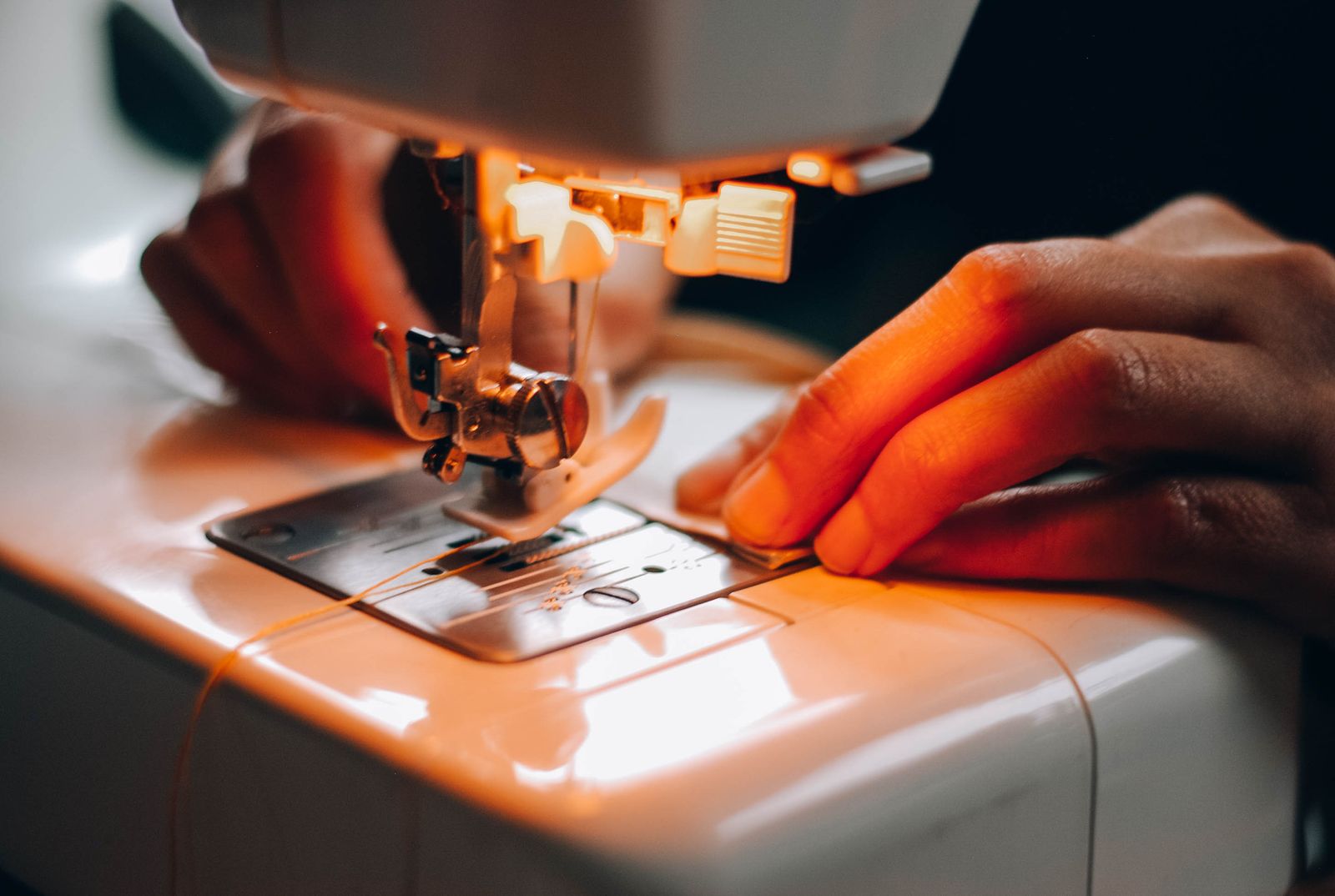
Inside a former girdle factory in Dover, Delaware, in the summer of 1968, women who had spent their careers sewing brassieres and Playtex Living Girdles were threading single-needle Singer machines through 21 layers of nylon, neoprene, Mylar, Dacron and Teflon-coated fiberglass — and they were doing it to a tolerance of 1/64th of an inch, by hand, because the engineers at ILC Industries had concluded that no automated machine on Earth could be trusted to assemble the only thing that would stand between Neil Armstrong’s skin and a lunar surface heated to 250°F in sunlight and chilled to minus 250°F in shadow.
The suit Armstrong wore on July 20, 1969 — designated the A7L — was, in the most literal sense, a hand-sewn garment. The seamstresses called themselves the sew sisters. Their day jobs, before NASA, had been making women’s underwear.
How a bra company beat Hamilton Standard for the Moon contract
The story starts with an industrial absurdity. In 1965, NASA ran a competition for the suit that would land humans on the Moon. The favored bidder was Hamilton Standard, a serious aerospace contractor with a portfolio of rigid, engineered hardware. Hamilton’s prototype looked like a robot. It was stiff, mechanical, and built around the assumption that a spacesuit was, fundamentally, a machine.
The underdog was the International Latex Corporation — ILC — a division of Playtex, the company best known at the time for the Cross Your Heart bra and the Living Girdle. ILC’s engineers had spent years figuring out how to make latex and nylon stretch and contain a human body without restricting it. They understood soft goods. They understood drape. They understood, in a way Hamilton’s engineers did not, that the suit had to let a person bend at the knee, grip a sample tool, and turn at the waist while pressurized to 3.7 psi.
ILC’s prototype, called the A7L, won the bake-off in 1965. As the BBC documented in interviews with the women who built it, the contract pulled the seamstresses from the Playtex factory floor straight into the Apollo program. Many of them were sisters, mothers, neighbors. They had been making girdles one week and signing classified blueprints the next.
Twenty-one layers, $3,000 a yard, and X-rays for stray pins
The A7L was built in 21 layers. From the inside out, in simplified order: a liquid-cooled undergarment laced with thin tubing carrying chilled water, then a comfort liner of nylon, then a pressure bladder of neoprene-coated nylon, then a restraint layer to keep the bladder from ballooning, then five alternating layers of aluminized Mylar and Dacron for thermal insulation, then layers of Kapton and Teflon-coated Beta cloth — a fiberglass weave — as the outer micrometeoroid shield.
Each layer was thinner than a sheet of paper. Stacked together, the assembly was still flexible enough to bend. Jeanne Wilson, who joined ILC at 19 after her sister told her about openings on the Apollo program, told the BBC the fabric “was almost $3,000 a yard. It was literally locked away in the safe.” She had previously sewn suitcases on a production line, where speed was everything. At ILC, every seam was inspected. Every stitch was logged.
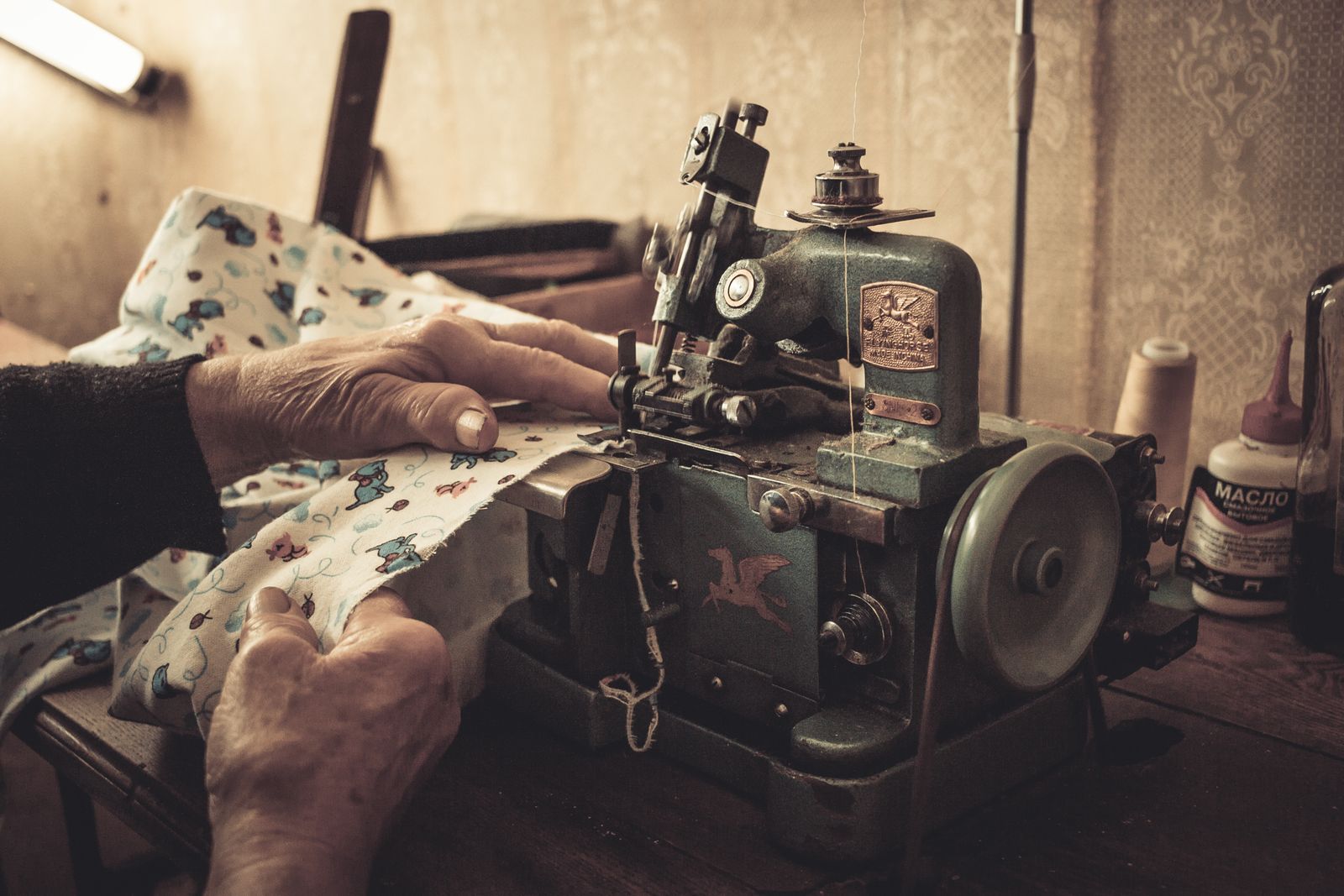
The tolerance the engineers demanded was 1/64th of an inch — about 0.4 millimeters, roughly the thickness of a credit card edge. A seam that drifted by more than that could fail under pressurization. The seamstresses worked on standard Singer machines, but with the feed dogs filed down and the presser-foot pressure modified, sewing without pins because pins might be left behind. When a suit was finished, it was driven to a hospital in Dover and X-rayed twice to confirm that no needle, pin, or fragment of metal was hiding inside.
Wilson described the weight of that responsibility. “There were nights we’d go home, worry and think, ‘Oh my God, did I leave a pin in it?’” she said. “You would lose a little bit of sleep at night sometimes. You actually broke down and cried.”
Why machines couldn’t do it
The reason hand-sewing won out wasn’t sentiment. It was geometry. A spacesuit is a pressurized vessel that has to articulate at every major joint of the human body. The shoulders, elbows, hips, knees, wrists and fingers all required convolute joints — accordion-like ridges of fabric that compressed on one side and expanded on the other.
Joanne Thompson, who specialized in gloves and stayed at ILC for 38 years, described the construction to the BBC. Each astronaut had moulds cast from their own hands. The palm pieces had long strips that ran through the fingers and attached to the knuckle sections, with an opening for the thumb that had to be stitched around by hand. The convolutes — those accordion ridges — let the astronaut close a fist or pinch a sample bag under 3.7 psi of internal pressure, which without those joints would have inflated the glove into a rigid balloon.
Automated sewing machines of the 1960s could run straight seams through flat fabric. They could not negotiate a compound curve through 21 layers of differing stiffness while holding a tolerance tighter than the diameter of a sewing needle. The seamstresses could. They had been doing equivalent work — fitting curves to bodies — for years.
The test that mattered
Before any suit went to Houston, ILC built sample seams and sent them to a destructive test lab. “We had to make different types of seam samples and they would send them to the test lab and they would test them until they tore,” Thompson told the BBC. “We used to make them all day long and knew they were gonna be trashed. But we knew a man’s life was going to depend on it so we just kept on going.”
The suits were also pressure-tested as full assemblies. A finished A7L would be inflated, monitored for leak rates, then flexed by a technician through the full range of motion an astronaut would need on the lunar surface — kneeling to collect samples, reaching overhead, climbing a ladder. The A7L was tailored to each astronaut. There was no medium or large. Armstrong’s suit fit Armstrong. Aldrin’s fit Aldrin. Collins’s fit Collins.
The women who don’t appear in the photographs
The Apollo 11 mission patch shows an eagle landing on the Moon. The famous photographs show three men in flight suits. The history of the suit, until fairly recently, lived in oral testimony rather than archives.
Hazel Fellows, one of the seamstresses, sewed sections of the suits that walked on the Moon. Her work has been documented through the Smithsonian American Women’s History Museum, which has begun cataloguing the contributions of the women who built Apollo’s soft goods. Several of the ILC seamstresses worked for decades without their names attached to the suits in any museum placard.
The pattern of unacknowledged technical labor by women on Apollo extended well beyond ILC.
Skylab, and the time a sewing machine saved a space station
The skill set ILC built didn’t end with Apollo. In 1973, NASA launched Skylab, America’s first space station. Within minutes of launch, the micrometeoroid and thermal shield ripped away, taking one of the solar panels with it. Internal temperatures climbed past 50°C. The crew could not board.
The fix was a fabric sunshade — a parasol of thin aluminized Mylar and laminated nylon that could be deployed through a small scientific airlock. It had to be designed, sewn, tested, and flown in a matter of weeks. Aylene Baker, a seamstress contracted from General Electric, was photographed at her sewing machine in the GE building across the street from the Johnson Space Center, the orange-and-silver material spread across the floor and fed through the needle by several people. The parasol deployed. Skylab cooled. The mission was saved.
That image — a woman at a sewing machine, surrounded by space-rated Mylar — still hangs on the walls at Johnson.
Why ILC still hand-sews suits in 2026
The basic logic that picked Playtex in 1965 still holds. Bill Ayrey, ILC Dover’s company historian, told the BBC that “the basic premise of a spacesuit hasn’t changed. Essentially the same suits are being used with some modifications onboard the International Space Station.” The Extravehicular Mobility Unit — the white suit ISS astronauts wear for spacewalks — still relies on multi-layer soft goods sewn by hand at ILC’s Dover facility. One man has now joined the team. The rest are still women.
The materials have changed. The threads are stronger. The pressure bladders are more durable. But a seamstress in Delaware still threads a needle through layers of fabric that will be the only thing between a human body and vacuum.
The Artemis program, which aims to return Americans to the lunar surface, is developing its next-generation Moon suit, the AxEMU, through Axiom Space — now the sole provider after Collins Aerospace withdrew from its NASA spacesuit contract in 2024. Under the revised plan NASA laid out in 2026, Artemis III has been reshaped into a crewed Earth-orbit test flight, targeted for 2027, that will check out the new suits in microgravity and rehearse docking with a lunar lander, while the first crewed landing has slipped to Artemis IV in 2028. A federal watchdog has warned the suits may not be flight-ready until 2031. The suits, like the rockets, are taking longer than planned. They are also still, at their core, soft goods. They will still be sewn.
A Delaware industry that started with girdles
The state of Delaware has, over the decades, claimed credit for an unusual list of things made within its borders — from nylon to the Apollo spacesuit. ILC Dover, still headquartered in Frederica, now also builds inflatable space habitats and the kind of fabric landing systems that delivered earlier missions to the surface of Mars. The company designed and manufactured the airbag cocoons that cushioned NASA’s Pathfinder lander in 1997 and, a few years later, the twin Spirit and Opportunity rovers — work it traces directly to its Apollo-era softgoods heritage.
The expandable module that Bigelow Aerospace flew to the International Space Station drew on the same softgoods expertise, a lineage that runs straight back to the Frederica factory floor where Hazel Fellows once stitched bras.
The artifact in the museum
Armstrong’s A7L suit is now in the collection of the Smithsonian National Air and Space Museum. It was off public display for years while conservators worked to stabilize the rubber bladder, the Mylar, and the outer Beta cloth — all of which were degrading. The suit went back on view in 2019 for the 50th anniversary of the landing.
The Smithsonian’s records on Armstrong include a recording made shortly before his death in 2012, in which he discussed his father’s career and his own path into engineering. He did not, in that recording, mention the women in Dover. He rarely did in public. Privately, the astronauts knew. They came to Delaware for fittings. They signed photographs for the seamstresses. They asked for adjustments by name.
The suit Armstrong wore down the ladder of the Eagle weighs about 180 pounds on Earth. On the Moon, in one-sixth gravity, it weighed about 30. Inside it, a human body could survive seven hours of vacuum, lunar radiation, and surface temperatures that swung 500 degrees between sun and shade.
It was held together, at the seam, by stitches placed 1/64th of an inch apart, by a woman at a Singer sewing machine in Delaware, who had learned the craft on her mother’s lap making clothes for dolls.
