
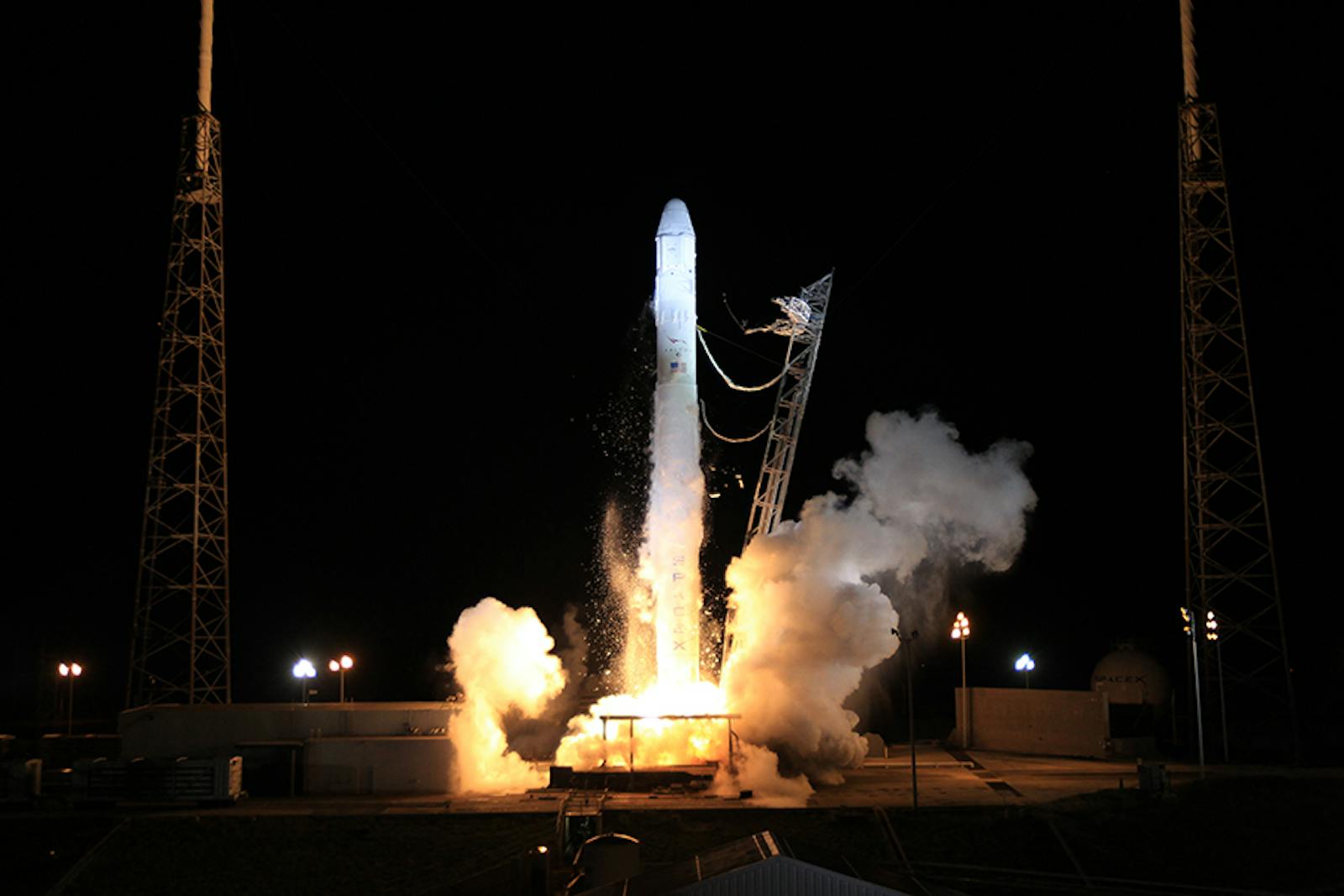
On May 15, a Falcon 9 lifted off from Florida carrying Dragon capsule C209 toward the International Space Station, with cargo aboard and docking scheduled two days later. The CRS-34 mission was, by the standards of contemporary commercial resupply, routine: science investigations, an external payload bay packed with NASA and U.S. Space Force experiments, a propulsive return planned for the Pacific.
What was not routine was the capsule itself. According to SpaceNews, C209 had now become the first cargo Dragon to reach a sixth flight — a milestone that the original Dragon 1 program never approached, and that the upgraded Dragon 2 cargo variant was certified to attempt only after what NASA officials described as a delta-certification review focused on the hardware unique to cargo configuration.
The sixth reuse arrived in the same month that Boeing’s CST-100 Starliner and Japan’s HTV-X remain conspicuously absent from the ISS visiting-vehicle manifest. The juxtaposition is sharp enough to invite the obvious comparison. It also invites a less obvious one.
The numbers that sit alongside each other
In September 2014, NASA’s Commercial Crew Program awarded two fixed-price contracts to ferry astronauts to the ISS. Boeing received approximately $4.2 billion. SpaceX received approximately $2.6 billion. The destinations were identical, the certification milestones nearly so, the contracting vehicle the same.
A decade later, the divergence is unambiguous. Public records compiled from NASA contract documentation and Boeing’s SEC filings indicate that as of early 2025, Boeing had absorbed substantial cost overruns on Starliner beyond its contract value. Starliner-1, the post-certification operational flight that was meant to follow the crewed flight test, has been redesignated to fly uncrewed as an ISS resupply mission. The crew capsule, in other words, is preparing to fly as cargo. Meanwhile, the cheaper contract’s cargo variant — using hardware lineage shared with the Crew Dragon already flying astronauts — is on its sixth reuse.
The temptation is to read this as an indictment of Boeing, or as vindication of SpaceX, or as a parable about procurement reform. Space Daily is not offering any of those. The structural question is narrower and more interesting: when the same agency awards parallel fixed-price contracts to a legacy prime and a new entrant on the same day for the same destination, what does the divergence in outcomes reveal about which organizational cultures can actually metabolize fixed-price discipline?
How this actually works historically
Procurement reform tends to be discussed as if its mechanism were universal — change the contract type, change the incentives, change the outcomes. The historical record is messier.
The shift from cost-plus to fixed-price contracting was not invented for commercial crew. The Department of Defense experimented with total package procurement in the 1960s on programs like the Lockheed C-5A Galaxy. The outcomes included financial difficulties for contractors and raised questions about risk absorption capacity. The contract type was sound on paper. The contractor’s ability to absorb the risk it transferred was not.
The opposite outcome — fixed-price discipline producing efficiency — has historical precedents too, but they tend to involve organizations built around the contract rather than retrofitted into it. The early Atlas and Thor programs at Convair and Douglas were run under cost-reimbursable arrangements that nonetheless produced rapid iteration, in part because the engineering cultures had not yet calcified around the accounting structure. By the time the Space Shuttle program matured, the prime contractors had organized themselves around cost-plus assumptions so completely that the program’s later attempts to introduce performance incentives produced marginal effects at best.
The pattern, if there is one, is not ideological. It is organizational. Fixed-price contracts do not equalize the ability of contractors to bear fixed-price risk. They surface, often brutally, the prior question of whether a firm’s internal cost structure, supply chain, and engineering decision-making can operate inside the envelope the contract defines. Boeing in 2014 was a company whose commercial-aviation and defense divisions had spent two decades optimizing around cost-plus and offset arrangements. SpaceX in 2014 was a company that had never known any other discipline.
Reality-check on the technical claim
The sixth flight of C209 is a real milestone, but it is worth being precise about what it means. Cargo Dragon 2 is not a separate vehicle from Crew Dragon; it shares the pressure vessel, the propulsion architecture, and substantial avionics heritage with the crewed variant. The reuse cadence reflects both engineering maturity and a refurbishment process that has been progressively streamlined since cargo Dragon reflights began. It does not, on its own, validate the broader claim sometimes made on SpaceX’s behalf that reusability has fundamentally lowered the marginal cost of access to low Earth orbit by an order of magnitude. The accounting on that claim remains internal to the company, and the public record permits only inference.
Nor is Starliner a failed vehicle in the categorical sense. It has flown crew. Its first crewed mission ended with astronauts returning on a different vehicle after thruster anomalies prompted NASA to adjust return plans. The vehicle’s propulsion system has been the focus of an extended remediation effort, and the redesignation of Starliner-1 to a cargo mission is best understood as a recertification path rather than an abandonment. Boeing has not exited the program. NASA has not cancelled it. The contract, in its essential structure, remains intact.
What has happened is that the schedule and cost margins that fixed-price contracting was supposed to discipline have, on the Boeing side, expanded well beyond the contract envelope — with the contractor, not the taxpayer, absorbing the overrun. In that narrow sense, the procurement model worked exactly as designed. The risk was transferred. The question is what the transfer revealed.
Whose vehicle, whose discipline
The observation that artifacts have politics — that they embed and enforce particular social arrangements — is usually invoked to discuss technology like highway overpasses or nuclear power systems. It applies with equal force to procurement instruments. A fixed-price contract is itself an artefact, and it carries political assumptions: that the contractor possesses the cost data to bid realistically, that internal incentives reward staying within the bid, that engineering decisions can be made without escalation to financial principals who do not understand them, and that the prime is willing to eat losses rather than seek relief.
Those assumptions are not neutral with respect to organizational form. A company organized around quarterly earnings, with a board accountable to dispersed shareholders and a defense division accustomed to negotiated relief on troubled programs, will encounter the fixed-price artefact differently than a privately held company whose principal can absorb losses against future equity value. Neither configuration is morally superior. They are differently shaped to absorb a particular kind of risk.
This is why the $4.2-billion-versus-$2.6-billion comparison is not, despite appearances, a budget argument. The larger contract did not cause Boeing’s difficulties; nor did the smaller one cause SpaceX’s discipline. The contracts were sized to the bidders’ estimates of their own costs. What the divergence in outcomes reveals is something prior to the contract: that the bidders’ internal capacities to operate inside their own estimates were not equivalent, and that the procurement instrument, designed to be culturally neutral, was in fact culturally selective.
The technology, then, is for the organization that can metabolize it. The political question — whose vehicle, whose discipline, whose risk — was decided before the contracts were signed, in the slow accretion of organizational habit that determines whether a firm can write a realistic bid and live inside it.
What this means, and what it doesn’t
The temptation to draw a clean lesson from this episode should be resisted. The clean lessons on offer are mostly wrong, or at least premature.
Fixed-price contracting did not, on the basis of one program, prove itself superior to cost-plus. Commercial Crew is a single data point in a domain where the same instrument has produced wildly different results in different organizational contexts. The Air Force’s recent experience with fixed-price satellite contracts has been mixed; the Navy’s with shipbuilding, worse.
SpaceX did not, on the basis of one capsule’s sixth reuse, demonstrate that vertical integration and private ownership are inherently better suited to space hardware than the traditional prime-contractor model. The company benefits from a constellation of factors — among them a launch business that subsidizes capability development, a founder with appetite for sustained operational losses, and a regulatory posture that has, for now, accommodated rapid iteration — that are not portable to every program.
Boeing did not, on the basis of Starliner’s troubles, prove itself incapable of building human-rated spacecraft. The company built Apollo’s first stage, the Space Shuttle’s orbiter integration, and substantial parts of the ISS itself. What it has demonstrated is that the organizational form that delivered those programs under cost-plus arrangements does not transpose without friction into a fixed-price environment.
The honest reading is that NASA’s 2014 dual-source decision created a natural experiment in which the variable was not the contract but the contractor, and the experiment is still running. The redesignation of Starliner-1 to cargo duty is a midpoint, not an endpoint. Boeing may yet certify the vehicle for routine crew rotation; SpaceX may yet encounter the kind of late-program failure mode that has humbled every previous human spaceflight program. The decade that has passed since the contracts were signed is, in the timescales of crewed spaceflight, not long.
What lingers is the structural observation that procurement reform, sold to Congress and the public as a mechanism for disciplining contractors, turns out to be a mechanism for revealing them. The instrument does not change the firm; it discloses the firm. If that is the actual function of fixed-price contracting in complex aerospace programs — disclosure rather than discipline — then the policy question is not whether to use it, but what an agency is willing to learn when it does.
And if the next major procurement decision — lunar lander services, Mars sample return, a successor cargo program — is structured around the same instrument, will the agency awarding it know how to read the disclosure it has chosen to elicit?
