
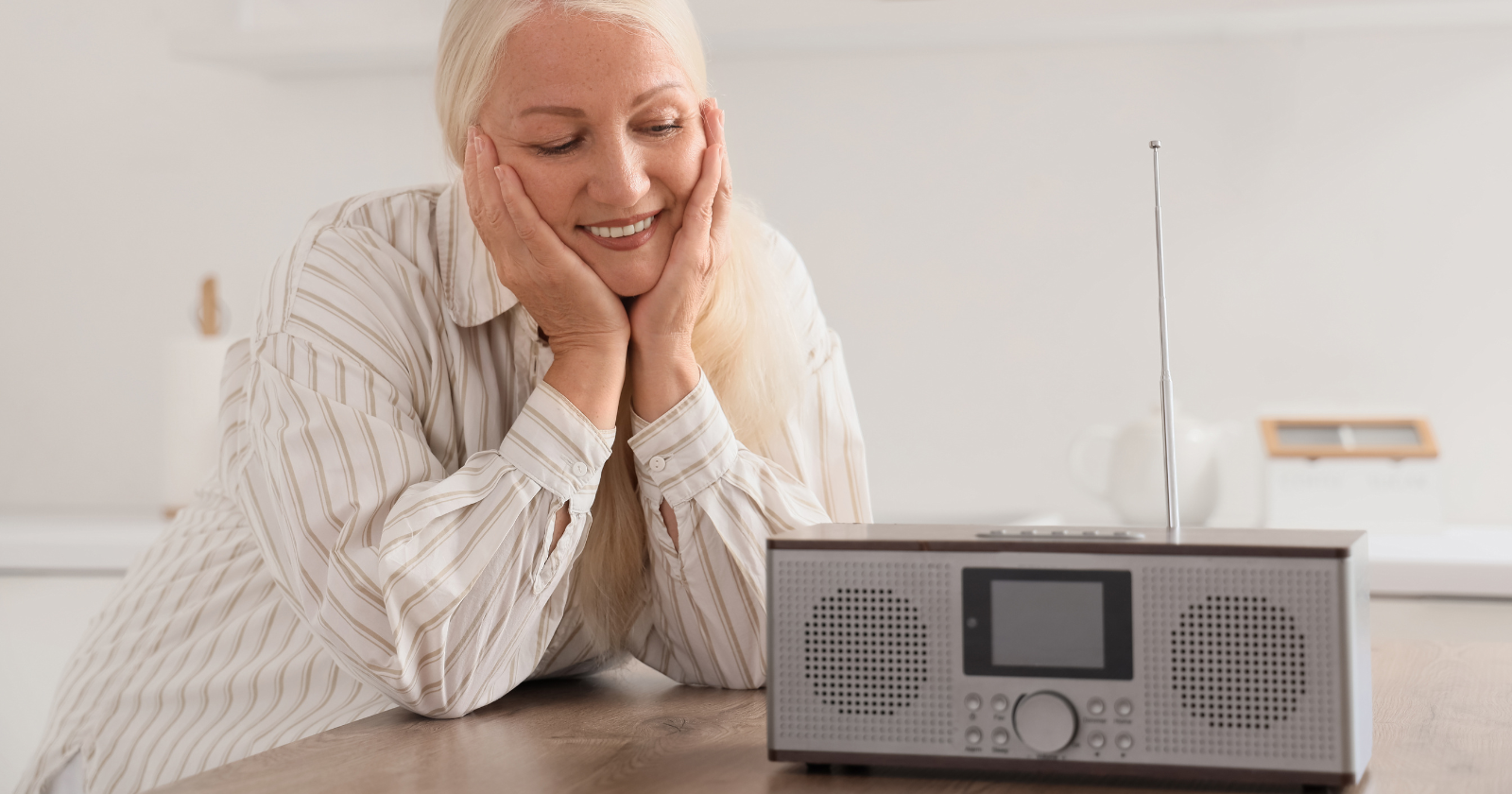
It is one of the smallest rituals in adult life. The kettle goes on. The radio goes on. The house, which had been silent, fills with the voice of someone talking about traffic on the M25, or interviewing a novelist, or reading the morning headlines.
The voice does not need to be especially interesting. It does not even, particularly, need to be listened to. It just needs to be there.
We have noticed that this small habit is often described, dismissively, as a sign of loneliness — as if the person reaching for the dial is admitting to a deficiency. The framing is not quite right.
Many of the people most committed to keeping the radio on in an empty house are not lonely in any ordinary sense. They have full lives. They have friends. They have phones full of unread messages from people who would happily call back.
The radio is doing something else. And once you know, it becomes hard to see the habit as anything other than what it actually is: a small, intelligent piece of self-management, performed daily, by adults who understand something about their own minds.
The discomfort is not with being alone — it is with being mentally alone
In 2014, the social psychologist Timothy Wilson and his colleagues at the University of Virginia and Harvard published a paper in the journal Science with a finding that startled even the authors. Across eleven studies, they asked participants to spend somewhere between six and fifteen minutes alone in a room with nothing to do but think. No phone. No book. No music. Just their own company.
Most participants, it turned out, did not enjoy the experience. When the researchers added a button that would deliver a small electric shock — a shock the participants had earlier said they would pay money to avoid — a substantial number of them pressed it. In one study, sixty-seven percent of male participants chose to shock themselves at least once during a fifteen-minute period of solitary thinking.
The lesson the researchers drew was not that people cannot tolerate being alone. It was that by and large “The untutored mind does not like to be alone with itself”.
Is the radio in the empty house is, among other things, a quiet response to this fact? It gives the mind something to lean against. It does not require attention. It does not even require interest. It simply provides a steady stream of external content for the mind to glance at, instead of glancing at itself.
The voice that does not ask for anything back
In 1956, decades before this kind of cognitive research was being done, Donald Horton and Richard Wohl published a paper in the journal Psychiatry with a long subtitle that has since become famous in media studies: “Observations on Intimacy at a Distance.” Horton and Wohl introduced a term that has since entered ordinary usage.The phenomenon they were describing was a parasocial relationship.
The relationships they had in mind were the ones radio listeners were forming, almost without noticing, with the announcers and hosts whose voices entered their homes every morning and evening. The hosts knew nothing about the listeners. The listeners felt, after enough mornings and evenings, that they knew the hosts.
It seems the human mind is not particularly fussy about the source of social presence.
Radio is the ideal medium for this. It does not demand the eyes. It does not pause when the listener leaves the room. It does not require any performance back. The closest analog in human experience is the sound of a family member puttering in the kitchen while you read in the next room — present, audible, undemanding. The radio reproduces, with surprising accuracy, the texture of cohabitation.
A small ceremony of presence
This is the part that the lonely-person framing tends to miss. The adult turning on the radio in the empty house is not announcing a deficiency. They are performing a small piece of self-knowledge. They have understood, often without ever having articulated it, that the human mind does not flourish in pure silence, that an unfilled room can become a slightly hostile environment after a few minutes, and that a voice on a frequency is one of the gentlest, least demanding ways to keep the room hospitable.
It costs little. It asks nothing. It does not pretend to be a substitute for the people who actually love them. It simply provides what the empty house cannot provide on its own — the texture of another life happening at the edges of attention, the sense that somewhere, someone is talking about the weather, and that the silence will not be allowed to win this morning.
The radio goes on with the kettle. The voice fills the kitchen. The house, briefly, becomes a place where someone is keeping the speaker company, and the speaker is keeping someone else company, and neither of them needs to know about the other for the small exchange to do its quiet work.
