
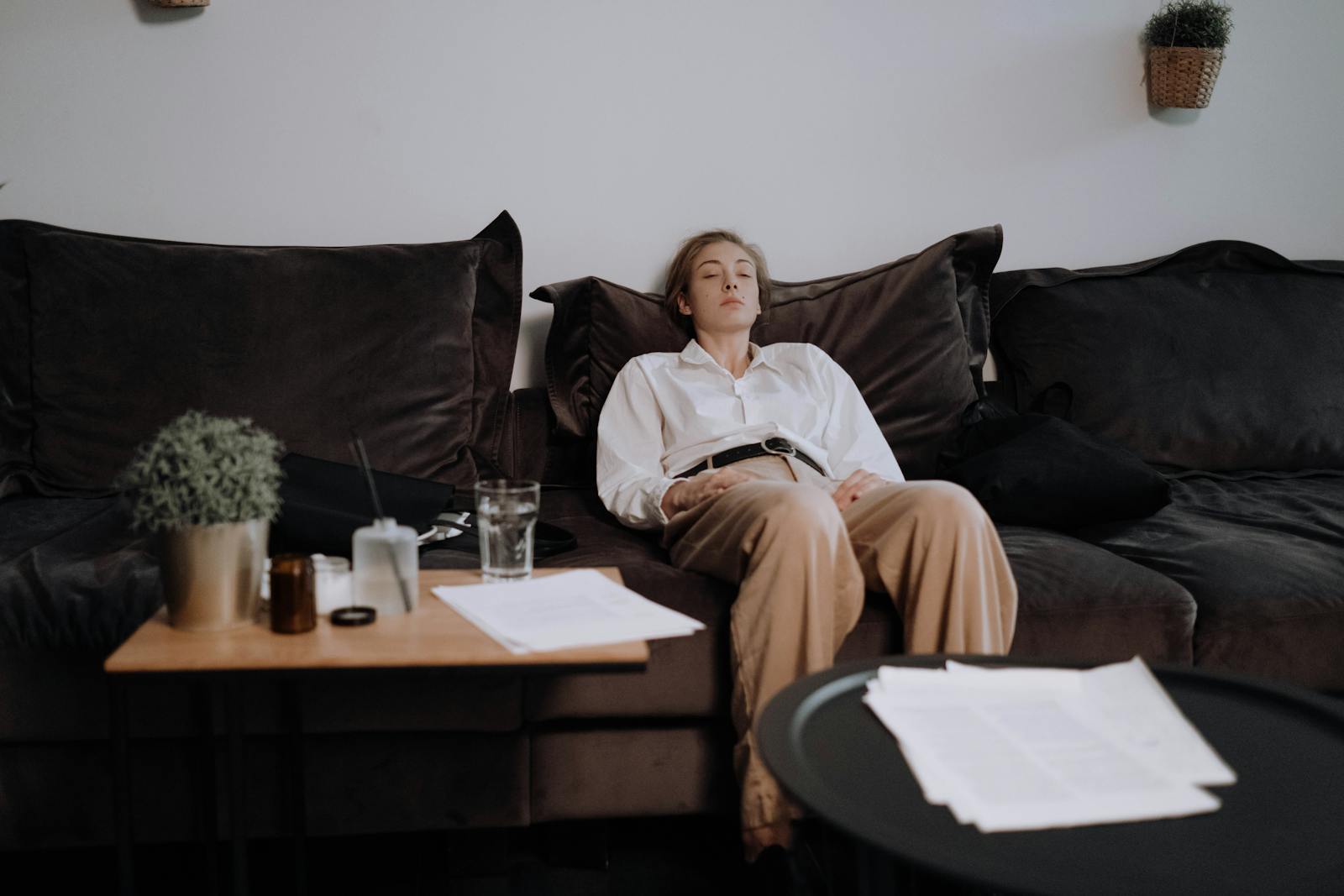
Watch a particular kind of person on a Sunday afternoon. The dishwasher is running. The laundry is folded. There is technically nothing left to do. And yet they are pacing the kitchen, opening cabinets, reorganizing a drawer that did not need reorganizing. Sitting down feels like falling.
This is not necessarily discipline. Disciplined people rest. Disciplined people understand that recovery is part of performance. What you are watching may be something older and stranger: a person who learned, very early, that stillness came with consequences.
The wellness industry has spent the past few years noticing this. The same magazines that sold productivity hacks now sell rest as a product: weighted blankets, sleep trackers, candles that promise stillness. A whole generation of adults needed permission, packaged and priced, to do what their bodies had been asking for since childhood.
The household economy of worth
In many homes, productivity was not just a value. It was a currency. Affection, attention, even a sense of peace were quietly priced in tasks completed and chores anticipated. A child who emptied the dishwasher without being asked got a different kind of look than a child sprawled on the carpet reading a book.
Nobody said the quiet part out loud. No parent sat their kid down and explained that lying on the couch made them less lovable. The message arrived sideways, in sighs, in the tone of voice reserved for the napping uncle, in the way a parent’s mood lifted when they walked into a clean room and dimmed when they walked into a still one.
Children are extraordinary readers of subtext. They can absorb a moral code their parents never explicitly taught and never even fully articulated to themselves. If rest was suspicious in the household, the child learned to be suspicious of their own rest.
Where the message comes from
Some of this is cultural. Some of it is economic. The home most adults grew up in was running on invisible labor that nobody named. Globally, women and girls perform 12.5 billion hours of unpaid care work every single day, according to UN Women-linked care-work reporting, and in many Latin American households women spend significantly more hours on it than men. Children raised inside that imbalance watched one parent rarely sit down. The lesson did not need to be taught.
If the most loved person in the house is also the most exhausted, a child may draw a conclusion. Love looks like exhaustion. Worth looks like motion. Sitting still looks like the thing the unloved or the resented do.
Then there is intensive parenting, an ideology that treats a parent’s time, money, and energy as resources to be poured continuously into the child. A 2024 study in Frontiers in Psychology surveyed 675 Japanese mothers of preschoolers and found that intensive parenting attitudes were linked to maternal parenting behaviors and children’s social outcomes. The paper also notes prior scholarship connecting intensive parenting attitudes with maternal stress, exhaustion, anxiety, depression, and guilt. The household philosophy becomes familiar: every minute should be useful. Children can absorb that philosophy whole.
What the body learned to call laziness
Adults raised this way often describe an internal voice that activates the moment they sit down. The voice is not loud. It does not scream. It just lists.
The voice lists what could be done. The unanswered email. The dusty baseboard. The friend not texted back. The voice frames doing nothing as a moral position requiring defense, as if the body has to file paperwork to justify the rest it is taking.
Consider a woman in her late thirties, call her Maya, who works in hospital administration and has not taken a real holiday in six years. The last time she tried, she spent the first morning of a beach trip cleaning the rental’s kitchen because the previous guests had left a smudge on the cooktop. Her husband watched her do it and said nothing. Maya’s mother had run a household of five children on her own and was, by family legend, never seen sitting down except at her own funeral. Maya does not consciously think about her mother when she scrubs a stranger’s stove on the first day of vacation. She just feels, in her body, that sitting on the balcony with a coffee would be wrong in a way she cannot defend in language. The voice is not arguing with her. It is her.
What this voice may be doing is repeating the household monitor. The child internalized the person who watched for unfinished work and grew up to become that monitor themselves. The vigilance that once belonged to a mother or father is now automatic, ambient, self-administered.
And the body cooperates. It learns to feel a low buzz of unease whenever stillness lasts longer than a few minutes. The unease gets misread as energy, as drive, as ambition. The person says they are wired to keep moving. Often, they are not wired. They are conditioned by repetition.
The cost of treating rest as failure
The pattern of chronic overwork and its consequences are now widely documented. Arianna Huffington, who collapsed from exhaustion in 2007 and has spent the years since arguing against the cult of overwork, told CNBC that the delusion that burning out is the price you must pay for success needs to end, and that people need to stop treating well-being as an obstacle to success.
Governments are starting to legislate around the same problem. India’s Right to Disconnect Bill 2025 has proposed giving employees the legal right to ignore work communication outside business hours. The fact that this is being debated as law tells you how completely the workplace has annexed the evening, the weekend, the body.
And the medical professions, which have often run on the cult of self-sacrifice, are showing the bill. The New Indian Express has reported on how Indian doctors face heavier workloads, lower safeguards, and a culture of endurance compared with peers in countries such as the United States.
None of this is news to the person who refuses to nap. They have already heard about burnout. They are not impressed. The voice in their head says burnout is what happens to other people, to people who slow down. They believe motion is what is keeping them upright. Often it is the opposite. The motion is what is wearing them out, and the rest they refuse is the only thing that would let them stay standing.
The signals that give it away
You can usually spot this pattern in small behaviors before the big ones.
Someone who cannot watch a film without also folding laundry. Someone whose vacation involves a daily itinerary tighter than their work week. Someone who feels guilty after a massage. Someone who describes a free Saturday as wasted instead of free.
The tell is not the activity itself. Plenty of people enjoy busy weekends. The tell is the inability to choose otherwise. A person who refuses to sit still has not chosen motion freely if stillness feels less like an option than a threat.
Why play got pathologized
The bias against rest gets installed early, sometimes before school. Even childhood play, the activity most central to early development, is being squeezed out of classrooms. The British Psychological Society has documented how play-based learning faces real institutional barriers in England’s primary schools, despite well-established evidence about its developmental value. Curriculum pressure, accountability metrics, and adult anxiety about whether children are learning enough have crowded out some of the unstructured time that lets children practice being people.
A child who learns at five that play has to be justified, that sitting on the carpet building nothing in particular requires a defense, can become an adult who cannot watch television without a second screen running. The habit goes in early.
The gendered shape of it
The pattern shows up differently in different bodies. Women raised in households where their mother never sat down often describe a near-physical inability to let someone else clean up after a meal. The hands move before the mind decides. They were not taught only to clean. They were taught that clean was who their mother was, and that being a woman who sat while others worked was a kind of moral collapse.
Men raised around the same household economy may externalize it differently: projects, side hustles, garage tinkering, an inability to take a vacation without bringing the laptop. The same basic equation can remain. The dialect just shifts.
Parenting messages are deeply gendered even on adjacent issues. A 2024 Washington State University study published in the Journal of Child and Family Studies found that maternal and paternal influence on adolescent attitudes toward cannabis operated through different channels, with closeness, monitoring, and modeling functioning differently depending on the parent’s gender. That study was not about rest, but it is a useful reminder that children do not receive one generic parental message. They read mothers and fathers separately, then integrate those messages into a composite belief about what a worthwhile adult does with their time.
What the refusal is actually protecting
Underneath the refusal to rest is often a fear, and the fear is rarely about productivity alone. The fear is about identity.
If a person has built their sense of self around being useful, capable, on top of things, dependable, then sitting still is not just unpleasant. It can feel destabilizing. Without the doing, who are they? The question is so uncomfortable that the body avoids it by keeping the hands busy.
This is a similar architecture to adults who can list reasons to be grateful but cannot access uncomplicated happiness. A child told, directly or indirectly, that their feelings did not earn them much room can become an adult who cannot quite locate what they actually want when nothing is required of them. The household trained them to skip past their own interior. Stillness brings the interior back, and the interior is unfamiliar territory.
The retirement problem
This is why some people who have built their entire adult lives around output collapse when they retire. The structure goes. The roles go. The reasons to be in motion thin out. And what is left is a self that was never given much permission to exist outside its labor.
The freedom that financial planning promised arrives, and it feels less like a reward than like an erasure. The person did everything right. They saved, they worked, they showed up. Nobody warned them that a life organized around being needed leaves you with no answer for the morning when nothing needs you.
The refusal to nap in your forties is the same person, twenty years earlier, refusing the version of stillness they may eventually be forced to confront.
What change actually looks like
People rarely fix this through willpower, because willpower is part of the problem. Telling yourself to relax harder is just adding another task to the list. The voice that polices rest is happy to enforce a meditation streak with the same severity it enforced the chore chart.
Change tends to happen in smaller, less heroic ways. Noticing the panic that comes when you sit down and not obeying it. Naming the household monitor instead of acting on its instructions. Letting a Saturday be unproductive without rewriting the story to call it a recovery day, which is just productivity in disguise.
It also helps to recognize that rest is not the opposite of capability. The most resilient people are not the ones who never stop. As Space Daily has reported, resilience often looks like falling apart quietly and showing up the next morning anyway. That requires, by definition, the falling apart. The collapse and the recovery are part of the architecture, not failures of it.
The quiet permission
What the person who refuses to rest actually needs is something they were never given as a child: the unspoken sense that their existence does not have to be earned by motion. That the family would still want them in the room if they were sprawled on the floor doing nothing. That love did not depend on the dishwasher.
Most adults will never get that retroactively. The parents who set the original terms are gone, or unchanged, or unreachable on this topic. The permission has to come from somewhere else, and usually it comes from the person themselves, slowly, after years of noticing what their refusal to rest is actually costing.
The first nap is the hardest. Not because the body cannot fall asleep. Because lying down feels like a confession. Like admitting that the household monitor was wrong, that the moral code was made up, that all those years of motion were not virtue but inheritance.
And on the other side of that confession, sometimes, is something the household never modeled. A person at rest. Still wanted. Still worth the room they take up. Doing nothing, and being, somehow, no less.
The unlearning
This is the part that gets missed in the wellness conversation. The person pacing the kitchen on a Sunday afternoon is not lazy in disguise. They are not secretly undisciplined. They are not failing at self-care because they have not found the right app. They are carrying an old household pattern from a home where stillness was treated as a kind of theft, and the body learned, accurately for that environment, to keep moving in order to keep the peace.
Calling that laziness is a category error. It is the opposite of laziness. It is over-functioning, run on a fuel the person did not choose and cannot quite see.
Which means rest, for these adults, is not just a habit to install. It is a belief to dismantle. The belief that they are worth more when they are useful. The belief that being still is being suspicious. The belief, planted early and watered for decades, that love is something you earn by never stopping.
Unlearning that is slower than buying a weighted blanket. It is also the only thing that actually works. The nap is not the goal. The nap is the evidence that something underneath has finally shifted, that the household monitor has, for an afternoon, been told it can go home. And that the person it was monitoring is, for the first time, allowed to stay.
Photo by Ron Lach on Pexels