
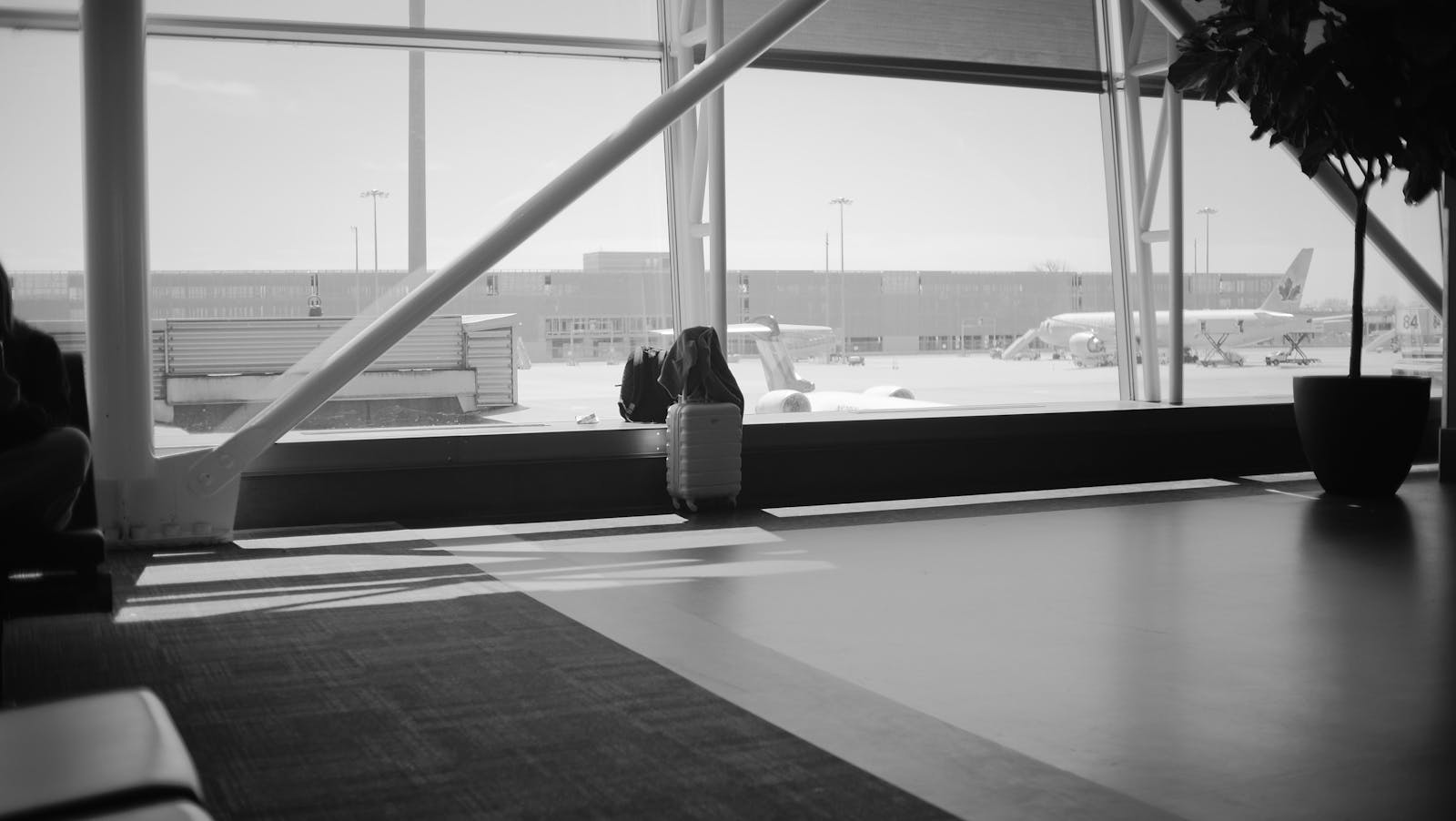
The man unfolding his boarding pass for the fourth time at gate B12, three hours before departure, is not afraid of flying, not afraid of crowds, not even afraid of missing the plane in any literal sense, but watching him smooth the paper flat against his thigh tells you something specific about who taught him what time meant, and what happened in the house he grew up in when someone ran late.
Early arrival looks like anxiety. It often isn’t.
Pure anxiety is diffuse. It attaches to everything. The three-hour airport buffer is something more precise: a learned response to a specific category of childhood memory, usually involving a parent who once stood in a line, in front of a clerk, in front of a customs officer, in front of a landlord, and discovered that being unprepared in public meant being humiliated in public.
The buffer is not about the plane
Ask a chronic early arriver what they’re afraid of and they’ll often struggle to name it. Missing the flight, sure. But pressed further, the fear gets stranger. It’s the line being long. It’s the printer at the desk being broken. It’s the agent looking up with that particular face that means a problem has been found in your paperwork.
The fear isn’t of inconvenience. It’s of being made small in front of strangers, with no time left to fix it.
That fear has a source. It usually has a face.
Watching a parent panic in public
Children who grow up watching a parent come undone at a bank counter, an immigration window, a doctor’s reception desk, or a utility office learn something the parent never sat them down to teach. They learn that adulthood contains thresholds where things can go wrong fast, where the wrong document or the wrong amount of money or the wrong arrival time produces a visible, specific kind of shame.
Financial therapist Rahkim Sabree, writing in Forbes on vicarious financial trauma, describes exactly this: the way children absorb a parent’s money panic without ever experiencing direct deprivation themselves. The body learns the choreography of dread before the mind has language for it.
A car declined for fuel. A check that bounced at the grocery store. A landlord who knocked on the door at the wrong hour. The child standing slightly behind the parent, watching a competent adult become, for thirty seconds, someone who could not protect themselves.
That image does not leave.
What gets transmitted, and how
Clinicians have spent decades documenting how this transmission happens. Children of Holocaust survivors have shown up in therapy carrying a familiar set of stress patterns despite having lived stable, peaceful lives. As a 2025 review in Psychology Today by clinical psychologists Robert Gordon, Felicia Connor, and Elizabeth Malkin lays out, intergenerational transmission of trauma is now a heavily studied field, and its mechanisms are both behavioral and biological.
The behavioral pathway is the one most people recognize. A parent who panics about being late teaches a child, through tone and posture and a thousand small reactions, that lateness is dangerous. The child internalizes a rule the parent never spoke aloud: be early, or something terrible happens.
The biological pathway is stranger. Recent epigenetic research, including a 2025 study of three generations of Syrian families led by molecular biologist Rana Dajani, has found measurable changes in the DNA of descendants who never experienced the original violence themselves, evidence that severe stress can leave marks on the genome that persist across generations.
You don’t need a war to inherit a stress response. You just need a parent who lived in one, even a small private one.
The specific shape of paperwork shame
There is a particular kind of family in which paperwork was a recurring crisis. Immigration documents. Custody filings. Disability claims. Tax forms. Lease renewals. The parent did not always handle these well, because handling them well requires a kind of bureaucratic fluency that nobody is born with and that schools rarely teach.
The child of that family grew up watching forms get filled out at the kitchen table at 11 p.m., with a parent muttering, frustrated, sometimes crying. The forms had deadlines. The deadlines had consequences. Missing them meant losing something: a benefit, a status, a place to live.
That child becomes an adult who arrives at the airport three hours early because the airport is, fundamentally, a paperwork environment. A passport, a boarding pass, a customs form, a security check. Every one of these is a checkpoint where the wrong document produces the wrong outcome.
The buffer is not about the plane. The buffer is about the line at the desk where, as a child, they once watched their mother get told no.
Why humiliation, specifically
Anxiety researchers tend to talk about fear in terms of threat. But the early arriver is rarely afraid of physical threat. They’re afraid of public humiliation, which is its own category, and which has its own developmental signature.
Public humiliation in front of a parent does something specific to a child’s nervous system. It teaches them that the adult world contains witnesses, and witnesses can be cruel. It also teaches them that competence is performative: that being adequate is not enough, you must visibly be adequate, with all your papers in order, in advance, before anyone has the chance to look at you with disdain.
The three-hour buffer is a defense against being looked at that way.
The empathy load this generation carries
One of the quieter consequences of growing up next to a parent who struggled in public is that the child often becomes unusually attuned to other people’s discomfort. They notice the agent’s stress. They notice the person behind them sighing. They notice that the family at the next counter is being asked too many questions.
This is not a neutral gift. It means the airport, even when nothing is going wrong for them personally, is full of small distresses they’re absorbing on everyone’s behalf. Arriving early lets them settle their own paperwork before they have to start absorbing anyone else’s stress on top of it.
Silence is the carrier
One of the consistent observations across intergenerational trauma work is that silence is the most efficient carrier. Families that don’t speak openly about what happened pass on the emotional residue without any of the context that would let the next generation make sense of it.
So the child who watched their father get yelled at by a customs officer in 1994 doesn’t grow up with a story about that day. They grow up with a feeling about airports. The feeling has no narrative attached, which makes it impossible to argue with. You cannot reason your way out of a fear whose origin you cannot remember.
You can only build infrastructure around it. Three hours of infrastructure.
The cost of the buffer
Most chronic early arrivers know the buffer is excessive. They know, intellectually, that ninety minutes would be enough. They know they’re sacrificing time, comfort, and often money (overpriced terminal food, longer parking fees) to soothe a fear that probably wouldn’t materialize.
What they don’t always know is that the buffer is also costing them socially. Travel companions get frustrated. Partners refuse to leave the house at the requested time, because they’ve learned the requested time is two hours earlier than necessary. Friendships erode slightly around the edges, because the early arriver insists on a level of preparation that other people experience as controlling.
The early arriver is not trying to control anyone. They’re trying to prevent a memory from happening again.
How families learn to talk about it
The way through is rarely solo. Work on family stress, including a recent Greater Good interview with UCSF psychiatry professor Nicki Bush, points to a simple principle: when parents acknowledge what happened and model a calmer response to it, children are better equipped to develop the same skill. Naming the inheritance, in other words, is half the work.
This is harder than it sounds. The parent who panicked at the bank counter in 1989 may not want to revisit it. They may not even remember it the way the child remembers it. The child experienced a defining event; the parent experienced a Tuesday.
For some families, the conversation is impossible because the relationship has already fractured. Psychologist Joshua Coleman, writing for Greater Good on how estranged parents and adult children can heal, argues that reconciliation tends to require a willingness on both sides to expand the story beyond pure blame, and that the most effective gestures are specific: acknowledging particular memories, particular impacts, rather than sweeping accusations or sweeping defences. For the inheritor of a paperwork-shame family, that specificity is often where the buffer starts to loosen.
What changes when the pattern is named
Recognition is not a cure. The three-hour arriver does not, after one therapy session, suddenly become someone who can stroll up to the gate forty minutes before boarding. Patterns this deep don’t dissolve on contact with insight.
What changes is the relationship to the behavior. The buffer stops feeling like a personality flaw and starts feeling like a strategy that once made sense. Less self-criticism. Less arguing with the partner about the leaving time. Maybe, eventually, a willingness to test ninety minutes instead of one hundred and eighty, and to notice that nothing terrible happened.
The point isn’t to abolish the buffer. The point is to know what the buffer is for.
The wider pattern
Airport behavior is one expression of a much larger inheritance. The same person often over-prepares for job interviews, double-checks restaurant reservations, prints directions even with a working phone, and arrives at medical appointments fifteen minutes before the staff are ready to see them. None of these behaviors are a problem on their own. Together they form a portrait of someone whose nervous system was trained, early, to treat unstructured time as dangerous.
Last week’s piece on adults who notice when the lightbulb goes out traced a related pattern: hypervigilance learned in childhood, repurposed as adult competence. Early arrival belongs in the same family of behaviors. The adult is not anxious. The adult is solving, every day, a problem that was solved a long time ago and never fully filed away.
What to say to the early arriver in your life
Telling them they don’t need to leave so early is rarely useful. They’ve already done the math. The math is not the issue.
A better question is what specifically they’re picturing. What’s the worst version of arriving late? What does the line look like, what does the agent look like, who is standing behind them? Sometimes the answer is a shrug. Sometimes the answer is a story about a parent, a counter, a year, a clerk’s face. Either answer is information. The shrug means the memory is still buried. The story means it’s already starting to surface.
Either way, what the early arriver needs is not faster. What they need is the company of someone who understands that the three-hour buffer is not the problem. It’s the receipt for a problem somebody else had, a long time ago, that the body refuses to throw away.

The plane will leave on time. It almost always does. The early arriver knows this. They’ve simply learned, through evidence they didn’t choose to gather, that being ready is the only thing that ever stood between their family and the version of public life where strangers got to decide how much you were worth.
Three hours is not anxiety. Three hours is armor.

Photo by Leo Sacchi on Pexels