
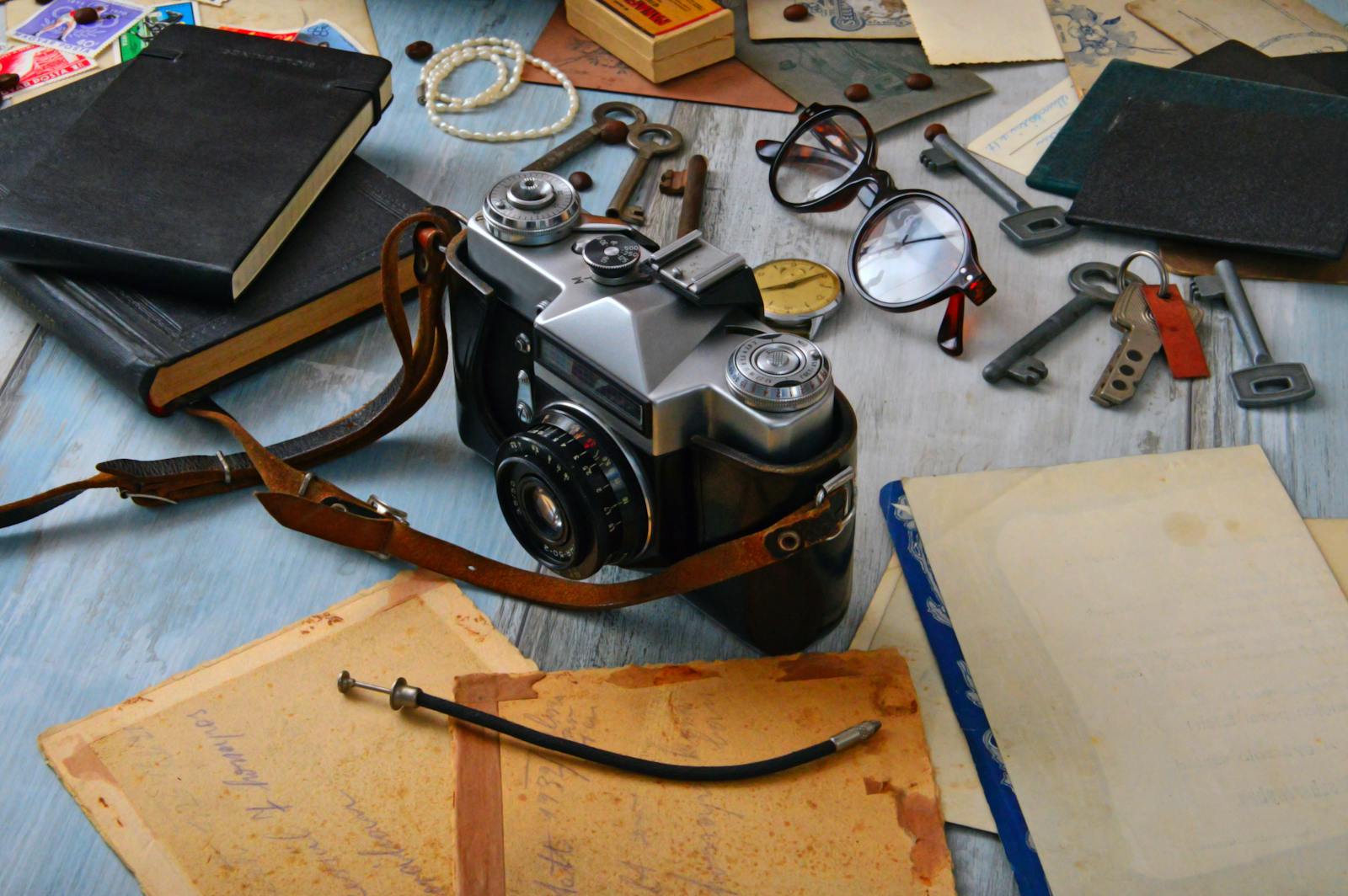
Standing at the edge of a kitchen drawer, deciding whether to throw away a key that no longer opens anything, is a small psychological event most people lose to. The hand reaches in, picks up the key, weighs it for a second, and puts it back. The drawer closes. The decision, somehow, has been made not to decide. That moment, repeated across decades and across drawers, is how a life accumulates evidence of itself.
The drawer in question exists in almost every adult home. It contains a broken watch with a leather strap that smells faintly of an old apartment. A warranty card for an appliance that died in 2014. Three loose buttons from a coat that was donated years ago. A single key.
People who own these drawers are usually described, by themselves and by others, as disorganized. The description is wrong.
The drawer is not clutter. It is testimony.
What looks like a failure of housekeeping is often a quiet refusal to let proof of one’s own existence be thrown out with the recycling. Each object in the drawer corresponds to a chapter, a person, a version of the self that no longer has any other physical anchor. The watch belonged to the year someone wore suits. The warranty card maps onto the apartment with the loud upstairs neighbor. The key opened a door that has since been replaced, in a building that may have been sold.
Throwing the key away does not destroy the door. It destroys the only object in the world that still confirms the door was real.
People form genuine emotional bonds with everyday items, not because the items are valuable, but because they function as external repositories of identity and memory. The object is not the memory. The object is the proof the memory belongs to a real life.
Why the brain refuses to let certain things go
Memory is reconstructive, lossy, and prone to revision. A person remembering their thirties at age sixty is not playing back footage; they are rebuilding a scene from fragments, and any fragment can fade. The brain is selective about what it keeps. Emotionally weighted moments tend to stick more deeply than ordinary ones, but even those can erode without cues to retrieve them.
Objects are cues. A broken watch held in the palm summons a year, a person, a particular Tuesday, the smell of a bakery near a long-vacated workplace. The watch does not have to work. Its only job is to exist.
This is why the drawer resists logic. Logic asks: does this item function? The drawer answers: functioning was never the point.
The expired warranty as autobiographical document
An expired warranty is, on paper, the most useless category of object imaginable. It promises something that is no longer promised, for a thing that probably no longer exists. And yet people keep them in alarming numbers, tucked inside drawers and folders and the pockets of jackets they no longer wear.
The reason is not laziness. The warranty is a dated document. It records, with bureaucratic precision, that on a specific day, in a specific store, a specific person bought a specific machine. It is a receipt for having been alive that afternoon. Tax returns, lease agreements, and old phone bills perform the same quiet function. They are the closest thing most people have to a daily diary they did not know they were keeping.
When someone shreds an old warranty, they are not freeing up space. They are deleting a timestamp.
The single key
Of all the objects in the drawer, the orphaned key is the one people are most embarrassed to admit they keep. It looks irrational. The door is gone. The lock has been changed. The landlord is dead or retired or unreachable. There is, in any practical sense, no reason for the key to remain.
But keys have a particular psychological weight. A key is the artifact of access. It says: this place was mine, and I could enter it whenever I chose. Throwing it away is not the same as throwing away a button or a receipt. It is closer to admitting that a version of the self that lived behind that door is not coming back.
People can hold this knowledge intellectually for years before they can hold it in their hand and walk to the trash.
The difference between hoarding and witnessing
It would be easy, and wrong, to file this behavior under hoarding. Clinical hoarding involves distress, impaired functioning, and an inability to discard items regardless of their meaning. The drawer of meaningful objects is the opposite. It is highly curated. The owner can usually account for every item in it, often with surprising specificity. The drawer is small. It is contained. It is, in its strange way, organized.
The pattern of why people hold onto objects draws a clear line between accumulation that overwhelms a life and selection that anchors one. The drawer of broken watches and expired warranties belongs to the second category. It is not chaos. It is a private museum with one curator and no visitors.
The owner has decided, often without articulating it, that some objects earn permanent residency in their life regardless of utility.
What decluttering culture gets wrong
The modern decluttering movement, in all its tidy variations, treats objects as functional units that either justify their existence or do not. The famous test, does this spark joy?, is a useful filter for kitchen utensils and unworn sweaters. It collapses entirely when applied to a key whose door no longer exists.
The key does not spark joy. It sparks something more complicated: continuity. The psychological effects of decluttering show that systematic discarding can produce real emotional relief, with many people reporting measurable release after deliberately letting go of items with heavy associations. That benefit is real. It is also not the whole story.
The same pattern distinguishes between ruthless elimination and mindful selection. The drawer is mindful selection at its most concentrated. Everything in it has already survived multiple rounds of elimination. Whatever is still there has earned its place by a standard that has nothing to do with use.
The neuroscience of the cue
Why does an object trigger such complete recall? The answer lies in how memory is structured. Memory is associative, meaning that any sensory input, a smell, a song, a texture, can pull an entire scene back into consciousness. Music researchers at Durham University have shown that a single song can summon vivid autobiographical detail from decades ago, often more accurately than deliberate attempts at recall.

Objects do the same thing, more reliably and more privately. The hand recognizes the weight of a watch before the conscious mind does. The eye recognizes the typography on an old warranty card before the brain reads the words. The key in the drawer is, neurologically, a shortcut to a self that would otherwise require enormous effort to remember.
This is not nostalgia. Nostalgia is a feeling. The cue is a mechanism.
Why some people need the evidence more than others
Not everyone keeps a drawer. Some people throw away keys the day the lease ends and never think about them again. The difference is not strength of character. It is, often, how stable a person’s sense of continuous identity feels without external scaffolding.
People who have moved frequently, lost family early, lived through periods of upheaval, or felt their selfhood challenged in ways large or small often need more physical anchors to feel that their life has been one continuous thing rather than a series of disconnected episodes. The drawer is the answer to a question they are barely aware of asking: did all of that actually happen to me?
The drawer is, in this light, a low-cost insurance policy against forgetting one’s own life.
Digital drawers and the same instinct
The instinct does not stop at physical objects. A 2025 study in Frontiers in Psychology on digital photo hoarding among university students found that emotional attachment was a central driver of the behavior, with people accumulating images they rarely revisit because the photos serve as anchors for a sense of self rather than as material for viewing. The mechanism maps almost exactly onto the kitchen drawer. The photos are not for looking at. They are for existing.
The same logic applies to old text threads, archived emails, voicemails from numbers that no longer connect to anyone. These are digital warranties, digital keys. They are dated proofs that on a particular day, a particular exchange occurred between a particular self and another person.
The medium has changed. The instinct has not.
The drawer as a hedge against revision
Memory revises itself constantly. People retell their own lives in ways that flatter the present, smooth out the contradictions, and minimize the parts that don’t fit the current narrative. This is not dishonesty. It is how memory works.
Objects resist this revision. A broken watch from a difficult year cannot be reinterpreted into a happy one. The warranty card is dated. The key opened a specific door, and no amount of present-tense storytelling can change which door it was. The drawer is, among other things, a small archive of facts the self has not yet been allowed to overwrite.
For people who have spent years replaying conversations and second-guessing their own perceptions, the drawer offers a different kind of confirmation. It cannot be argued with. The object is there or it is not.
What to do with the drawer
The advice that follows from any of this is not throw it away. It is also not keep everything forever. It is something quieter.
Open the drawer occasionally. Pick up the watch. Hold the key. Let the cue do what cues do. The point of the drawer is not that the contents stay sealed. The point is that they remain available, in case the self needs them, which it sometimes will.
Some objects will eventually be ready to leave. Most will not, and that is fine. A drawer is small. A life is long. The math works out.
The impulse to retain meaningful items across cultures is not a quirk of any one society. It is a basic human strategy for staying continuous with oneself across time. The drawer is one of the oldest technologies people own, even when the things inside it have stopped working.
The quiet thing the drawer says
People who keep drawers like this are often slightly defensive about them. They will joke about being messy, or promise to clean it out next weekend, or apologize when a guest accidentally opens it. The defensiveness is misplaced.
The drawer is doing something serious. It is saying: I was here. This happened. I am not making it up.
For an adult moving through a life that no one else has fully witnessed, that is not a small claim. It may be one of the few claims that cannot be taken back. The watch is broken. The warranty has expired. The door is gone. The drawer remains.
And the person who owns it is not disorganized. They are simply unwilling to let the only physical evidence of their own life be carried away with the trash on a Wednesday morning, because they understand, in the wordless way people sometimes understand things, that some forms of forgetting are also a form of disappearance.
Photo by Adonyi Gábor on Pexels
