
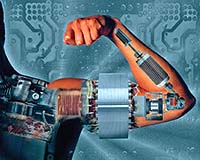
University of Utah scientists have joined a team of U.S. researchers in developing a bionic arm for amputees. “We want to try to get an artificial arm that works and feels and looks like a real arm,” said University of Utah Bioengineer Greg Clark, the university’s principal investigator. “The goal is not to develop a superarm.”
The Utah researchers — who might gain up to $10.3 million in funding for the four-year project — are focusing on turning signals from the nervous system into movement and sending touch signals back to the brain.
Researchers note many people who undergo arm amputations avoid using their prosthetic limbs because they cannot feel sensations from the pseudo limb.
“If they’re not looking (at the arm), they might not notice if an object slips on to the floor,” said Reid Harrison, a University of Utah engineer who is helping develop microchips for a bionic arm to access the nervous system. The chips would intercept electrical signals and translate then to trigger mechanical parts in the bionic arm.
Johns Hopkins University in Baltimore is leading the project, with the other universities involved acting as subcontractors.
