
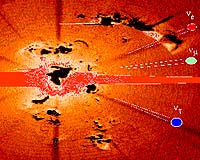
Two European astrophysicists say ancient neutrinos can help track the early history of the universe, less than 300,000 years after the Big Bang.
Roberto Trotta of Britain’s Oxford University and Alessandro Melchiorri of the University of Rome looked at the cosmic microwave background, which they say shows the signature of neutrinos created soon after the Big Bang.
The cosmic microwave background dates from about 300,000 years into the universe’s life, the point when light could move in a straight line for the first time without being blocked.
The background contains ripples, because matter was unevenly distributed as the universe began expanding.
But Trotta and Melchiorri say that a detailed examination of the microwave background found that it contains less variation than expected, a sign that neutrinos were smoothing out the lumpiness.
The theory is to be published in a forthcoming edition of Physical Review Letters 2.
