
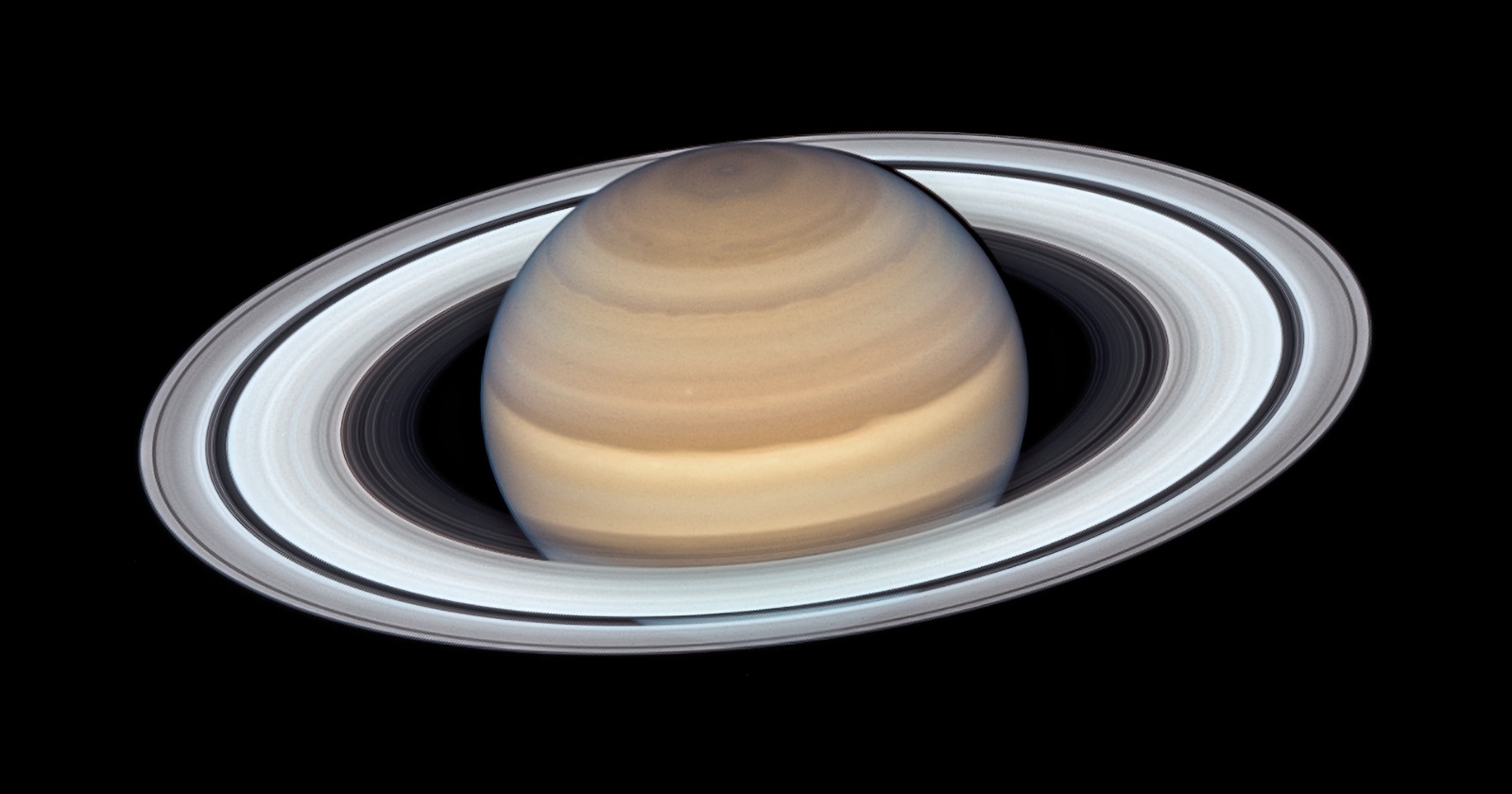
Of the eight planets that orbit the Sun, seven would sink if you could somehow drop them into water. Saturn would not. Its average density is lower than that of water, the only planet in the solar system for which that is true. NASA puts the consequence in deliberately silly terms: the gas giant “could float in a bathtub if such a colossal thing existed.”
That single line, from NASA’s own Saturn facts page, is doing real work. Density is mass divided by volume, and water is the familiar yardstick: a substance denser than water sinks in it, a substance less dense floats. Saturn, the second-largest planet in the solar system and nine times wider than Earth, averages out to less than the density of the water in your kitchen tap. The largest ringed object in the sky is, on the whole, lighter than rain.
Why a planet can be lighter than water
The number that makes this possible comes from what Saturn is built out of. Like Jupiter, Saturn is, in NASA’s description, “a massive ball made mostly of hydrogen and helium,” the two lightest elements there are and the same two that make up most of the Sun. Earth is rock and iron. Saturn is mostly the stuff of stars, held together as gas and liquid rather than packed into stone.
A planet’s average density is the whole mass spread across the whole volume. Saturn has an enormous volume and, for that volume, not very much mass. Spread the hydrogen and helium across a globe more than 120,000 kilometers wide and the average works out below the density of water. The comparison is not a measurement of any single place inside the planet. It is a property of the planet taken as one object.
That distinction matters, because Saturn is not uniform. NASA describes a “dense core of metals like iron and nickel surrounded by rocky material,” wrapped in liquid metallic hydrogen, wrapped again in liquid hydrogen. The center is brutally compressed. The outer layers are something closer to thick atmosphere. The famous low density is the average of the crushing core and the airy outside, and it lands on the light side of the line.
The only one on the list
Being less dense than water is not the same as being light, and it is not common. The four inner planets, Earth among them, are made of rock and metal and sit far above water on the density scale. Earth is the densest planet in the solar system. Drop any of the rocky four into a large enough sea and they would go straight down.
The gas giants are the interesting case, because Saturn is not the only planet built mainly from hydrogen and helium. Jupiter is too. Yet Jupiter would still sink. It is so much more massive than Saturn that its own gravity squeezes its interior to a density above water’s, even though it is made of the same light ingredients. Saturn, lighter and less compressed, is the one that comes out under the line. That is why NASA singles it out: not because its recipe is unique, but because it is the only planet where that recipe and that gravity combine to beat water.
It is a clear result rather than an extreme one. Saturn’s average density is roughly two-thirds that of water, so it sits below the line with room to spare, but not the way a cork floats high and dry. The headline is true, and it is worth stating with that precision rather than turning into a stunt.
The bathtub that could never exist
The image of Saturn bobbing in a tub is a teaching tool, not a forecast. NASA reaches for it precisely because it is absurd, and the absurdity is the point: there is no bathtub, no ocean, and no container in the universe that could hold a planet 120,500 kilometers across. The thought experiment isolates one true fact, average density, and ignores everything else.
It also quietly assumes Saturn would stay in one piece, which it would not. Floating, in the everyday sense, means a solid object resting on a liquid surface. Saturn has no solid surface to rest. As a gas giant it is, in NASA’s words, “mostly swirling gases and liquids deeper down,” with no boundary a bath’s waterline could press against.
So the honest version of the claim is narrow and specific. Saturn’s average density is less than water’s. That is the verified fact, and it is genuinely strange. The buoyant planet drifting in a cosmic tub is the cartoon NASA draws to make the fact stick, and it should be read as a cartoon.
What this does and does not prove
What the density figure proves is compositional: Saturn is overwhelmingly made of light elements and is not, by mass per volume, a dense world. What it does not prove is that Saturn would behave like a rubber duck. Buoyancy as we experience it needs a stable liquid, a container, and an object that holds its shape against the push of the fluid. None of those exist at planetary scale, and Saturn supplies none of them itself.
There is a second caveat worth keeping in view. “Average” is load-bearing. Plenty of material inside Saturn is far denser than water, starting with that iron and nickel core. If you could stand at the center, you would not find anything floaty. The planet floats only as an abstraction, only when its entire mass and entire volume are reduced to one ratio.
It is also worth resisting the temptation to extend the trick. Saturn being less dense than water does not make it lightweight in any ordinary sense. The planet is 95 times the mass of Earth. It is light only in the specific accounting of mass against the very large volume it occupies, and only by comparison with a substance, water, that happens to sit just above it on the scale.
A planet that is mostly sky
Strip away the bathtub and the fact that remains is still arresting. The second-largest planet in the solar system, the one with the rings visible through a backyard telescope, is on average less substantial than a glass of water. Its grandeur is mostly volume. Its matter is mostly the lightest gases in the cosmos, pulled into a sphere by nothing more than its own gravity.
NASA keeps the joke because the joke carries the physics. A reader who pictures Saturn floating has, almost by accident, understood something accurate about what the planet is: not a heavier world than ours, but a far emptier one, vast and bright and barely there.
