
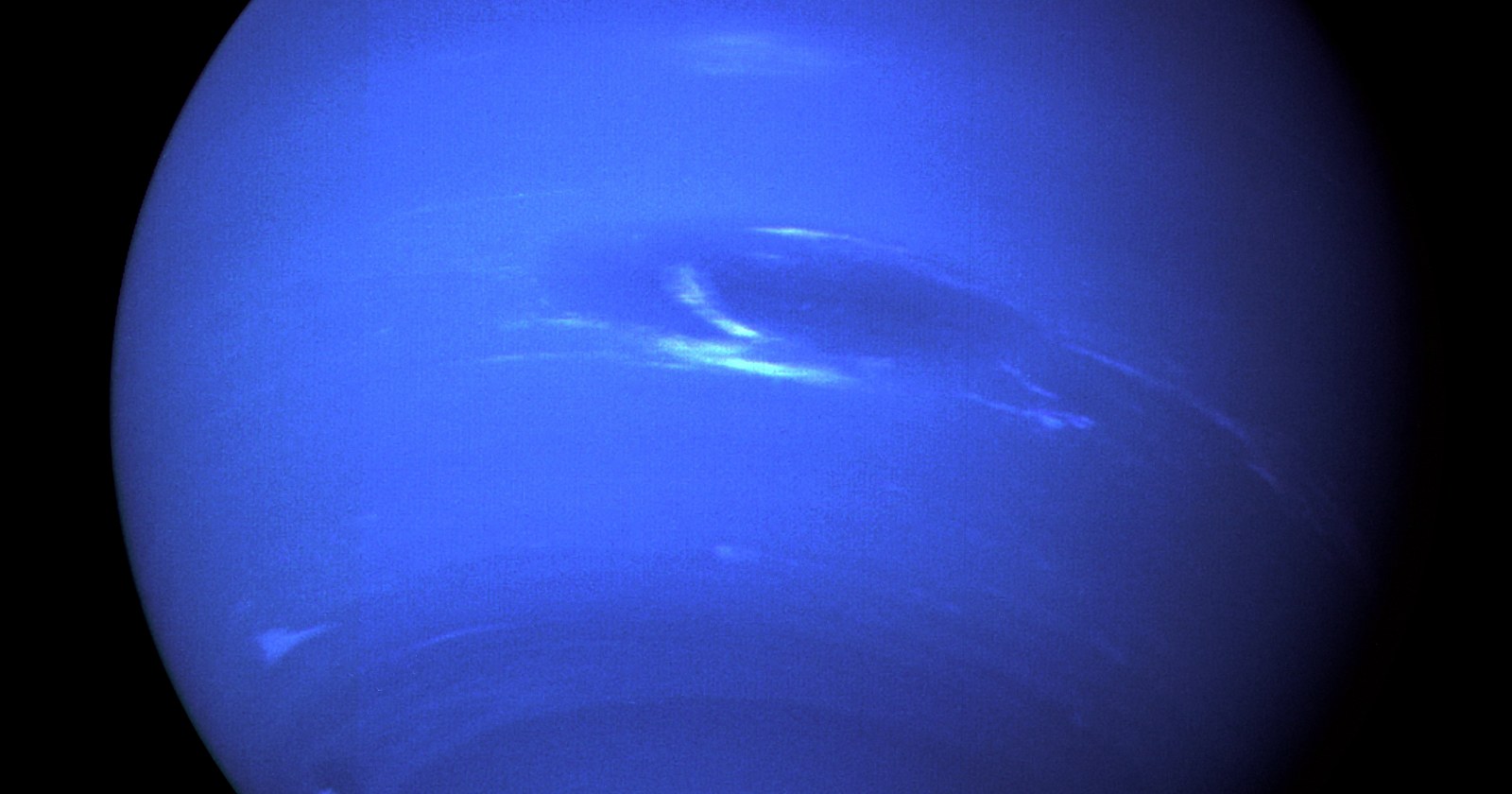
Neptune is a planet humans have visited exactly once, for a few hours, in 1989, when Voyager 2 swept past and kept going. Almost everything we believe about what happens inside it comes from physics, not photographs. And the physics points somewhere that sounds like a jeweler’s fever dream: a layer, deep down, where carbon falls through the dark as solid diamond.
The idea has been around for decades. What changed recently is that someone built a small piece of Neptune’s interior on a lab bench and watched it happen.
Why anyone suspected diamonds in the first place
Neptune and Uranus are what astronomers call ice giants, and the name is slightly misleading. They are not made of ice in the everyday sense. Beneath their outer atmospheres of hydrogen and helium sits a deep, hot, dense layer of water, ammonia, and methane, compressed into states of matter that do not exist anywhere on Earth’s surface.
Methane is the key ingredient. Each methane molecule is one carbon atom bonded to four hydrogen atoms, and methane is what gives both planets their blue-green color, because it absorbs red light.
As you descend into the planet, the pressure climbs into the millions of atmospheres and the temperature into the thousands of degrees. Theorists working in the 1970s and 1980s, including the Lawrence Livermore physicist Marvin Ross, suggested that under those conditions the methane would break apart, the freed carbon would bond with itself, and at sufficient depth it would crystallize into diamond. The diamonds, being heavier than the material around them, would then sink, drifting down toward the core like a slow mineral snow.
It was an elegant prediction. It was also, for a long time, almost impossible to test.
The problem with testing a planet you cannot reach
You cannot drop a sensor into Neptune. The pressures that would form diamond rain sit beneath thousands of miles of atmosphere that would crush any spacecraft long before it arrived. So for decades the diamond-rain idea lived in computer models and educated argument, which is a respectable place for an idea to live, but not the same as evidence.
The breakthrough was figuring out how to make the relevant conditions last just long enough to photograph the result, even if only for an instant.
In 2017, a team led by the physicist Dominik Kraus used the giant X-ray laser at the SLAC National Accelerator Laboratory in California to recreate the reaction and watch it happen, with the results published in the journal Nature Astronomy.
How you build diamond rain on a workbench
The team did not use methane. They used a thin sheet of ordinary polystyrene, the plastic found in disposable cups and packaging, because polystyrene is made of hydrogen and carbon, the same two elements that matter inside the ice giants.
They then hit the plastic with a powerful optical laser to send two shockwaves through it, one fast and one slow, timed so that the waves would overlap. Where they met, the plastic was briefly subjected to pressure and heat close to what exists thousands of miles inside Neptune.
At that exact moment, the researchers fired the lab’s X-ray free-electron laser, the Linac Coherent Light Source, through the sample. The X-rays acted as an impossibly fast camera, capturing the arrangement of atoms in the fraction of a second before everything blew apart.
The X-rays showed it plainly. In the overlap zone, the carbon atoms had separated from the hydrogen and snapped into the ordered lattice of diamond. According to SLAC, nearly every carbon atom in the sample had been pulled into tiny diamond structures, some a few nanometers across, formed in the time it takes light to cross a room.
What this does and does not prove
This is where care matters, because the headline version of this story tends to drift past what the experiment actually showed.
The lab did not observe diamonds falling inside Neptune. No one has. What the experiment demonstrated is that the specific chemical step at the heart of the theory (hydrocarbons splitting under ice-giant pressure and the carbon crystallizing into diamond) really does occur, and occurs readily, under conditions that match those interiors. It moved the diamond-rain idea from plausible model to a process confirmed in the relevant regime.
The leap from there to “it rains diamonds on Neptune” is a reasonable inference, not a direct measurement. The planets’ interiors are still known only through models, gravity data, and magnetic-field readings, and there is honest scientific debate about the precise temperatures and the depth at which any diamond layer would form. The experiment strengthened the case considerably. It did not put a diamond in anyone’s hand.
That distinction is worth keeping, because it is the difference between reporting a finding and embellishing it.
Why it would matter even if the diamonds are small
A persistent question is whether these would be gemstones or grit. The lab diamonds were nanometers wide. Some models suggest that inside a real planet, with vastly more time and material, the falling diamonds could grow far larger as they sink, possibly to millions of carats, though this is firmly in the territory of modeling rather than observation.
The more interesting consequence is energetic. As dense diamonds sink toward the core, they release gravitational energy as heat, the same way a stone dropped into a pond stirs the water. The SLAC team noted that this falling rain could be an additional source of internal heat, which is one of the open questions about how the ice giants stay as warm inside as they appear to be. How large that contribution might be is still a matter of modeling, not measurement.
The planets we keep not visiting
What lingers about the diamond-rain story is not really the diamonds. It is how little we have actually seen.
Neptune and Uranus are the only two planets in the solar system that no spacecraft has ever orbited. Everything we know was gathered in two brief Voyager flybys at the end of the 1980s, plus telescope observations and a great deal of theory. The most recent US planetary science decadal survey named a Uranus orbiter its highest-priority new flagship mission, but the long travel times mean any such probe would not arrive for well over a decade after launch.
So for now, the most vivid thing we can say about the inside of Neptune was learned from a sheet of cup plastic, a pair of shockwaves, and a flash of X-rays in California. The diamonds in that experiment lasted less than the blink of an eye before the sample destroyed itself. Somewhere out past the orbit of everything, in the dark and the pressure, the same reaction may have been running quietly for billions of years, and we have never been there to watch.
